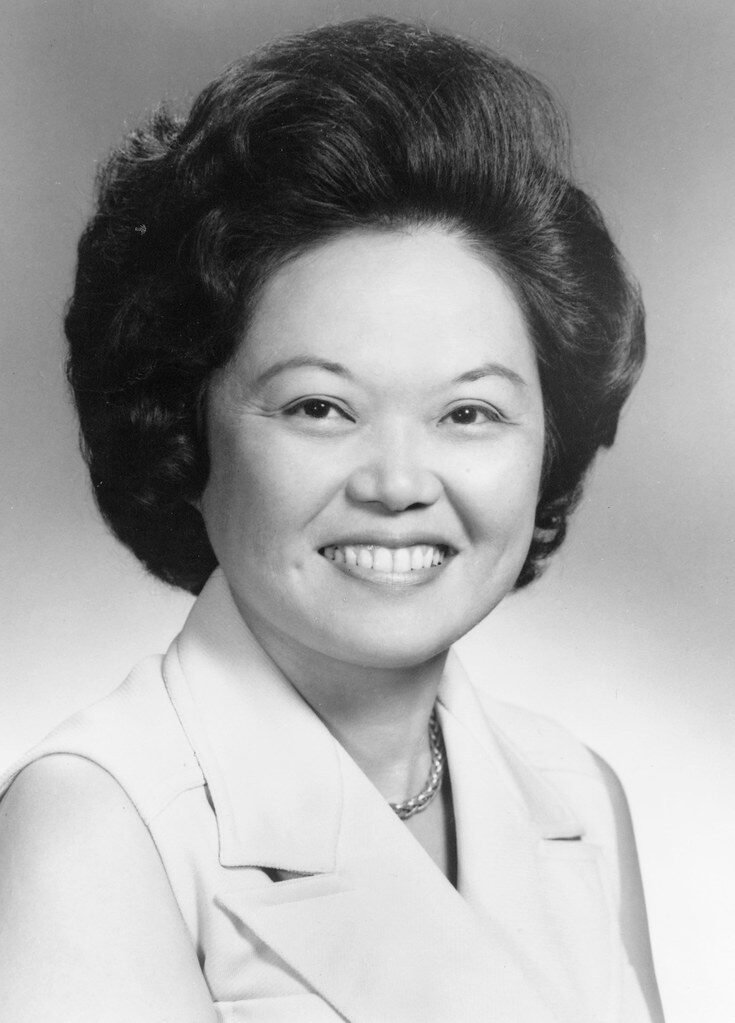
updated from April 19 2024 If you're a female athlete, you owe your opportunities and career (if you have/had one) to this woma
updated from April 19 2024
If you’re a female athlete, you owe your opportunities and career (if you have/had one) to this woman.
“What we tolerate is who we are.” Congresswoman Patsy Mink.
What we *tolerate* is who we are.
Congresswoman Patsy Mink’s unwavering advocacy has fueled the economic empowerment of countless young women, enabling them to shatter the shackles of racism-driven generational poverty.
Through her instrumental efforts, female athletes have been granted access to athletic scholarships, creating an indispensable pathway to pursue higher education and unlock their full potential.
By championing equitable opportunities, Congresswoman Mink has empowered female athletes to rise above systemic barriers and achieve academic success. Her determination has empowered a new generation of leaders and role models, inspiring young women to believe in their dreams and strive for greatness. Her legacy is a testament to the transformative power of education in overcoming adversity and paving the way for a more just and equitable society.
Without #PatsyMink, there is no….
Serena Williams
Venus Williams
Dawn Staley
Angel Reese
Megan Rapinoe
Caitlin Clark
Flo Jo
Sha’Carri Richardson
If we go back to the historical record rather than reading Title IX backward through today’s controversies, Patsy Takemoto Mink was trying to dismantle an entire system in which being “female” routinely meant fewer educational opportunities. Women and girls were not incidental beneficiaries of the project. Sex discrimination against women and girls was one of the central problems Mink and the other architects were trying to remedy.
Before Title IX, colleges could maintain different admissions standards for women, limit how many women they admitted, steer women away from particular fields, discriminate in scholarships, and restrict access to academic programs. Girls could be channeled toward traditionally female subjects (GenX and Boomers remember Home Economics in grade school. Not bad, just the funneling if you were female)…… while boys were encouraged toward science, engineering, professional careers, and athletics. The Library of Congress says the original focus of Title IX was not athletics at all. It was discrimination in admissions, access to academic subjects, scholarships, and faculty employment and promotion.
And Mink was extraordinarily explicit about what she believed was happening.
During the 1970 congressional hearings that helped lead to Title IX, she called discrimination against women in education:
“one of the most insidious forms of prejudice”
She then described colleges imposing sex-based admissions quotas under which fewer women were admitted than men and women had to demonstrate exceptional academic achievement to get through the door. Her conclusion was that the country could no longer tolerate a system that “demoralizes and demeans half of the population.”
That is powerful evidence of legislative purpose. She wasn’t speaking abstractly about some unidentified class of people. She identified women, described the discrimination they were experiencing because they were female, and argued that federal law needed to respond.
There is another piece that makes Mink especially interesting: she had lived it. Lived experience.
Mink originally wanted to become a doctor. After graduating from the University of Hawaiʻi, she applied to medical schools and was repeatedly rejected in an era when medical schools severely restricted women’s admission. She went into law instead. Even after earning her law degree, she encountered discrimination because she was a married woman and mother. The National Archives describes those experiences with sex discrimination as helping fuel her determination to secure equality for women in education.
So when Title IX says:
“No person in the United States shall, on the basis of sex…”
there is an important historical distinction worth preserving.
“No person” describes who receives the legal protection. “On the basis of sex” describes the prohibited discrimination.
The fact that Congress chose universal legal language does not erase the historical problem that produced the legislation.
This becomes even clearer when you look at Mink’s next major project, the Women’s Educational Equity Act. She pushed for federal resources to counter sex-role stereotyping, expand career counseling and educational opportunities for women, support women’s studies, and change educational materials that depicted men as doctors, engineers, and lawyers while women appeared primarily in domestic or traditionally female roles.
Mink explained the problem herself: society had perpetuated stereotyped roles for men and women that produced limitations in opportunity.
And here’s an important nuance.
Title IX was not originally a women’s-sports bill. Its transformation of girls’ and women’s athletics became one of its enormous consequences. Once attempts were made to weaken Title IX in ways affecting those opportunities, Mink helped defend the law. The House historical office records that she successfully fought efforts in Congress to roll back Title IX after complaints arose about its effect on men’s collegiate athletics.
Patsy Mink was pursuing equal opportunity in education by prohibiting sex discrimination. The legislation was written as a universal prohibition because either sex could receive its protection, but the political movement, hearings, evidence, Mink’s own testimony, and much of the discrimination Congress was confronting concerned barriers imposed upon women and girls.
It arose during a period when women were fighting to get through doors that formally and informally treated male as the educational default.
You see how hard women have to work only for people to later say that men were “generous.”
Sources: Patsy Mink, Title IX, and Educational Opportunity for Women and Girls
Library of Congress — Patsy T. Mink Papers: Title IX Overview
The Library of Congress explains that Title IX emerged from congressional investigation into sex discrimination in education, including admissions, academic subjects, scholarships, faculty hiring and promotion. It also links directly to Mink’s 1970 testimony, handwritten research notes, correspondence with Edith Green, her Women’s Educational Equity Act materials, and her later recollections of Title IX’s passage.
Library of Congress: Patsy Mink and Title IXPatsy Mink’s June 24, 1970 congressional testimony — Library of Congress collection
This is especially valuable because it gets us close to Mink’s own thinking before Title IX existed. Mink testified during Edith Green’s hearings investigating discrimination against women in education. The Library of Congress identifies these hearings as an important origin point for what became Title IX.
Mink Papers and Primary Title IX MaterialsU.S. House of Representatives — “Edition for Educators: Patsy Mink of Hawaii”
The House Historian traces Mink’s partnership with Edith Green and Senator Birch Bayh, the passage of Title IX, and Mink’s later fight to prevent Congress from weakening its application to athletics. Particularly useful is Mink’s later insistence that schools pursue “educational equity for women and girls.”
U.S. House: Patsy Mink and Title IXNational Archives — 50th Anniversary of Title IX
Excellent for establishing the relationship between Mink’s personal experience and her legislative work. The National Archives states that she was denied admission to medical school because of her sex and that the educational discrimination she experienced “fueled her desire to secure equality for women in education.”
National Archives: The 50th Anniversary of Title IXU.S. House Historian — Equality in Education and Title IX
This is useful for the broader congressional context. The House describes Mink, Edith Green, and Martha Griffiths as pursuing gender equality in education and says these women sought to level the playing field for women inside and outside the classroom.
U.S. House: Equality in Education and Title IXPatsy T. Mink Papers — Library of Congress Finding Aid
For deeper research, save this one. The collection contains legislative files documenting Mink’s work on sex discrimination, the development of Title IX, its regulations, attempts to restrict it, and Mink’s role defending it. It also points researchers toward Mink’s own later statements about writing the legislation with Edith Green.
Library of Congress: Patsy T. Mink PapersU.S. House — Women’s Educational Equity Act
The WEEA is extremely important to your argument because it helps illuminate what Mink meant by educational equality. The House records that her 1974 law addressed gender stereotypes in textbooks and supported educational programs promoting gender equity. The Library of Congress adds that it funded efforts against sex-role stereotyping, career counseling for women, women’s studies programs, and community education programs for women.
U.S. House: Women’s Legislative Interests and Educational EquityU.S. House — Mink’s Defense of Title IX in 1975
Once Title IX began expanding women’s athletic opportunities, Congress considered an amendment that would have exempted school athletics. Mink actively fought the effort. This is useful evidence that women’s athletic opportunity was not some later development to which she objected; she defended Title IX when its protection of women’s sports came under congressional attack.
U.S. House Biography of Patsy Takemoto MinkGovInfo — Senate Resolution 500, 2012
This is a later congressional source, so I would use it as corroboration rather than evidence of original legislative intent. Its full title describes Title IX, formally renamed for Mink, as legislation whose accomplishments include pursuing “equal educational opportunities for all women and girls.”
GovInfo: Senate Resolution 500 on Title IX
Women Have Heard “Of Course We Mean You Too” Before – WE Survive Abuse
Less Policing Women’s Relationships. More Recognizing the Patterns Around Us. – WE Survive Abuse