
Table of Contents
Of course they want you to forgive AND forget. Forgetting makes it easier for them to escape accountability. Remembering makes it harder for history to repeat itself.
Imagine helping overthrow a government because you believe your country deserves a better future. You march, organize, risk arrest, and stand beside people who promise that change is coming.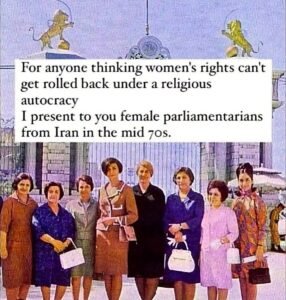
Then the revolution succeeds.
And suddenly, some of the people you marched beside begin telling you how to dress, whether you can work, and how much authority your husband should have over your life.
This is part of what happened to women during Iran’s 1979 revolution.
And it is a history worth remembering.
Some people want your forgiveness because they value reconciliation. Others want your forgetfulness because they value their reputation.
1. Why Did Iranian Women Join the Revolution?
Iran was ruled by Shah Mohammad Reza Pahlavi, whose government was criticized for political repression, corruption, inequality, and its close relationship with Western powers.
Women participated in demonstrations against his rule. They included religious women, secular women, students, professionals, working-class women, and women from different political movements.
They did not all want the same kind of government.
Some supported an Islamic republic. Others wanted democracy, economic justice, greater political freedom, or a combination of reforms.
But women helped make the revolution possible.
They marched, organized, distributed political messages, and joined the mass demonstrations that helped bring down the monarchy in February 1979.
2. What Happened After the Revolution?
Ayatollah Ruhollah Khomeini emerged as the country’s dominant political and religious leader.
Within weeks, the new authorities began reversing protections women had gained under earlier family laws.
On March 7, 1979, Khomeini called for women working in government offices to observe Islamic dress requirements.
The next day, International Women’s Day, thousands of Iranian women protested.
Some had opposed the Shah themselves. Now they were confronting restrictions imposed by the new leadership.
Women had helped overthrow one government, only to discover that their freedom was not guaranteed under the next.
3. What Rights Did Women Lose?
Your freedom does not depend on convincing the people who harmed you that you deserve it. Some people will never approve of the boundaries that prevent them from mistreating you again. And again. And again.
Changes were introduced over time, not all on the day of the revolution.
Among the restrictions were:
- Compulsory dress requirements. Authorities gradually imposed mandatory hijab, backed by penalties.
- Reduced divorce protections. Reversals of family-law reforms restored substantial advantages to husbands.
- Restrictions on women’s judicial careers. Women were removed from judicial positions.
- Reduced protections concerning child custody. Family-law changes strengthened paternal authority.
- Restrictions on employment and movement. Husbands retained or gained significant legal powers affecting wives’ choices.
- Reduced marriage-age protections. Earlier reforms that had raised the minimum marriage age for girls were reversed.
- Punishment for public resistance. Women challenging the new restrictions faced harassment, intimidation, and sometimes violence.
These changes were not simply disagreements over religious practice.
They involved the state’s authority over women’s legal rights, opportunities, and everyday decisions.
Isn’t it convenient how the people who benefited from silencing you are often the first to announce that it’s time to move on…in their preferred direction?
4. Did Women Resist?
Absolutely. And they resisted almost immediately.
Beginning March 8, 1979, thousands demonstrated against the new restrictions.
Women marched through Tehran, protested outside government buildings, and demanded that the revolution respect their freedom.
Some protesters were attacked and accused of supporting the old regime.
Women’s organizations continued challenging discriminatory policies, but increasing political repression made independent organizing more dangerous.
Their resistance is an essential part of this history.
Iranian women did not simply surrender their rights without objection.
5. Did All Iranian Women Agree?
No. Some religious women supported the revolution and its Islamic direction. Others supported the revolution but opposed restrictions on women’s independence. Some women opposed the new leadership from the beginning.
Even among women who supported an Islamic republic, views about women’s rights differed.
The Shah’s government also had a record of repression and had previously imposed compulsory unveiling under Reza Shah. Women’s clothing had been subject to state control before 1979, although the requirements changed dramatically.
The history cannot be reduced to one group of women making one decision.
What we can document is that the new government imposed restrictions that many women opposed, including women who had participated in the revolution.
The people who say we talk too much about past oppression rarely explain how forgetting it would make the people silenced, oppressed, and harmed safer
6. What Should New Feminists Understand?
We do not teach girls history so they will inherit our wounds. We teach them history so they can recognize dangers we were never warned about. I was beyond college before pieces of this truth and history began to reach me.
Participating in a movement does not guarantee that the movement will protect your freedom once it gains power.
Women can help build political organizations, sustain campaigns, and bring about enormous social changes without receiving an equal share of decision-making authority afterward.
Iranian women’s experiences also demonstrate why promises about future freedom deserve careful examination.
Who will write the laws? Who will interpret them? Can women challenge the leadership? Will their rights survive when their interests conflict with the movement’s priorities?
Those questions are not distractions from a political cause.
They are part of understanding what the cause will mean for women’s lives.
7. The Lesson We Should Carry Forward
The women who resisted Iran’s post-revolutionary restrictions deserve to be remembered alongside those who helped bring about the revolution.
Their history did not end in 1979. Later generations continued challenging compulsory dress requirements and other restrictions, including through the Woman, Life, Freedom protests that began in 2022.
Their struggle reminds us that a political victory is not necessarily a victory for every person who helped achieve it.
And remembering what happened is not playing the victim.
It is preserving the history of decisions that changed women’s lives, including the warnings women gave when their freedom was threatened.
Women should never have to help win a revolution only to begin another struggle for the right to govern their own lives.
Affirmation: I refuse to confuse peace with pretending.
Peace does not require me to deny what I experienced. I can stop fighting old battles without surrendering the wisdom they gave me. My freedom is worth protecting, even when other people would prefer that I forget why.
Historical Sources
- Encyclopaedia Iranica: Feminist Movements in the Islamic Republic — Women’s organizations, the March 1979 protests, and the reversal of legal protections.
- United States Institute of Peace: Phases of the Women’s Movement — Women’s political participation and the divisions that emerged after the revolution.
- Radio Free Europe/Radio Liberty: Iranian Women Remember the Revolution — Firsthand accounts from women who participated in the revolution.
- Carnegie Endowment: Hijab in Iran, From Religious to Political Symbol — How compulsory dress rules became part of broader restrictions on women’s autonomy.
When the World ONLY Rewards Women for Being Agreeable – WE Survive Abuse
