Table of Contents
Gordon Braxton begins Empowering Black Boys to Challenge Rape Culture with an admission that should make adults stop and think. He was already in his third year of college before anyone seriously talked with him about sexual violence, even though people he knew and loved had experienced it.
He later discovered that many boys were growing up inside the same silence. Adults warned girls. Adults talked to girls about danger. Adults taught girls how to watch drinks, watch surroundings, watch men, watch friends and get home safely. But boys were often left without equally serious conversations about consent, sexual violence, intervention, responsibility and what to do when another boy crossed a line.
Braxton’s book asks us to change that.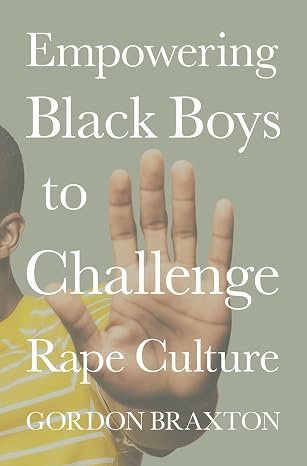
1. We cannot spend years warning girls about sexual violence while barely talking to boys about preventing it.
This may be the book’s most important reversal.
Girls often receive prevention education as potential victims. Be careful. Don’t walk alone. Watch your drink. Call when you get there.
Braxton asks why boys aren’t being brought into prevention with the same seriousness. His argument is that boys need to understand that sexual violence is not some distant social problem they are powerless to affect. They may know Survivors. Some may be Survivors themselves. They may also be standing beside boys whose attitudes and behavior are becoming dangerous.
That changes the prevention question.
Instead of asking only, “How do we keep girls safe?”
We also ask, “What are we teaching boys about keeping other people safe?”
2. Do not wait until something terrible happens to begin talking about consent.
Too many conversations with boys begin after a crisis.
Someone has been accused.
Someone has been assaulted.
A video is circulating.
A celebrity case is in the news.
A school is investigating.
Now everybody suddenly wants to discuss consent.
Braxton argues for something much more useful: sustained conversation. Boys need opportunities to talk about sexual violence, relationships, masculinity and responsibility before they are standing in the middle of an emergency.
Consent education belongs in growing up.
We shouldn’t introduce the subject only when somebody is already hurting.
3. Boys need permission to define manhood for themselves.
One of the more hopeful ideas in Braxton’s book is that challenging rape culture does not require boys to reject being male.
It can require questioning what they have been told being male means.
Braxton examines male socialization and encourages adults to help boys identify parts of traditional masculine training that can harm them and other people. He also describes freedom from restrictive male stereotypes as something boys themselves can gain from this work.
A boy doesn’t have to prove manhood through sexual conquest.
He doesn’t have to laugh at degrading jokes.
He doesn’t have to pretend pornography taught him everything he needs to know about sex.
He doesn’t have to remain silent because another boy might call him weak.
He doesn’t have to follow the crowd into cruelty.
Sometimes growing into manhood means deciding which lessons about manhood you refuse to carry forward.
4. Black boys can understand racist stereotypes about Black males without abandoning Black women and girls.
This is one of the book’s most difficult and valuable conversations.
There is a horrific American history of falsely portraying Black males as sexually dangerous, particularly in relation to white women. False accusations and racist sexual mythology have contributed to terror, imprisonment and lynching.
Braxton does not ask Black boys to forget that history.
He asks them to become capable of holding another truth beside it: sexual violence against women is real too, including violence against Black women and girls. Fighting racism and fighting sexual violence do not have to become competing loyalties.
That distinction is crucial.
Protecting Black people cannot mean automatically assuming every Black man accused is guilty.
But it cannot mean automatically assuming every woman speaking about violence is lying either.
Our children deserve enough historical knowledge and moral confidence to resist both traps.
5. Boys need to know that sexual harm is not limited to the most stereotypical image of rape.
Braxton spends considerable attention on how boys understand sexual misconduct.
That is necessary because people can carry an extremely narrow definition of sexual violence: a stranger, a weapon, physical resistance, obvious brutality.
Real situations are often more complicated.
Braxton examines misunderstandings involving consent, intoxication, withdrawal of consent and the idea that unrelated behavior somehow establishes sexual permission. He specifically challenges definitions that require physical resistance or treat consent as something that cannot later be withdrawn.
This is where prevention education becomes practical.
Dating someone is not consent.
Going home with someone is not consent to everything afterward.
Previous sexual activity is not permanent consent.
Drinking does not erase responsibility.
And when there is uncertainty, communication is available.
6. “I didn’t mean to hurt anybody” is not enough education about harm.
One of Braxton’s chapters carries a title that may make some adults uncomfortable: “Understanding Our Power to Harm.”
But there is wisdom in teaching this before harm occurs.
Young people need to understand that intentions and effects are not always identical. Someone can misunderstand a situation. Someone can pressure another person while telling himself he is merely being persistent. Someone can ignore hesitation because he wants the answer to be yes.
Braxton encourages boys to think about where seduction becomes coercion, use verbal communication and recognize that walking away is always available. He also makes a particularly useful point: boys can hold themselves to standards higher than whatever minimum a law or school policy happens to require.
That is character.
The goal should not be:
How close can I get to the line without technically violating a rule?
A better question is:
Do I know that the person with me freely wants what is happening too?
7. When a Survivor tells you what happened, you do not have to become the detective.
This is one of Braxton’s most practical insights.
Boys need to be prepared for disclosures.
A friend may someday tell them she was assaulted. A girlfriend may reveal something from her past. A sister, cousin, teammate or another boy may disclose abuse.
Braxton has explained that boys can instinctively begin trying to adjudicate what happened. His advice is beautifully simple: if someone approaches you as a friend, respond as a friend. Listen and support rather than immediately assuming the role of investigator, judge or avenger.
You don’t need to conduct an interrogation.
You don’t need to demand every detail.
You don’t need to decide the entire case before offering human concern.
Sometimes the first responsibility is simply knowing how to hear another person’s pain without making the moment about yourself.
8. A boy who challenges another boy can interrupt something adults never see.
This is where bystander education becomes powerful.
Adults are not present for every conversation.
We don’t hear every joke in the locker room.
We don’t see every group chat.
We aren’t at every party.
We don’t hear one boy bragging to another about what he intends to do.
Other boys sometimes do.
Braxton therefore places boys inside prevention rather than leaving them on its sidelines. His book includes becoming an active bystander as an entire stage of the work.
Intervention doesn’t always mean physically confronting somebody.
Sometimes it is refusing to laugh.
Sometimes it is checking on someone.
Sometimes it is interrupting a situation.
Sometimes it is telling a friend, “Leave her alone.”
Sometimes it is getting help.
Sometimes it is refusing to help another person humiliate somebody.
A culture is partly built from what a group rewards, laughs at, excuses and refuses to challenge.
Peers can change those signals.
9. Black boys do not have to inherit every defense Black adults developed under racism.
History gives us survival strategies.
But survival strategies also need examination.
Braxton takes seriously the pressure some Black people feel to defend Black men against accusations because accusations of sexual violence have historically been weaponized against Black males. Yet he also challenges the idea that automatic defense should become the default response.
We can teach Black boys the history.
Teach them about racist stereotypes.
Teach them about false accusations.
Teach them about unequal policing.
Teach them about due process.
And teach them about Black female Survivors.
Teach them that Black women and girls deserve protection from violence too.
Teach them that concern for an accused person’s rights does not require contempt for the person reporting harm.
Our children are capable of learning more than one truth at a time.
10. Black boys should grow up knowing that preventing violence is part of their inheritance too.
Braxton ends by placing boys inside something larger than an individual conversation.
There is a worldwide movement against sexual violence, and boys have a place in it. He also points toward a history of Black men participating in struggles against violence rather than presenting anti-violence work as something foreign to Black communities.
That may be one of the book’s most hopeful ideas.
Imagine what changes when a boy grows up hearing:
You have power here.
Not merely the power to avoid becoming a perpetrator.
The power to listen.
The power to notice.
The power to question what his friends normalize.
The power to walk away.
The power to intervene safely.
The power to believe that another person’s boundaries are worthy of respect.
The power to become the friend a Survivor can safely approach.
The power to teach younger boys something better.
We have spent generations giving girls instructions for surviving male violence.
There will always be a place for teaching girls safety, boundaries, instincts and self-protection. Those tools should never be taken from them.
But those cannot be the whole prevention strategy.
Girls cannot be the group society continually goes to and asks to make one more adjustment.
Walk differently.
Dress differently.
Drink differently.
Date differently.
Travel differently.
Watch your surroundings differently.
Hold your keys differently.
Something is missing when prevention education concentrates primarily on the people we hope will escape the harm.
Gordon Braxton asks us to bring boys into the conversation much earlier.
Not because Black boys should grow up carrying collective suspicion for what violent men have done.
Because they deserve something far better than suspicion.
They deserve preparation.
They deserve adults willing to teach them what consent looks like, how coercion develops, how to respond to disclosures, how to recognize harmful peer behavior, how to intervene, how racism complicates these conversations and how to build their own standards of manhood.
A boy should not have to reach his third year of college before somebody finally tells him that he has a role in preventing sexual violence.
We can start much sooner.
And perhaps one of the greatest gifts we can give Black boys is letting them know that protecting human dignity is not something standing outside Black manhood.
It can be part of the man he decides to become.