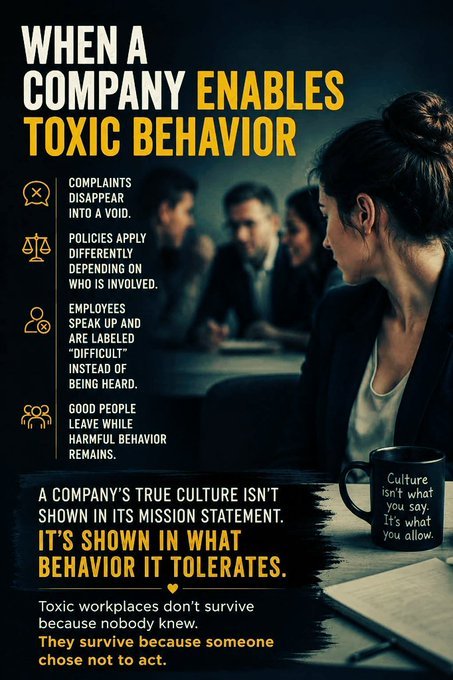
The warning signs are not always obvious.No one usually announces, “Women no longer deserve equal treatment.”History shows that rights are oft
The warning signs are not always obvious.
No one usually announces, “Women no longer deserve equal treatment.”
History shows that rights are often weakened more quietly—through changes in laws, enforcement, workplace policies, funding, and cultural messages about whose voices are believed and whose experiences are dismissed.
And this is why women must pay attention:
A right written on paper only matters when it is protected in practice.
A workplace can claim to value equality, but the real question is:
Who has the power to decide whether a woman’s dignity is protected when she speaks up?
1. When protections become harder to enforce, women carry the risk
Workplace rights exist because generations of women fought against discrimination, harassment, unequal pay, and unsafe conditions.
But protections are only meaningful when women can access them.
If reporting systems are weakened, investigations become harder to pursue, or workplace concerns are dismissed, women may begin receiving a dangerous message:
“Your discomfort is not important enough to address.”
A right that cannot be enforced can become a promise without protection.
2. Women’s ability to control their lives affects their ability to thrive at work
Women’s workplace equality has always been connected to whether women have control over their own bodies, health, and futures.
When access to reproductive healthcare changes, women may face additional barriers:
- time away from work without adequate support,
- delayed education or career opportunities,
- increased caregiving responsibilities,
- employers who view women’s lives as inconveniences instead of realities.
The question we must ask is:
Are workplaces designed to support women as full human beings—or only women who never need care, flexibility, or understanding?
3. When conversations about inequality disappear, inequality does not disappear
Some workplaces have reduced diversity and inclusion efforts because of political and legal debates.
The conversation is often framed as:
“Should we talk about differences, or should we only talk about individual achievement?”
But history reminds us:
Individual success does not erase systems that created unequal starting points.
Black women, Indigenous women, immigrant women, disabled women, and poor women have often faced barriers that were overlooked when the “average woman’s” experience was defined too narrowly.
If we stop examining inequality, we do not automatically create fairness.
Sometimes we simply make inequality harder to see.
4. The most dangerous message is the one women are taught to accept
One of the oldest ways inequality survives is by convincing women that unfair treatment is normal.
Women are told:
“That is just how workplaces are.”
“Don’t be difficult.”
“Don’t make a problem out of it.”
“Be grateful you have a job.”
“You are too emotional.”
“You are too aggressive.”
The message changes, but the pattern remains:
Accept less. Speak less. Need less.
When women’s rights are minimized, traditional gender expectations can return stronger:
- women should tolerate disrespect to keep peace,
- women should carry more caregiving responsibilities without support,
- women should stay quiet to avoid being labeled difficult,
- women should prove their worth while others are assumed to belong.
But here is the truth:
A woman asking for fairness is not asking for special treatment. She is asking for equal humanity.
Black women especially know this history. They have often been expected to endure more, protect more, and survive more—while receiving less protection and less understanding.
The “strong Black woman” stereotype has too often been used as an excuse to deny Black women care.
Strength should never become society’s reason for withholding support.
The question we must ask:
Not only:
“Do women have rights?”
But:
“Are women’s rights being respected when it becomes inconvenient for others?”
Because equality is not measured by what people say when everything is comfortable.
Equality is measured by what happens when women speak, set boundaries, report harm, ask for fairness, and refuse to accept less.
Affirmation
I do not have to accept disrespect to prove I am cooperative.
I do not have to shrink my voice to make others comfortable.
My boundaries are not rebellion. My dignity is not negotiable.
I deserve workplaces where I am respected, protected, and valued—not merely tolerated.
Journal Reflections
- Where have I been taught to accept unfair treatment as “just the way things are”?
- What workplace behavior would I recognize as harmful if it happened to someone I love?
- When did I first learn that speaking up might make me “difficult”?
- What would change if women no longer apologized for asking to be treated with dignity?
It is important that working women keep an eye on EEOC guidelines
Going forward, it is important to ensure that the focus remains on sex-based protections. The U.S. Equal Employment Opportunity Commission (EEOC) has changed its workplace guidance and enforcement priorities in recent years, including rescinding certain harassment guidance issued under the previous administration. Supporters argue these changes clarify and strengthen protections based on sex. As workplace policies continue to evolve, the priority should remain ensuring that women are protected from discrimination, harassment, and unequal treatment because of their sex.
While there are ongoing debates about changes to workplace guidance and enforcement priorities, the central concern must not be lost—women must have the ability to work, lead, speak, and succeed without facing discrimination because they are women.
As workplace policies continue to evolve, one principle must remain clear: protections against sex-based discrimination must remain strong, accessible, and enforceable. Whatever debates arise around enforcement priorities, women’s right to a workplace free from discrimination because of sex must remain at the center.