
Table of Contents
I can care deeply about how you feel without letting your feelings dictate how I live.
Kindness is something you offer. Obedience is something you give in response to authority, fear or intimidation. And the difference between them is especially important when someone attempts to turn your compassion into an obligation.
Kindness allows you to remain a thinking, reasoning, independent human being. You can consider another person’s feelings, recognize their humanity, and offer generosity without surrendering your judgment.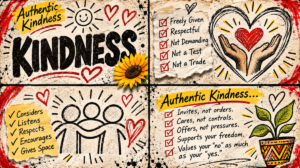
Obedience is different. Obedience concerns compliance with a direction, rule, or command. Sometimes obedience is appropriate, particularly where authority is legitimate and accountable. But obedience is not automatically virtuous simply because someone has attached a moral argument to the demand.
The difference becomes clear when you say no.
A person seeking kindness can make a request and respect your freedom to decline.
A person demanding obedience may treat your refusal as defiance, selfishness, disrespect, or proof that something is wrong with your character.
That distinction tells us a great deal.
Consider the difference:
-
Kindness says: “This is important to me. Would you consider it?”
-
Obedience says: “This is important to me. Therefore, you must.”
-
Kindness says: “I appreciate your willingness.”
-
Obedience says: “Your willingness is irrelevant. Compliance is expected.”
-
Kindness respects: Your conscience, circumstances, and boundaries.
-
Obedience demands: That you follow the instruction, whether you agree or not.
And here is something I wish more women and girls were taught early in life.
A person can behave kindly while refusing a request. And a person can obey a request while feeling frightened, resentful, manipulated, or coerced.
Compliance is not evidence of kindness. Sometimes it is evidence that someone does not feel free to refuse.
Why this distinction matters for women and Survivors
For generations, women and girls have been taught to demonstrate goodness through accommodation. Be agreeable. Don’t embarrass anybody. Don’t make a scene. Consider how the other person feels.
Sometimes those lessons encouraged genuine consideration. Other times, they trained women to distrust their own discomfort.
And when a woman finally says, “I understand what you want, but I am not willing,” people may suddenly stop describing her as kind.
Notice what changed.
She did not necessarily become cruel. She became unwilling to comply.
If someone’s assessment of your kindness changes the moment you exercise independent judgment, you have reason to question whether kindness was ever what they wanted from you.
That does not prove malicious intent. But it reveals something important about the expectations operating in that relationship.
The question I would teach every girl to ask
“Am I being invited to show kindness, or am I being required to demonstrate obedience?”
And then a second question:
“What happens if I say no?”
That second question is often where the truth begins to emerge.
Because genuine kindness does not need to destroy your freedom to exist.
You do not have to become less compassionate to become less obedient. You can have a generous heart, a thoughtful mind, a clear conscience, and a firm boundary.
There is no contradiction in that.
That is not cruelty. That is moral agency.
In fact, some of the greatest acts of kindness in human history came from women who refused to obey.
If your definition of kindness requires me to surrender my right to say no, you are no longer asking for kindness. You are asking for control.
In advocacy work, we learn to recognize how compliance can be cultivated. It does not always begin with threats. Sometimes it begins with appeals to compassion, guilt, loyalty, or the suggestion that a good person would never hesitate.
If you cared, you would.
It’s such a small thing.
Why are you making this difficult?
It means so much more to them.
Those statements are not necessarily abusive. People make emotional appeals in perfectly ordinary, healthy relationships. But they can also become tools of coercion when questioning is discouraged, refusal is punished, or someone’s goodness is made conditional upon compliance.
What concerns me most is the attempt to make another person’s emotional investment the final authority over my decision.
Because where does that principle end?
If somebody wants access to my home more than I want to deny it, must I open my door?
If somebody wants my forgiveness more than I want to offer it, must I forgive?
If somebody wants my silence more than I want to speak, must I be quiet?
Of course not.
The strength of somebody else’s desire does not settle the question of what I owe them.
We must be careful about moral arguments that always seem to end with the same people being told to yield.

Photo by Derick McKinney
Women have spent generations being instructed to protect everybody else’s comfort, reputation, pride, and emotional well-being. We were told that our goodness could be measured by how much we could tolerate without complaint.
I have no intention of dressing that old expectation in new language and calling it liberation.
Now, I also believe in ordinary generosity. I LOVE giving from the heart.
There are times when I will gladly use a name, title, or form of address because it makes somebody feel welcome. Relationships require some give and take.
But a freely offered courtesy and a compulsory declaration are two different things.
And the difference is not whether the request seems small to the person making it. The difference is whether the person receiving it remains free to think, question, disagree, and decline without being subjected to intimidation or humiliation.
If your appeal to kindness cannot survive another person’s freedom to say “no”—like a toddler—then we need to examine what you are calling “kindness.”
Love, authentic love, does not require that arrangement.
Respect, authentic respect, does not require that arrangement.
And neither does human dignity.
I am willing to be kind. I am not willing to be trained out of my own judgment.
