There is wisdom in women noticing when something is changing before everyone else is willing to name it. There is something deeply wrong when women
There is wisdom in women noticing when something is changing before everyone else is willing to name it.
There is something deeply wrong when women are expected to adjust themselves to dangers the world has decided not to fix.
Words like “deterioration,” “reversal,” “rising exposure,” or “collapsing support” are appropriate. Around the treatment of women. The numbers below show movement in the wrong direction. Women did not come this far to become quiet witnesses to our own reversal.
The UN itself is using language such as “backlash,” “retreat from equality,” “war reversing gains,” and “progress has stalled or even reversed.”
Here are some of the most alarming indicators.
Nearly 1 in 4 countries is experiencing a backlash against women’s rights.
In reports submitted by more than 150 governments, nearly one-quarter acknowledged backlash against women’s rights. UN Women describes the pattern as involving greater discrimination, weaker legal protections, and declining support for institutions serving women and girls.
That is important because this is not simply “we haven’t reached equality yet.” Governments are reporting movement backwards.
The number of women and girls living near armed conflict has reached the highest level recorded since the 1990s.
About 676 million women and girls lived within 50 kilometers of armed conflict in 2024. That represents roughly 17% of the world’s women and girls and is the highest number and share recorded since the 1990s.
UN Women also reports that the number of women and girls living in conflict settings increased by about 50% over the preceding decade.
Women and girls are being killed in war at sharply increasing levels.
The proportion of women among people killed in armed conflict doubled from 2022 to 2023. In 2023, women accounted for four out of every ten people killed as a result of conflict.
The longer-term comparison is even more disturbing: UN Women reports roughly four times as many women and girls were killed in conflict during 2023–2024 compared with 2021–2022.
That is a genuine worsening indicator.
Verified conflict-related sexual violence rose 87% in just two years.
The United Nations verified more than 4,600 cases of conflict-related sexual violence in 2024.
That was an 87% increase from 2022.
And women and girls represented 92% of the verified victims in 2024.
The year-to-year trajectory is grim: verified cases rose roughly 50% in 2023, followed by another 25% increase in 2024.
Those are verified cases, not estimated total incidence, so they should not be interpreted as capturing every assault.
More than 60 million displaced and stateless women and girls are living with elevated violence risks.
By the end of 2024, approximately 123.2 million people worldwide had been forcibly displaced, continuing a decade of year-on-year increases.
More than 60 million forcibly displaced and stateless women and girls face heightened risks of gender-based violence.
So conflict is not only killing more women. It is placing enormous numbers of women into environments where sexual violence, exploitation, trafficking, poverty and loss of healthcare become more likely.
Maternal-health progress has stalled across much of the world.
Maternal mortality fell substantially between 2000 and 2023, so it would be inaccurate to claim that maternal deaths globally have simply been climbing for decades.
But the recent picture has deteriorated.
WHO reports that maternal-mortality progress has stagnated since 2015 across five major world regions, including Europe and North America, Latin America and the Caribbean, Northern Africa and Western Asia, Eastern and South-Eastern Asia, and Oceania outside Australia and New Zealand.
Approximately 260,000 women still died from pregnancy- and childbirth-related causes in 2023, more than 700 every day.
Conflict is making pregnancy extraordinarily dangerous for women.
This one stopped me.
Around 160,000 women died from preventable maternal causes in fragile or conflict-affected settings in 2023.
That is about 6 in every 10 maternal deaths worldwide, despite these countries accounting for only about one-tenth of global live births under WHO’s 2026 conflict/fragility classification analysis.
A woman’s maternal mortality risk per pregnancy in a conflict-affected country is approximately five times that of a woman in a stable country.
This is one place where war, sex and basic female biology collide in a way broad “civilian impact” statistics can hide.
Women’s frontline organizations are being financially dismantled while need is rising.
UN Women surveyed 411 women-led and women’s-rights organizations across 44 humanitarian crisis settings in 2025.
Ninety percent had already been affected by funding cuts.
Seventy-two percent had laid off staff.
Fifty-one percent had suspended programs.
And 47% said they expected to shut down within six months if funding conditions continued.
These include organizations providing shelters, healthcare, protection and services to Survivors of gender-based violence.
So the alarming story is not simply “violence is rising.”
The infrastructure women rely upon when violence happens is simultaneously being weakened.
Organizations fighting violence against women report severe service losses.
A later UN Women survey of 428 organizations found nearly 90% reporting severe reductions in women’s and girls’ access to essential services because of funding cuts.
Almost one-quarter had stopped prevention programs entirely.
Only 5% believed they could maintain their current operations for another two years or more.
That creates a dangerous feedback loop: more instability and violence, fewer prevention programs, fewer shelters and services, and less capacity to document what is happening.
Femicide remains extraordinarily high, with no evidence of meaningful global improvement.
About 50,000 women and girls were killed by intimate partners or family members in 2024.
That is approximately 137 every day, or one roughly every ten minutes.
About 60% of all women and girls intentionally killed were killed by intimate partners or family members. For male homicide victims, only around 11% were killed by intimate partners or family members.
One caution is important here. The 2024 estimate is slightly below the 2023 estimate of 51,100, but UN Women specifically warns that the difference should not be interpreted as a real decline because country-level data availability changed.
So femicide is more accurately described as showing no meaningful progress than as demonstrably increasing worldwide.
Women’s poverty has essentially stopped improving since 2020.
Approximately 376 million women and girls were living in extreme poverty in 2025, about 9.2% of the female population, compared with 8.6% of men and boys.
UN Women says the female extreme-poverty rate has hovered near 10% since 2020. At the current trajectory, around 351 million women and girls will still be living in extreme poverty in 2030.
That is another form of regression worth understanding: sometimes going backwards means losing previously expected progress rather than the raw number increasing every single year.
Employment equality is moving at an almost absurdly slow pace.
In 2024, around 46.4% of working-age women were employed compared with 69.5% of men.
Over thirty years, that employment gap narrowed by only four percentage points.
At the present rate, UN Women estimates global employment parity could take nearly two centuries.
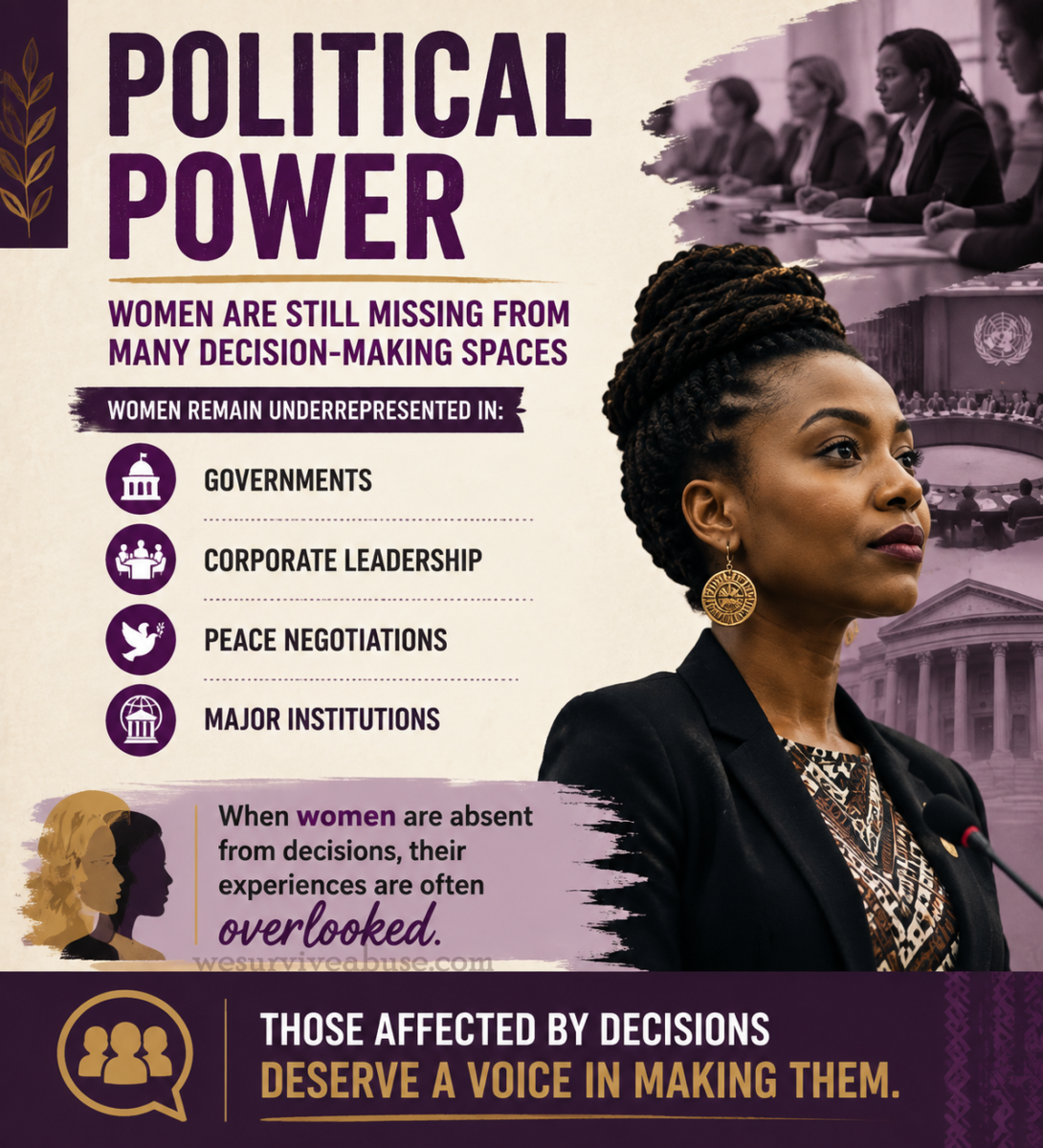
Women remain largely excluded from the tables deciding wars and peace.
Only about 1 in 10 peace negotiations in 2024 included women negotiators.
Think about that alongside the other statistics: more women living near war, enormous increases in conflict-related sexual violence, more female conflict deaths, massive displacement, and yet women remain overwhelmingly absent from negotiations determining what happens next.
That is not a small democratic deficit. It is a structural one.
And there is one larger statistic that brings the whole picture together:
UN Women and UN DESA’s 2025 Gender Snapshot concluded that none of the gender-equality targets it assessed was on track for 2030.
The world has not simply “failed to finish” the work of women’s equality. In several measurable areas, women are now facing expanding war exposure, rapidly rising conflict-related sexual violence, backlash against established rights, stalled poverty and maternal-health progress, and the erosion of the very organizations built to protect them.
The good news is girls’ schooling has improved enormously, maternal mortality is far lower than it was in 2000, child marriage has declined globally, and women’s parliamentary representation has risen.
But those achievements actually make the current warning more significant. The UN is not saying women never made progress. It is saying some of that progress is now fragile, stalled, or being reversed.
Progress for women is not a door humanity walks through once. Every generation must refuse to let that door be pushed closed. Pay attention when women begin losing choices their mothers fought to gain.
When the world becomes more dangerous for women, telling women to be less afraid is not enough. Make the world safer.
@_fall3n4ngel (video not directed to her but to ppl that think like her) hope this clears thinsg up🥀 #radfem #terf #genderabolitionist #gendercritical #transwoman
I will learn the history women fought to give me.
Knowing what came before helps me recognize what must not be lost.