When violence against women becomes visible as a pattern, men who possess some socially valued characteristic have repeatedly had an avenue for saying
When violence against women becomes visible as a pattern, men who possess some socially valued characteristic have repeatedly had an avenue for saying, in effect, “You cannot mean men like me.” The separating characteristic changes depending on the society: class, education, profession, wealth, race, religion, refinement, political standing, even supposed moral character.

No woman is exempt from being a target, but every male wants to be excluded from the category of “male violence against women.”
Society could condemn that kind of man WITHOUT confronting male authority and violence more broadly. This approach was ineffective at building safety for women.
And women noticed….of course.
For a very long time, people have tried to make violence against women belong to a certain “kind” of man.
Sometimes people said violent husbands were poor men. Sometimes they blamed men from certain races, cultures, neighborhoods, or social classes. Meanwhile, men who were educated, wealthy, respected, well dressed, religious, or professionally successful could be treated as though those things made them safer.
Women have been challenging that idea for generations.
Historical research from Australia shows women writers pushing back against the belief that domestic violence happened mainly in poor homes. They wrote about women being harmed by politicians and supposedly respectable gentlemen. Their stories made a simple point that still needs saying today: a beautiful house does not tell us what happens behind its doors.
Women in Britain were still fighting the same idea during the battered-women’s movement of the 1970s. Advocates reminded the public that women were being abused by men from many walks of life. Some husbands were laborers. Others were journalists, lawyers, professionals, and prominent members of their communities.
Even judges could have trouble believing that a respectable man could behave violently. The men who shared their education level and could afford their lifestyles would never.
That tells us something important about stereotypes.
When society decides that a dangerous man is supposed to look a certain way, the stereotype can actually make some dangerous men harder to recognize.
Race makes this history even more complicated.
In the United States, Black men were often portrayed as especially dangerous or violent. That racist stereotype had terrible consequences. Even campaigns against wife beating could become racialized, with Black men receiving punishments that were not applied equally to white men.
Black people had every reason to challenge that injustice. But there is another truth that must be allowed to stand beside it. Women can experience violence from men of every racial group.
We do not have to choose between these truths.
We can say that Black men should never be treated as naturally violent because they are Black. AND. We can also say that being Black does not automatically make an individual man safe to be around.
The same principle applies elsewhere.
Being poor does not make a man dangerous. AND. Being wealthy does not make him safe.
Being Muslim, Christian, gay, straight, trans-identified male, immigrant, Indigenous, educated, disabled, politically progressive, conservative, marginalized, powerful, or respected does not give us enough information to know how an individual man will treat women.
Human beings are so much more complicated than categories.
The trouble begins when a discussion about violence against women is heard as a personal accusation against every man.
When women say, “Male violence is a safety issue we have to take seriously,” an individual man may hear, “You are saying that I am violent.”
But those are two different statements.
A woman can take precautions around men without believing that every man will hurt her. We understand this principle in ordinary life.
When you lock your front door, you are not accusing everyone walking down the street of planning to rob you. When people who work with children undergo background checks, we are not declaring every teacher, coach, volunteer, or childcare worker dangerous.
We use precautions because we cannot always know ahead of time who will cause harm. Mostly we don’t know. People are free to choose their actions and behavior in every given moment.
Women deserve that same freedom to think about safety. No woman should ever have to prove that a particular man is dangerous before she is allowed to establish a boundary designed to keep herself safe.
And no man should need to be declared dangerous before a woman is allowed to say no.
This becomes especially important when someone says, in one form or another:
But men like me aren’t the problem.
History gives us good reason to be careful with that argument.
For generations, societies have created an image of the man who supposedly hurts women. Once that image becomes powerful enough, everyone outside the picture receives a little protection from suspicion.
People begin thinking:
He couldn’t have done that. He is educated.
He couldn’t have done that. He has an important career.
He couldn’t have done that. He fights for justice.
He couldn’t have done that. Everybody respects him.
He couldn’t have done that. He is marginalized too.
He couldn’t have done that. He doesn’t look like the kind of man who would hurt a woman.
And suddenly we have created another problem.
Instead of asking what a man did, we start asking what kind of man he is. This is why I DESPISE when a crime against someone happens and people rush to say, “See? It wasn’t this person. See it wasn’t that person. That’s reputation management and not for victims and Survivors. Do you even care about the health, well-being, and safety of victims and Survivors of whatever the crime is?
Women have paid dearly for society’s quick, fast defense of males.
A respectable reputation cannot tell us what happens inside someone’s home. Education cannot tell us how someone behaves when a woman tells him no. Political beliefs cannot tell us how someone responds when a woman leaves him. Money cannot tell us whether someone respects boundaries. Marginalization cannot tell us whether someone is incapable of abusing power. Claimed identities do not tell us anything about choices a person will make in a dispute or disagreement.
Behavior tells us much more.
This is why women do not need to sort the world into “good groups of men” and “bad groups of men” before protecting themselves. Our safety can’t afford it.
We can reject racism without abandoning women’s safety.
We can reject class prejudice without pretending wealthy men cannot be violent.
We can stand beside marginalized communities without requiring women to surrender their boundaries as proof of solidarity.
We can refuse to stereotype men while still taking patterns of male violence seriously.
These ideas can live together.
Perhaps one of the most important lessons history gives women is this:
You do not have to decide that someone is a bad person before deciding that a boundary is good for you. I lock all my doors without a thought. I lock and secure all the things that I care about keeping. Others may think it is “doing too much,” but then again, my health, well-being, and safety are not theirs, are they?
You are allowed to notice behavior.
You are allowed to notice patterns.
You are allowed to take precautions BEFORE something terrible happens. (Please do; too often no one does anything to help after harm either.)
You are allowed to say no without presenting a courtroom case explaining why.
You are allowed to protect yourself even when someone believes he deserves an exemption or a pass.
And when society tells you, “But surely not men like him,” you are allowed to remember what women before us learned the hard way:
Safety has never belonged only to women who correctly guessed which man would become dangerous.
Affirmations
I do not need certainty about someone’s intentions before I honor my boundaries.
I can reject prejudice without surrendering reasonable precautions.
Someone else’s identity does not require me to ignore my own judgment.
A person’s reputation does not outrank my experience of their behavior.
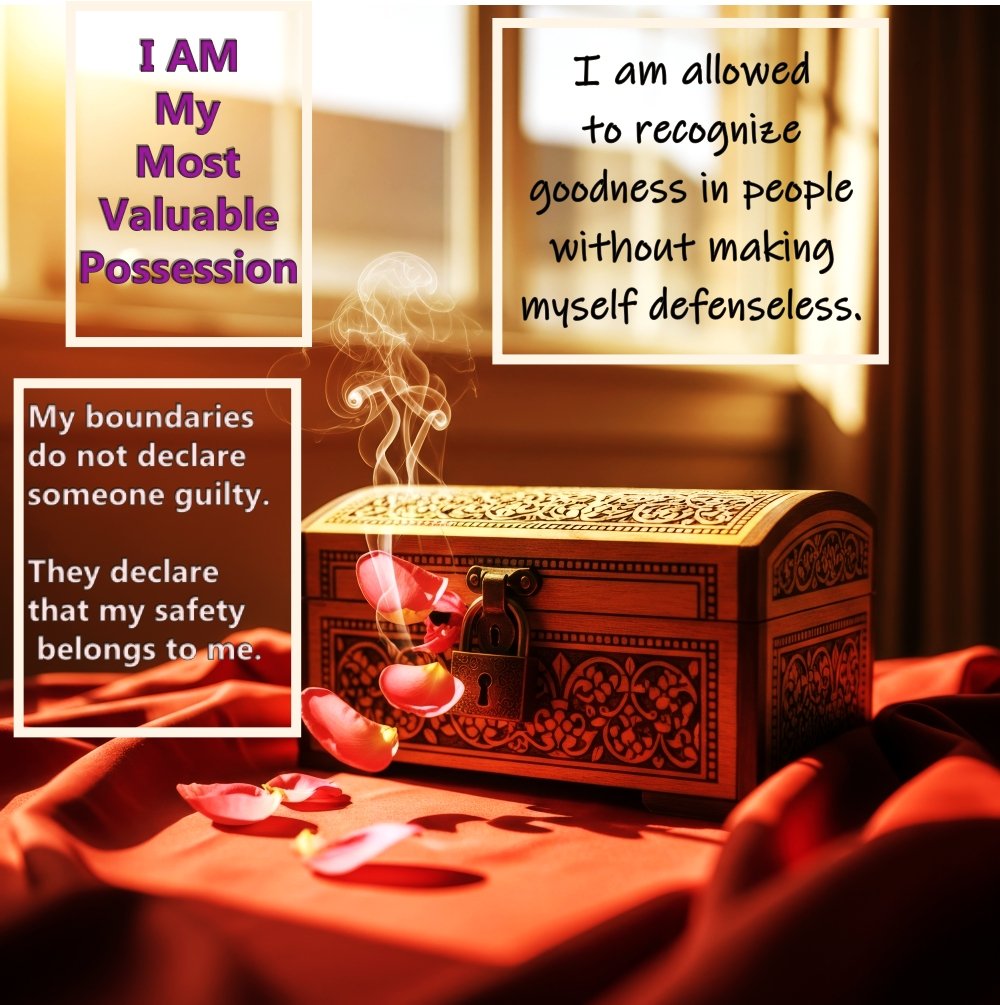
I am allowed to recognize goodness in people without making myself defenseless.
My boundaries do not declare someone guilty. They declare that my safety belongs to me.
I will pay attention to behavior rather than allowing status, education, money, politics, charm, or reputation to do my thinking for me.
Women before me questioned the stories society told them about who could and could not be dangerous. I can question those stories too.