
Table of Contents
Are any of the people demanding Black women’s labor reciprocally laboring on our behalf?
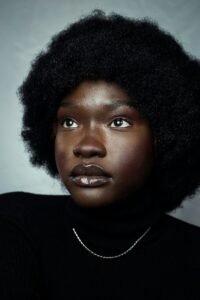
Photo by Christian Agbede
As scholar Heather Bergeson notes, storytelling is an act of “claiming the power to name and state and face the events” . Slave narratives, civil rights writings, and contemporary digital storytelling all serve to counter dominant narratives and center Black perspectives . This power lies in the ability to reshape how communities see themselves and how society perceives them.
What the data shows
- On‑screen presence: The Representation Project notes that Black women characters in popular films nearly doubled in the last decade, reaching 16.7% in 2023 . Worldmetrics reports that 49% of series regular roles on broadcast networks were held by underrepresented racial/ethnic groups in 2023, up from 40% in 2020 .
- Leading roles: Geena Davis Institute’s 2009–2019 study found Black women made up only 3.7% of leads/co‑leads in top‑grossing films and 6.1% of characters in family films . While some recent data shows modest gains in TV lead roles, these figures remain far below their share of the U.S. population .
- Perception: In 2023, 68% of Black Americans said media underrepresents their community, compared with 32% of white Americans . Nielsen Attitudes on Representation (2023) found 60% of Black women feel misrepresented in media .
Another obstacle in the debate: Some critics argue that mandated diversity efforts produced box-office misfires or felt forced to audiences. Organizations like America First Legal celebrated the rollbacks as an end to treating people differently based on race and sex. Supporters answer that UCLA’s box-office data contradicts the claim that audiences reject diverse casts. eurweb
In short, many in the industry understand the demand. In the current climate, avoiding political and legal risk is outweighing it. If it would help, I can look into which areas are still growing, such as independent film, international content, or particular genres.
Quality and type of representation
Recent qualitative research from In Our Own Voice found that Black women are not just rejecting harmful portrayals but are demanding authentic, multi‑dimensional, and positive stories — ones rooted in care, dignity, joy, and everyday life beyond struggle . This points to a gap between dominant narratives and what audiences want.
Stereotypes and negative portrayals
- Black women remain overrepresented in negative tropes: 29.3% of Black women characters in films are depicted as violent, compared to 24.6% of white women .
- Geena Davis Institute data shows Black women are more likely to be sexualized, objectified, or cast in stereotypical roles like “The Subservient Wife” .
- Media still perpetuates harmful tropes such as the “Angry Black Woman” and hyper‑sexualization .
Leadership and behind‑the‑scenes roles
Representation gains are limited in creative control: only 6% of U.S. film directors in 2023 were Black, up from 3% in 2019 . Women of color held just 9% of series regular roles in 2023, compared to 5% in 2015 .
What the data shows: For more than a decade, UCLA’s Hollywood Diversity Report has found that audiences want to see diverse content, and that as shows become more diverse, they make more money, get higher TV ratings, and earn more at the box office. Diverse audiences dominated the box office in 2023. thewrapthepostathens
What happened next: The trend reversed anyway. Representation for women and minorities in movies dropped sharply in 2025, according to UCLA’s latest report. The streaming edition, released in June, found that people of color lost ground in every major employment category examined: leads, total cast, directors and writers. For women specifically, one count found women hold just 7% of cinematographer roles in Hollywood’s top films. Print Print Close Close +2
The main reasons people point to for the holdup:
- Political and legal pressure. The reversals came after a January executive order directing the U.S. attorney general to pursue private-sector DEI programs. Amazon Studios walked back its inclusion program after the FCC chairman began probing DEI practices at Comcast and NBCUniversal. Paramount Global dropped its diversity staffing goals altogether. SAG-AFTRA reaffirms ‘unwavering commitment’ to DEI as Hollywood studios scale back +2
- Risk aversion. Studios are owned by large corporations with mergers, licenses, and regulators to manage. Avoiding government scrutiny can outweigh audience demand, at least in the short term. Critics say studios scaled back to mollify the administration and its supporters, at the possible cost of alienating a large and growing audience. thewrap
- Financial strain. Financial pressures are guiding these decisions. When budgets tighten, studios tend to fall back on familiar franchises and established names, and the people who hold those slots are mostly the same people as before. ground
- A long cycle of promises and retreats. The industry made modest gains after #OscarsSoWhite in 2015 and again after 2020, but it never fully followed through on its promises. Some advocates say the retreat is no surprise, since the original commitments were already weak. thewrapthewrap
- Gatekeeping. Diverse stories need diverse decision-makers: executives who greenlight projects and the writers, directors, and crew behind the camera. That is where progress has been slowest, and it is the first thing lost when pipeline programs are cut.
Money does speak.
It just isn’t the only money in the room, and the audience’s money is often the quietest. Here are some reasons the signal gets drowned out.
Regulators can cost more than audiences. Hollywood studios are now small parts of huge conglomerates that need government approval for mergers, broadcast licenses, and acquisitions. Losing some ticket buyers is a slow loss spread over years. A blocked merger or a federal investigation costs billions right away. Executives tend to protect against the bigger, faster threat.
Lost audiences are hard to see. When people stop showing up, they rarely announce why. They drift to YouTube, international content like K-dramas and anime, independent creators, or nothing at all. Studios see falling numbers but can blame streaming fatigue, ticket prices, or competition. An audience that leaves quietly is easy to misread.
Failure is punished unevenly. If a conventional franchise film flops, executives call it bad luck. If a film with a diverse cast or a woman director flops, it often gets treated as proof the whole approach doesn’t work. So a cautious executive sees the “safe” choice as safer for their career, even when it isn’t safer for the company.
Short-term thinking. Quarterly earnings and stock prices reward cutting costs and avoiding controversy now. Building loyalty with underserved audiences pays off over years, often after the executive has moved on.
Decision-makers greenlight what they know. The people approving projects are still mostly the same demographic they were decades ago. Stories outside their experience can look riskier to them simply because they’re unfamiliar.
Global markets. Studios weigh some international markets heavily, and certain content can create problems with censors or distributors abroad.
So yes, they are likely losing audiences, and many inside the industry know it. Whether money eventually “wins” may depend on whether the people taking their money elsewhere become visible enough to force the issue.
Where the old patterns carry over into independent media
- Pay gaps. An Adobe study found women creators earn 20% less per hour and BIPOC creators 21% less than their counterparts. One industry group reports male influencers earn about 40% more than women, even though women make up 70% of the creator market.
- Brand deals. A study by the PR firm MSL found Black influencers earn 35% less than white influencers, even with comparable follower counts and engagement.
- Algorithms. Research in New Media & Society found Black creators, especially Black women and darker-skinned creators, often get less discoverability and less consistent promotion than peers making similar content. In effect, algorithms can become a new kind of gatekeeper.
- Culture flows up, money doesn’t. Black creators shape internet language, music, and trends at an outsized level but are rarely paid in proportion to that influence.
- Indie film isn’t automatically equal. Earlier data found men still outnumbered women 2 to 1 behind the camera on festival films. The Directors Guild has also called the idea that indie film is much fairer a misconception.
So independent media widens the door: more voices get in, and audiences decide who succeeds. But the money still largely flows through brands, advertisers, and platform algorithms, which tend to repeat the patterns Hollywood had.
Bottom line
Visibility has improved in some areas, but not enough to close the gap. While the number of Black women characters in popular media has risen, their share in leading roles, the quality of portrayals, and their control over storytelling remain far from equitable. Many Black women report that the current representation still fails to reflect their full humanity, and the persistence of stereotypes and underrepresentation in leadership roles suggests that the problem is not just about quantity — it’s about quality and power .
- UCLA IRLE – Hollywood Diversity Report
- ABC7 – Diversity in Hollywood drops, latest report finds
- Washington Times – Streaming report
- Fox News – Steep decline for minority and female leads
- TheWrap – With DEI Rollbacks, the Business of Hollywood May Take a Hit
- The Post Athens – Studios rolling back DEI
- Variety via AOL – Amazon Studios walks back inclusion playbook
- SAG-AFTRA reaffirms commitment to DEI
- RedShark News – Women behind the camera
- EURweb – Hollywood studios DEI initiatives
- Ground News – Hollywood’s DEI commitments vanishing
- Rolling Stone – Hollywood diversity barely improved; Sundance data
- NBC News – Women make strides in indie movies
- AP via WSVN – Directors Guild study
- Adobe – Future of Creativity study
- Planoly – Racial pay gap in content creation
- Net Influencer via Pulse – International Creator Day 2026
- Medium – Black virality doesn’t build wealth
