Table of Contents
Most people are perfectly capable of thinking, reasoning, and making thoughtful decisions. We do it every day. We manage families, solve problems at work, care for loved ones, and navigate situations that require patience and judgment.
But most people do not spend their working and adult lives assessing danger, identifying coercive control, interpreting vulnerability, or deciding how to protect people whose needs may appear to conflict.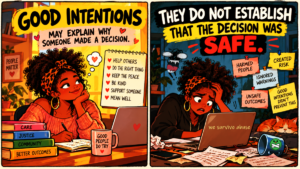
Why would they? These are specialized responsibilities. People train for them. They study. They gain experience. They update their knowledge as research, laws, and professional standards change.
And even with that preparation, the work can be difficult.
I spent years working with Survivors of domestic and sexual violence. One thing I learned is that people rarely arrive describing their experiences in the neat categories professionals use.
They talk about their feelings. They talk about what happened yesterday, what happened years ago, and what they hope will never happen again. They may talk about loving someone -their “soul mate” -who frightens them. They may worry about their children, their housing, their partner’s disability, or what will happen if they leave.
A trained advocate listens to all of that while remaining attentive to patterns, vulnerabilities, and possible danger.
We don’t simply decide that whoever sounds most distressed must be right. We don’t assume that whoever speaks most confidently understands the situation best. And we certainly don’t assume that a person’s good intentions establish that their behavior is safe.
We listen. We assess. We ask questions. We pay attention to what keeps happening.
That training does not make advocates infallible. It gives us tools for doing work that requires more than sympathy.
And this brings me to something I wish more people understood about women’s concerns over safety, privacy, and sex-based protections.
Most People Have Never Had to Make These Decisions
Imagine being responsible for a domestic violence shelter.
One person requests an accommodation because they feel vulnerable and unsafe. The request sounds reasonable when you hear their story.
But you also have women living in the shelter who have experienced rape, stalking, physical assaults, and coercive control. Some have disabilities. Some are pregnant. Some have young children. Some have only recently escaped men who threatened to kill them.
You cannot responsibly make the decision by listening to one person’s account and stopping there.
You must understand the law. You must understand the purpose of the shelter. You must consider privacy, trauma, access, available alternatives, and the safety of everyone affected.
You need to know what questions to ask. And you need the judgment to recognize when an apparently compassionate decision could create another serious problem.
Now imagine that the person making the decision is a political leader, school administrator, prison official, or policymaker who has never worked directly with women escaping violence.
Perhaps they are both educated and intelligent. Perhaps they are deeply compassionate. Perhaps they sincerely believe they are doing the right thing.
None of those qualities automatically prepares them to assess the risks when it comes to violence, abuse, and safety.
Good intentions are not a substitute for safety expertise. (Remember I told y’all about the retired cop turned attorney who couldn’t even pretend to be amused when I approached him about what he thought about young, untrained, and unarmed me facilitating custody exchanges. The heart was in the right place, but training and preparation was not)
Women Have Already Seen Institutions Get These Decisions Wrong
This is one reason I take women’s warnings seriously.
We have watched institutions mishandle sexual violence for generations.
On college campuses, women have reported sexual harassment, stalking, assault, and threats, only to encounter inadequate investigations, institutional defensiveness, or responses that left them exposed to further harm.
An independent review found serious shortcomings in how university personnel responded to her reports. Her case demonstrated how fragmented communication, missed warning signs, and inadequate institutional responses can have devastating consequences.
Lauren did not need everyone involved to become an expert in her feelings. She needed people responsible for safety to recognize the danger and respond competently.
And her case is not the only one. There are sooooo many. Too many.
We have seen schools protect reputations and athletic standing while students sought protection. We have seen institutions minimize threatening behavior. We have seen victims forced to repeat their experiences to people who did not understand the patterns they were describing.
These failures do not prove that every institution will make the same mistakes. They do explain why women may be skeptical when leaders assure us that new policies will be implemented safely.
We have heard assurances before. And we have seen what happens when confidence exceeds competence.
Recognizing One Person’s Vulnerability Does Not Eliminate Another Person’s
This is where conversations about gender, institutional access, and sex-based protections become especially difficult.
Someone may sincerely describe feeling vulnerable because of their gender identity. Their experiences of discrimination, harassment, or violence deserve serious consideration.
AND women and girls have legitimate concerns about bodily privacy, sexual violence, trauma, and safety in particular environments. Always have.
The responsibility of an institution is not to decide that one person’s vulnerability makes everyone else’s concerns irrelevant.
It must examine the setting, the actual risks, the applicable law, the available evidence, and the people who will live with the consequences.
A prison presents different risks than a school. A domestic violence shelter has different responsibilities from a public library. A hospital ward may require considerations that do not apply to an ordinary workplace.
These distinctions are important. And they require more than women being fed slogans.
When women raise questions about these policies, they are not necessarily asking institutions to disregard anyone else’s humanity. They may be asking whether the institution has properly understood its responsibilities to them.
The question is not simply whether someone deserves compassion. The question is whether the proposed decision provides appropriate protection for everyone affected. And quite frankly, not enough people seem to care about that. They just want women to go along, be quiet, and be “nice”. That is not how problem-solving in this area works.
Sometimes What People Call Competing Rights Is Actually a Failure to Examine the Problem
I think we have become too comfortable announcing that rights are competing before carefully examining what people are requesting.
We need to distinguish fundamental rights from specific requests and legal obligations from personal preferences.
We also need to understand that protecting people sometimes requires different arrangements for different circumstances.
An institution may be able to meet someone’s needs without removing protections another person relies upon. But finding those solutions requires careful work, appropriate resources, and a willingness to listen to everyone affected.
That is precisely why professional judgment matters. The answer cannot simply be to tell women to stop worrying when she smells smoke. Inside the house.
Women Are Not Wrong to Question the Decision-Makers
When a woman asks whether a prison has adequately assessed the risks of a placement decision, that is a legitimate question.
When parents ask whether a school has considered children’s privacy and safeguarding needs, that is a legitimate question.
When women who have experienced sexual violence ask whether a shelter has appropriate protections and trained staff, that is a legitimate question.
Institutions have a duty to be prepared to answer them with evidence, clear procedures, and meaningful accountability. I promise you, they have a plan B-Z and back again for everything else that “could” happen.
So when leaders dismiss those questions rather than examine them, they have chosen to repeat a familiar institutional failure.
They confuse disagreement with ignorance.
They confuse reassurance with protection.
They confuse having a policy with knowing whether the policy works.
Women have every good reason to demand way more.
Safety Decisions Require More Than Confidence
I want people to understand that this work is hard.
Assessing vulnerability can be difficult. Recognizing manipulation can be difficult. Determining how different legal protections apply in a particular setting can be difficult.
People can make mistakes even after years of training.
That is why we have professional standards, safeguarding procedures, independent reviews, reporting requirements, and opportunities to correct failures.
We do not establish these safeguards because everyone is foolish or malicious. We establish them because human judgment has limits and mistakes can cost people their lives.
And when institutions know that a decision may expose vulnerable people to serious harm, they have a responsibility to examine those risks before acting.
Women should not have to wait for another tragedy before leaders take their concerns seriously.
We should not have to produce another murdered student, another abused prisoner, or another woman whose repeated requests for help went unanswered before someone agrees that a safety procedure needs improvement.
Prevention means learning from what has already happened.
It means understanding that protecting vulnerable people requires more than announcing compassionate intentions.
And it means recognizing that the people most affected by a decision may notice risks that decision-makers have overlooked.
Women Are Sounding the Alarm. Who Is Qualified to Hear It?
I am not asking political leaders, prison wardens, educators, or policymakers to know everything. I am asking them to recognize the limits of what they know. You’re not listening and that is making people even more concerned.
Consult people with relevant experience. Include trained advocates. Listen to women who have survived violence. Examine documented institutional failures. Consult safeguarding specialists and legal professionals. Assess the risks of proposed changes and establish ways to measure whether protections are working.
And when women raise concerns, do not begin by assuming they need correction.
Begin by asking what they are seeing. We can show you.
Because women have been watching institutions make mistakes for a very long time. We have seen what happens when officials ignore warnings, minimize risks, and reassure people without providing meaningful protection.
We have also seen the consequences fall on people who had little power over the decisions that endangered them.
Women are not sounding the alarm because we believe everyone else is incapable of thinking. We are sounding the alarm because we know how difficult safety work is, how often institutions have failed at it, and how much people can lose when those failures happen.
The question is not whether leaders mean well. A lot of people do that.
The question is whether they have done the work necessary to protect the people who depend on their decisions.
And when women’s health, safety, dignity, and lives are at stake, that is not too much to ask.
It is the very least we should expect.
Affirmation:
I am not responsible for making an unsafe decision appear successful.
If an institution makes a choice that places me at risk, I do not owe it silence, gratitude, or cooperation that endangers me. I can question the decision and demand meaningful safeguards.
Imagine How Women Escaping Domestic Violence Feel – WE Survive Abuse
⚠️ They Know. And Still, They Point You Toward the Danger. – WE Survive Abuse