
Inspired by MJ Murphy’s question:
“If women are not a biological category, what exactly are women’s rights based on?”
The bigger the proposed change, the more questions people should be expected to ask.
At work. At church. In neighborhoods. In communities. If you change even one small thing, people WILL have questions. A lot of them. If I change the type of food in my cat’s dish from one day to the next, I brace for skepticism and maybe protest.
We ask questions when someone wants to change the rules at our workplace, reorganize our schools, redefine legal terms, or alter the way public institutions operate. We ask who benefits, who might be harmed, what protections remain, and what happens when something goes wrong.
So why would we expect fewer questions when the discussion concerns women, a category of human beings with a long history of sex-based discrimination?
Why would women suddenly stop asking questions?
Women ask questions about school policies, workplace rules, medical procedures, financial decisions, and neighborhood safety. Nobody should find it remarkable that we also have questions about proposals affecting the meaning of womanhood and the operation of sex-based protections.
These are not small questions. They concern language, law, privacy, safety, medical care, sports, data collection, and how institutions recognize and protect people.
Questions are not evidence of hatred. They are part of how human beings evaluate change.
Women have every reason to examine the details. What happens to existing protections? How will institutions handle privacy? What happens when interests conflict? Who decides? What evidence supports the proposed changes? Who is accountable when a policy causes harm?
These are ordinary questions about consequential decisions.
You cannot ask women to take a proposed change seriously while treating their serious questions as the problem.
The people proposing policy changes have a responsibility to explain what they mean, how the change will work, whose interests it affects, and how they intend to address legitimate concerns.
Women should not have to demonstrate unquestioning agreement before anyone will take their questions seriously.
If a proposal is important enough to change how society defines or recognizes an entire category of human beings, it is important enough to withstand serious, persistent, ordinary questions from the people affected.
You want to change something that affects women as a group, and you’re surprised that women have questions? Why?
1. If being a woman has nothing to do with being female, why have women spent centuries fighting discrimination based on being female? Why did men restrict women’s rights? In the US, women’s rights still vary by state. How did that happen? Based on what?
3. If biological sex does not determine who is a woman, why does it still determine who can become pregnant, give birth, and experience certain forms of reproductive discrimination?
4. If women and girls cannot clearly name themselves as a group, how can they organize to defend their shared interests? 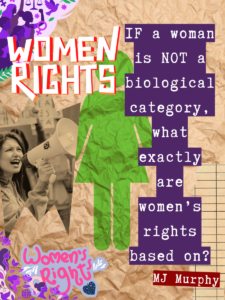
5. If being a woman is based on an internal feeling, how do we explain women who have never experienced any particular feeling of womanhood but know they are female? How do we explain period huts? female genital mutilation? girl-child marriage? the history (and present) of preventing women from voting? obtaining credit? owning property? inheriting property?
6.If women can be masculine, feminine, or neither, why are we discussing personality instead of the female human beings themselves?
7. If sex is no longer considered relevant to the definition of woman, how do we accurately measure discrimination, violence, and inequality experienced specifically by females?
8. If women have a right to bodily autonomy, does that right include deciding who may enter spaces where they undress, sleep, or receive intimate care?
9. If protecting women’s rights requires balancing different people’s needs, why should women and girls the human beings, be expected to make the sacrifices rather than institutions finding solutions that protect everyone? How did you decide which human beings would be the people making all the sacrifices? Based on what exactly? Why?
10. If the word “woman” no longer specifically identifies adult human females, what word are adult human females supposed to use when speaking about ourselves, our bodies, our experiences, and our rights?
11. If anyone can be a woman, what does the word woman actually mean? Do we still need it? Why?
12. If being female doesn’t make someone a woman, what does? Specifically. How is it measured?
13. Are we only attempting to redefine women? Does this apply to everything that we have distinct and defined categories for or just women? Not anything else, just women?
14. If biological sex doesn’t matter, why have women faced discrimination because of it? Why should the meaning of “woman” depend on social expectations that women have spent generations challenging?
15. If a man can become a woman by saying so, what makes his declaration different from a woman’s biological reality?
16. If women cannot have spaces reserved for females, what does the right to female privacy mean? Do any human beings have a right to privacy then? Who? Based on what?
17. If being a woman is based on feelings, what about women who don’t feel feminine at all? Are they included? How exactly?
18. If we cannot clearly define who is female, how can we accurately measure discrimination against females? How can we measure anything around being female? How do we treat ailments that impact female human beings differently?
19. If women’s rights are supposed to protect women, why shouldn’t women have a major say in how those rights are defined?
20. If the word “woman” no longer means adult human female, what word are adult human females supposed to use?
21. And as an animal lover, are they part of this too? Why or why not?
And one more question worth asking
If women cannot define the group whose rights we are defending, who do people believe ought to get to define it for us?
Women do not all look alike, dress alike, think alike, or live alike. We have different personalities, beliefs, abilities, and experiences. None of those differences changes the fact that female human beings have faced particular forms of discrimination throughout history.
We should be able to discuss that history, recognize those realities, and ask serious questions about the future of women’s rights without treating the questions themselves as wrongdoing.
A right that women cannot clearly name, explain, or defend is a right that becomes harder to protect.
If your definition of a ‘woman’ requires her silence, and your definition of ‘women’s rights’ requires her surrender, perhaps the problem isn’t women. Perhaps it’s what you expect women to accept.
