Table of Contents
I’ll tell you this. What I admire about J.K. Rowling is that, no matter how often people threaten or slur her, she won’t back down. No matter how much wealth and success she has, she still talks about and uplifts women’s rights.
On October 21, 2026, J.K. Rowling published an update to her 2020 essay about sex, gender, women’s rights, and the consequences of speaking publicly about them.
An Update to My Essay of June 2020 – J.K. Rowling
I want to highlight ten things I applaud about her position. Not because I agree with every word she has ever spoken, or because I believe any public figure that I do not know personally needs unquestioning loyalty. I already know that I do not agree with some of her stated positions on social issues.
And yet, I applaud these points because they raise questions about women’s safety, dignity, language, legal protections, and our right to speak for ourselves. JK Rowling utilized her platform, wealth, and social status to keep raising questions when other women abandoned us because it was the socially acceptable thing to do. She could have left the issue of women’s and girls’ rights behind for more popular pastures like the rest of the higher-profile class. She didn’t have anything to gain from fighting and some things to lose. She fought anyway. That’s a warrior. A hero.
I want to begin with the question that keeps coming back to me.
If the word “woman” no longer has a specific meaning that identifies adult human females, what are we supposed to call ourselves? And then I think…forget that. Because I don’t care what people think we should call ourselves unless its something along the lines of “the human beings formerly known as women will now be referred to as goddesses.”
We are not some newly discovered population in need of a name. We are not an afterthought to be accommodated in language that once described us plainly. Women have lived, labored, organized, resisted, raised families, built communities, fought discrimination, and demanded recognition under that name.
Women are not going to be colonized out of a word that describes us.
1. I applaud her insistence that the word “woman” must retain its meaning.
Words are how human beings identify realities, communicate needs, and establish protections. The word “woman” has long identified adult human females, and that meaning remains important in discussions of sex-based discrimination.
Harvey Marcelin had already been convicted of murdering two women before entering residential facilities serving vulnerable people.
Women raised concerns about his history and behavior. Monica Archer alleged that she faced retaliation after reporting threats and workplace safety concerns. Another worker, Anne Brennan, questioned his placement in a women’s shelter.
In 2022, Marcelin murdered Susan Leyden, a 68-year-old woman. A court later convicted him and sentenced him to life without parole.
Here was a man with an established history of killing women. Women raised concerns. Those concerns deserved serious attention.
Where were the voices demanding that the women living and working in these facilities receive adequate protection? From here, it sounded like people were on mute or something.
If a word can no longer clearly identify the population whose rights we fought to establish, we have a serious problem.
2. I applaud her concern about predatory men exploiting access policies.
A safety policy cannot depend entirely on the assumption that everyone who approaches a boundary has good intentions.
Rowling raises a concern that deserves serious examination: whether rules based entirely on self-declaration can create opportunities for predatory males to enter spaces intended to protect women.
California transferred Tremaine Carroll, a male prisoner with a violent criminal history, into a women’s prison under its gender identity housing policy.
Female prisoners subsequently reported sexual assaults. Authorities eventually transferred Carroll back to a men’s facility, and criminal proceedings followed.
These women could not simply leave. They could not choose another bedroom or another prison.
The state controlled their environment and had a responsibility to protect them.
Whatever position people hold on prison housing policies, allegations of sexual violence require serious investigation and protective action.
Women do not surrender their humanity when they enter prison. And the government does not surrender its duty to protect them.
This does not mean that every person who identifies differently is dangerous. Rowling herself distinguishes vulnerable trans identified people from predators.
But we already know that predatory men exploit trust, authority, institutional weaknesses, and opportunities for access. We should evaluate safeguarding policies with that reality in mind.
3. I applaud her defense of female-only spaces.
In October 2025, Maryland police arrested 44-year-old Tshikundi Taty after investigators alleged that he disguised himself as a woman to enter female locker rooms and secretly record women showering. Police found him inside a women’s locker room at a Planet Fitness in White Oak. Investigators feared there could be additional victims.
Then, in October 2026, Massachusetts police arrested Laquan Holland after two women reported sexual assaults inside a Planet Fitness women’s locker room in Cambridge. Prosecutors alleged that he physically attacked and restrained one woman and assaulted another who tried to intervene.
And in Virginia, registered sex offender Richard Cox faced numerous charges after authorities investigated reports that he repeatedly entered female locker rooms at schools and recreational facilities, exposing himself to women and girls.
These were not imaginary concerns. Women reported actual conduct, police investigated, and arrests followed.
So where were the loud voices accusing women of hatred for defending female privacy? Where were their campaigns for these women? Where was their outrage about men violating women’s boundaries in places where women were showering, changing clothes, or simply expecting privacy?
I would welcome evidence that those same voices spoke just as forcefully for the victims. The selective silence around male violence against women and girls is so frustrating.
Women have been lectured endlessly about the danger of their words. Meanwhile, women have been reporting the dangerous actions of men.
We should not have to wait for another arrest, another assault, or another frightened woman to establish that our safety concerns deserve attention.
If your outrage begins when women speak and disappears when men violate women, it is time to examine what your outrage is actually protecting.
Women do not seek privacy in changing rooms, shelters, prisons, or sexual assault recovery settings because we believe ourselves superior to anyone. We seek privacy because our bodies, experiences, vulnerabilities, and histories are real.
A woman recovering from sexual violence should not have to defend her need for a female-only support environment. Institutions should be capable of protecting her dignity while also providing appropriate services for other vulnerable populations. They ought to be capable of at least that.
Compassion never requires eliminating boundaries.
4. I applaud her refusal to treat women’s objections as evidence of hatred.
The silence was eerie. When Jennifer Melle was called slurs, including that n-word by a shackled convicted child predator, you could have heard a cricket crawl from communities that USUALLY lead such conversations. One day I’m going to find these hiding places.
In May 2024, Jennifer Melle, a Black Christian nurse working at St Helier Hospital in London, referred to a male prisoner-patient, a convicted child sex offender who identified as a woman, as “Mr.” According to Melle, the patient responded with racist abuse and physical threats. It involved a catheterization, and personally I felt that he should have been grateful for her compassionate service. Other people might have responded to the request a little differently.
Yet Melle herself faced disciplinary action, received a written warning, and was referred to the Nursing and Midwifery Council for refusing to use female pronouns.
She was later suspended after speaking publicly about her experience. Her case raised troubling questions about whose dignity, safety, and rights institutions choose to prioritize, particularly when a Black woman reports racial abuse and intimidation. In April 2026, the NHS trust reached a settlement with Melle, and the Nursing and Midwifery Council subsequently closed its investigations without further action.
I have spent enough years advocating for Survivors to recognize how easily institutions can dismiss an uncomfortable question by attacking the person who asks it.
Calling women “hateful” STILL does not answer whether a policy is safe, lawful, or fair. I want women and girls to finally be called things like “safe” and “at peace.”
If an institution has made a sound decision, it should be able to explain that decision without demanding women’s silence. And please do not come to the table expecting women to use nouveau words society deems acceptable when we are discussing male violence against women. There is power in speaking truth, even if it stings at first.
5. I applaud her attention to women who cannot afford to fight back.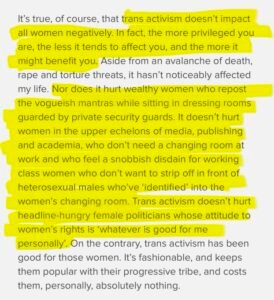
Rowling’s new essay describes her Women’s Fund, which provides financial support for women in the United Kingdom and Ireland pursuing legal action over their rights.
Now, that caught my attention.
A wealthy woman can hire lawyers, withstand a public controversy, or walk away from an institution. The buildings they frequent have different security measures and standards. It’s easy for them to tell other women that their concerns are “no big deal.” To get comfortable with misogyny and other forms of disrespect, “or else.” A working-class woman may have to choose between her paycheck and speaking up about something that makes her uncomfortable.
Women’s rights cannot exist only for women who can afford to defend them.
6. I applaud her willingness to confront institutional failures.
Girls are human beings too. In 2025, a teenage girl in Washington state reported that a male competitor sexually assaulted her during a girls’ wrestling match. Her mother had recorded the competition, and the family pursued legal action. Her reaction in the moment of the alleged assault was on video. For all the videos that are discussed online, too many people remained silent about that. Too “complicated” perhaps?
Federal officials also examined the school district’s response.
This girl was participating in a school sport. When she reported misconduct, she deserved a serious investigation, protection from retaliation, and adults willing to listen.
Yet girls who question male participation in female sports can find themselves caught in arguments about prejudice before anyone has fully examined their experiences. I have heard plenty of public lectures about what girls should accept. Few to zero words from the same crowd about girls deserving not to be threatened, slurred, or assaulted as they try to engage in positive youth activities. Where are the public demands that schools protect them?
Adults are responsible for examining these questions and developing policies that can withstand scrutiny. Girls should not have to absorb the consequences of unresolved adult disagreements while being told that raising questions makes them unkind.
Rowling questions the actions of employers, government agencies, schools, and other institutions that she believes have disregarded women’s concerns.
This is familiar territory for anyone who has worked in Survivor advocacy.
Institutions can write beautiful policies about inclusion, dignity, and respect. But what happens when a woman reports that a policy leaves her vulnerable? Who investigates? Who evaluates the risk? Who has authority to make corrections?
We should not confuse an institution’s stated intentions with the consequences of its decisions.
7. I applaud her concern for incarcerated women.
A woman does not lose her humanity when she loses her freedom.
In California’s women’s prisons, female prisoners reported sexual assault, intimidation, and threats involving trans identified male prisoners housed in female facilities under state policy. Some women also alleged that prison officials retaliated when they complained, including through disciplinary write-ups, removal from their rooms, and solitary confinement. The allegations involving Tremaine Carroll brought further attention to these concerns.
At FCI Dublin, women reported years of sexual abuse by male prison employees. Some described threats, punishment, and retaliation for speaking out. The scandal resulted in criminal convictions, the prison’s closure in 2024, and a $115.8 million settlement involving 103 women.
These women could not simply leave. They depended on prison authorities for their safety, yet some alleged that asking for protection exposed them to further punishment.
So where were the loud voices accusing women of hatred when female prisoners were reporting sexual violence and retaliation? Where was the passionate defense of their bodily autonomy, dignity, and right to safety?
Women were asking for protection, not permission to hate anybody.
And what does it say about our priorities when people find their voices to condemn women who question prison policies, yet we hear so little from those same voices about women who report being assaulted under those policies?
A woman should never have to choose between enduring abuse and risking punishment for reporting it. Prison walls do not erase women’s rights, and accusations of hatred do not erase the danger women are describing.
Rowling specifically addresses women in prisons who must share intimate facilities with males who identify as women.
Prisoners cannot simply leave when they feel unsafe. They cannot select another institution, hire private security, or decide to go home.
The state controls their surroundings. That gives the state an extraordinary responsibility to protect their bodily safety, privacy, and dignity.
Prison officials should take sex, violence histories, individual risk, and women’s vulnerability seriously when making placement decisions. What are you doing if you aren’t doing that? How are you accessing risk?
8. I applaud her recognition that sexual assault Survivors deserve female-centered services.
Rowling discusses Beira’s Place, the women-only sexual violence support service she founded in Edinburgh.
As someone who has worked with Survivors, I understand why the availability of female-only services is important.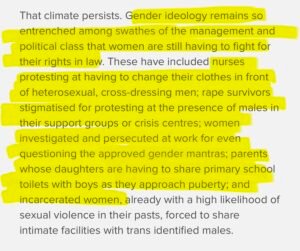
Some women need to speak about male violence without a male present. They may need time to recover their ability to trust, to speak freely, or simply to feel comfortable in a room.
Those needs should not become grounds for shaming them.
Society has the resources and imagination to provide compassionate services for different populations without requiring every service to operate under identical rules.
9. I applaud her insistence that women’s sex remains relevant to our rights.
Sex matters in medicine, reproductive health, sexual violence research, sports, and the study of discrimination.
Consider maternal mortality, female genital mutilation, sex-selective abortion, or the historical exclusion of girls from education. These are not merely questions about how someone identifies. They involve discrimination and harm connected to being female.
Respecting someone’s gender identity does not require abandoning the collection of accurate sex-based information.
And women’s collective experiences deserve a language of their own.
10. Most importantly, I applaud her refusal to surrender the meaning of womanhood.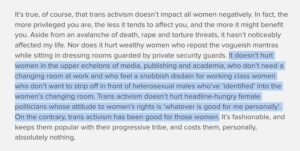
Rowling ends her October 21 essay by arguing that if males can be women, the category of woman loses its distinct meaning. That is her philosophical and political position, and it is the part that most strongly prompted my response.
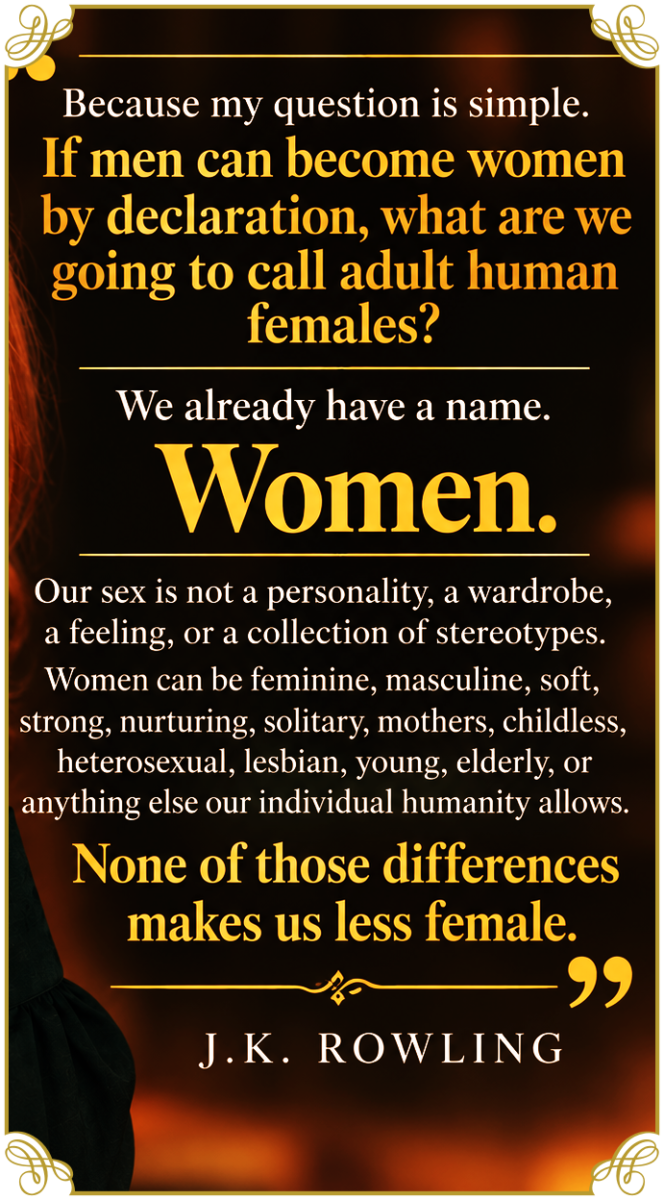
Because my question is simple.
If men can become women by declaration, what are we going to call adult human females?
We already have a name. Women.
Our sex is not a personality, a wardrobe, a feeling, or a collection of stereotypes. Women can be feminine, masculine, soft, strong, nurturing, solitary, mothers, childless, heterosexual, lesbian, young, elderly, or anything else our individual humanity allows.
None of those differences makes us less female.
I do not believe women’s recognition as a sex class should depend on whether everyone agrees with our politics or approves of our language. We are grown-a** women. We don’t need permission from the human beings outside of our sex class.
Women will not be colonized out of our own name.
There is something deeply troubling about asking a historically disadvantaged population to surrender the very language through which it organized its struggle for recognition.
Women are still fighting fights we shouldn’t even have to fight.
Women have fought to be recognized as full human beings under the law. We have fought to be educated, to own property, to vote, to earn wages, to refuse unwanted sexual access, and to live without violence.
Black women, in particular, know what it means to fight for recognition in a society that has repeatedly exploited our labor, dismissed our suffering, and expected us to redecorate our lives to accommodate everyone else’s needs.
So when I use the word colonized, I am speaking about the attempted displacement of a population’s established language and the power to define its own material experiences.
Women should not have to accept the loss of sex-specific language as the price of demonstrating kindness.
We can recognize the humanity of trans-identified people. We can oppose harassment, discrimination, and violence against them. We can debate policies fairly and insist that institutions examine evidence rather than assumptions.
I applaud J.K. Rowling for continuing to raise questions about those protections, particularly for women who have little institutional power and few financial resources.
Women are not visitors to our own history. We are not temporary occupants of our own name.
We are women. We have a right to describe ourselves, organize around our shared interests, and defend the protections our foremothers fought to secure.
And we do not need permission to continue doing so.
It doesn’t hurt women in upper echelons of media, publishing & academia, who don’t need a changing room at work & who feel a snobbish disdain for working class women who don’t want to strip off in front of heterosexual males who’ve ‘identified’ into the women’s changing room/ JK Rowling
Primary sources: Rowling’s October 21, 2026 essay and her original June 10, 2020 essay. The ten points above are commentary and personal interpretations, not ten verbatim statements by Rowling.
The Penthouse Lectures and the Ground Floor Reality – WE Survive Abuse
🚩 Entitlement to Women’s Choices Is Misogyny—No Matter Who It Comes From – WE Survive Abuse
Male Access Supremacy: When Entitlement Disguises Itself as Equality – WE Survive Abuse
Predators Are Not Always Charismatic—Don’t Be Fooled by the Stereotype – WE Survive Abuse
We Keep Asking Women to Be Kinder. Who Is Asking Why Men Are Not Kinder? – WE Survive Abuse
Women Built These Spaces: 20 Historical Reasons Single-Sex Spaces Exist – WE Survive Abuse
There Are No Magic Words That Grant Access to Our Boundaries – WE Survive Abuse
“Say the Right Words and Walk Right In” Was Always Stupid AF – WE Survive Abuse