
Table of Contents
updated from December 12, 2023
Black girls have spent generations learning how to endure unfairness. They deserve a generation of adults determined to stop it.
I was not surprised when I heard Black women in positions of leadership make arguments that seemed to place the needs of girls beneath the demands of others.
I was saddened. But I was not surprised.
Black girls growing up in the United States learn this lesson early. Sometimes we learn it at school. Sometimes at church. Sometimes in our own families. And sometimes from the very women we thought would understand.
We learn to make room, even when there is barely enough room for us. We learn to consider everybody else’s feelings before expressing our own. We learn that being a good girl often means accepting something unfair without making a fuss.
And when we finally object, somebody reminds us to be “gracious.” You all aren’t tired of saying that? That is why the words “lose gracefully” troubled me so deeply.
1. “Lose Gracefully.” But Why Must Girls Be the Ones Who Lose?
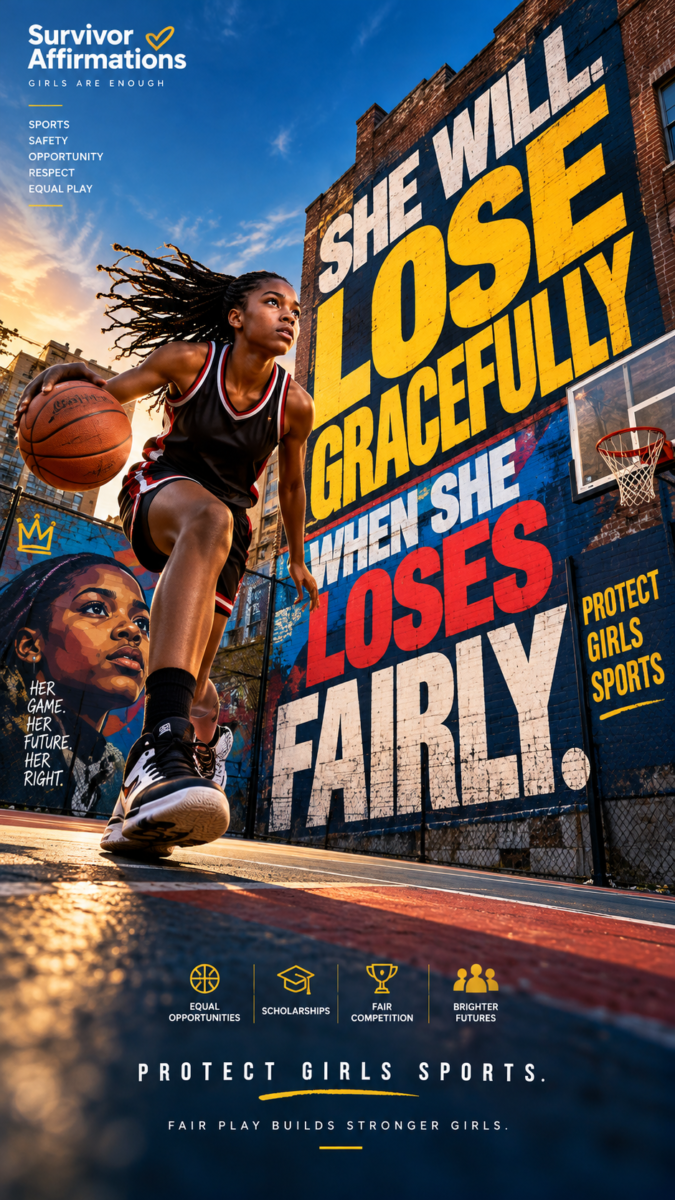
During a 2023 congressional hearing on transgender participation in school sports, Fatima Goss Graves, president of the National Women’s Law Center, spoke about learning to lose gracefully as one of the lessons of athletics.
I understand that sports teach children how to handle defeat. But there is a difference between losing a fair competition and being expected to accept a policy that you believe makes the competition unfair.
That difference deserves an answer.
Female athletes train, sacrifice, compete, and dream. Their families invest time, money, and energy into helping them succeed. Some girls hope to earn scholarships. Others want championships, records, or the simple satisfaction of discovering how far their abilities can take them.
These opportunities belong to girls, too.
When leaders advocate allowing male-born athletes to compete in female categories, they owe girls a serious explanation of how those policies protect competitive fairness. They cannot settle that question by appealing to sportsmanship.
Sportsmanship is how we conduct ourselves within competition. It is not a substitute for determining whether the rules of competition are fair.
Girls should learn to lose gracefully when they lose fairly. They should NOT learn to surrender their interests gracefully because adults find their objections inconvenient.
2. Black Girls Have Already Learned Too Much About Losing Gracefully
This is where the conversation becomes personal for me.
Black girls have long faced expectations that require them to be “stronger, quieter, and more understanding” than other children.
Georgetown Law’s research on the adultification of Black girls documented how adults can perceive Black girls as older, less innocent, and less in need of protection than their peers.
Think about what that means.
A child may need comfort, but adults expect maturity. She may need protection, but adults praise her toughness. She may need somebody to intervene, but adults expect her to manage the situation herself.
And if she becomes angry? Suddenly, her response receives more scrutiny than the circumstances that produced it. I recognize this pattern in discussions about girls’ sports.
We spend so much time evaluating whether girls are being “gracious, accepting, and inclusive” that we risk neglecting the question of whether adults are being fair to them.
Black women know what it means to fight for opportunities that others take for granted.
We should not become comfortable passing the expectation of sacrifice down to our daughters.
The next generation deserves more than instructions on how to survive what we survived.
3. Summer Lee, Aren’t Girls Children, Too?
This was challenging because I respect what Summer Lee brings to Congress. That said, there is no way I can agree with her on this issue. During that same congressional debate, Representative Summer Lee urged lawmakers to remember the children at the center of the controversy.
She spoke about trans-identified children and the benefits of participating in sports. Cool. My father was a physical education teacher, and my aunt—his sister—attended an HBCU on a basketball scholarship. On that side of the family, sports and movement are life. I get this part.
But as I listened to that argument and kept returning to one question.
Aren’t girls children, too?
Girls need physical activity. Girls need friendship. Girls need opportunities to develop confidence, discipline, leadership, and athletic ability.
Girls need spaces where they can compete under rules designed to recognize female athletic achievement.
And girls need adults who will take their concerns seriously.
Recognizing the needs of trans identified children does not require pretending that female athletes have no competing interests. Nor does recognizing girls’ interests require denying anyone else’s humanity.
But when adults discuss inclusion, they must explain whose opportunities may change and what protections remain.
They must be willing to answer difficult questions about eligibility, competitive advantages, privacy, and the purposes of female athletic categories.
What troubles me is the ease with which some advocates speak about girls’ concerns as though those concerns are obstacles to justice rather than questions justice itself must answer.
Girls should never have to wonder whether their representatives remember that they are children, too.
4. Why Are We Asking Children to Carry Adult Decisions?
Here is the part I believe deserves much more attention.
Children do not write federal policy. They do not establish athletic eligibility rules. They do not control school boards, national sports organizations, or civil rights institutions.
Adults do.
Yet when adults make controversial decisions, girls are often left to navigate the consequences.
A girl who questions a policy may face criticism from classmates, teachers, activists, or strangers online. She may be expected to explain complicated legal and scientific arguments simply to defend her position.
Why?
Why should a teenager have to become the public face of a controversy that adults created?
Why should she have to withstand public hostility before leaders consider her concerns legitimate?
If adults believe their policies are so fair, let those adults explain the policies.
Let them answer the questions.
Let them take responsibility for the outcomes.
Stop making girls do the emotional and political labor that belongs to grown people.
Children should be able to attend school, participate in sports, and enjoy their childhood without being required to defend their dignity in a national argument.
5. Girls Deserve Adults Who Will Speak for Them
I believe girls deserve for us to speak for them.
Not because girls lack intelligence, courage, or opinions. They have all three.
But because children should not have to fight every battle themselves.
We do not expect children to negotiate building safety codes before entering a school. We do not expect them to argue for clean drinking water or prove that playground equipment should be safe.
Adults establish protections because children deserve them. ALL children. Not just the children each adult thinks are special. Every single child.
Why should the protection of girls’ interests become different?
We should listen when girls tell us what they need. We should make room for their voices and respect their experiences.
But we must never confuse listening to children with abandoning our responsibility to advocate for them.
Sometimes a girl cannot speak publicly without risking her privacy, friendships, education, or peace of mind.
Sometimes she does not have the language to explain what feels wrong.
Sometimes she is simply tired of being expected to explain herself.
That is when adults should be especially willing to stand beside her.
A girl should not have to prove that she is brave enough to face public hostility before adults decide she deserves their protection.
We are supposed to carry responsibilities that children are not yet equipped or obligated to carry.
That is part of being grown.
6. Compassion Cannot Always Mean Girls Must Give Something Up
I want us to examine a habit that appears throughout discussions about women’s rights.
Someone identifies a need. Someone proposes a solution. And before long, women and girls are expected to accommodate that solution, sometimes without meaningful discussion of what they may lose.
If they object, people question their kindness. But kindness and agreement are not the same thing.
A girl can respect another person’s humanity and still disagree with a sports eligibility policy.
She can believe that every child deserves opportunities while also believing that female athletic categories serve an important purpose.
She can show compassion without surrendering her right to ask questions.And she can reject an expectation without rejecting another person’s dignity. We should be teaching children these distinctions.
Instead, too many adults teach girls that compassion requires compliance. That is a dangerous lesson to carry into adulthood.
Girls need to know that disagreement is not cruelty, that boundaries are not hatred, and that fairness does not require them to ignore their own interests.
If a policy depends on girls remaining silent about its consequences, that policy deserves more scrutiny, not less.
7. Black Women Should Recognize the Cost of Being Told to Wait
Black women have heard variations of this argument throughout American history.
Wait your turn.
Support the larger cause.
Don’t divide the movement.
We will address your concerns later.
We know how easily later becomes never.
Black women have contributed to movements that did not always give our own needs equal attention. We have defended communities while confronting racism and sexism within those same communities.
We should know better than to tell another generation of girls that their concerns must wait until everyone else feels comfortable.
This is not an argument that every Black woman must agree on every sports policy.
It is an argument that our political disagreements must not make Black girls disposable.
Our history should make us especially attentive when adults expect girls to absorb disadvantages for a supposedly greater good.
Because we know the cost of that expectation.
And we know that praising someone’s strength does not excuse refusing to protect her.
8. We Need Leaders Who Can Answer Girls Without Shaming Them
I want leaders who can discuss difficult questions without treating female athletes as enemies.
Leaders who can distinguish between the dignity of an individual and the fairness of a policy.
Leaders who can examine evidence, acknowledge competing interests, and explain their decisions without hiding behind slogans.
And leaders who understand that girls are not obligated to applaud policies they believe disadvantage them.
There are legitimate disagreements about transgender participation in sports, including how rules should vary by age, competitive level, and sport. Those disagreements require evidence and careful judgment.
But none of that changes a basic obligation. Girls deserve representation in decisions affecting them. Their interests should not become an afterthought.
And adults should never use the language of “kindness” to discourage girls from raising legitimate concerns.
Personally, I do not need every leader to agree with me. I need leaders to demonstrate that girls count.
9. Our Responsibility Is to Give Girls Something Better
I want Black girls to grow up knowing they are worthy of protection before anything terrible happens.
Before they become exhausted.
Before they learn to hide their disappointment.
Before they become experts at making themselves smaller to preserve somebody else’s comfort.
I want them to know that their athletic achievements matter. Their privacy matters. Their opportunities matter. Their voices matter.
And I want them to know that adults will sometimes have to make difficult, unpopular decisions to defend those interests.
That is our responsibility.
We cannot claim to be building a better world for girls while teaching them that the price of belonging is silence.
We cannot praise their potential while treating their opportunities as negotiable.
And we cannot keep calling girls resilient when what they need from us is protection.
I do not want another generation of Black girls to become exceptional at enduring what adults should have worked to prevent.
I want girls who are free to compete, question, achieve, and enjoy being children.
I want them to inherit opportunities rather than apologies.
And I want them to know that when the world demands too much of them, somebody older, wiser, and stronger in their position will stand up and say, “No. We are not putting that burden on these girls.”
That is the kind of leadership our daughters deserve.
That is the kind of womanhood I want them to witness.
And that is the responsibility we should be willing to carry.
Girls are children, too.
Girls are enough, just as they are.
And the measure of our leadership is not how gracefully we teach girls to lose. It is how faithfully we defend their right to a fair chance.
Listen to Warnings from Girls | WE Survive Abuse
The Stubborn American Habit of Obstructing Black Girlhood | WE Survive Abuse
How Society Continues to Enable Abuse and Violation of Women and Girls in Sports | WE Survive Abuse
Keeping Girls Safe in a Dangerous World (ebook) | WE Survive Abuse
2022 Fall Mood Board on Women’s Rights | WE Survive Abuse