Table of Contents
There is a mistake we can make when thinking about divide-and-conquer strategies.
We imagine somebody has to promise the recruited group something enormous.
Equality.
More rights.
Freedom.
A seat at the very top.
History tells us otherwise.
Sometimes people will participate in maintaining a system that does not offer them equality at all. The reward can be belonging. Respectability. Social approval. A sense of protection. Recognition as one of the “good” women. Distance from another group that has been marked as troublesome, selfish, dangerous, radical or undeserving.
Women have lived this history before.
And women have overcome these divisions before.
1. 🧩 You don’t have to be offered equality to be given a role
This is the first lesson.
A system can deny women equal power while still giving some women meaningful responsibilities inside that system.
They can organize.
Speak.
Recruit.
Teach.
Campaign.
Enforce social expectations.
They can even become highly influential.
Being given a role within a hierarchy is not the same thing as being liberated from the hierarchy.
That distinction helps us understand quite a bit of women’s history.
2. 🏠 The campaign AGAINST the Equal Rights Amendment depended heavily upon women
The Equal Rights Amendment was remarkably short. Its central promise was that equality of rights under the law could not be denied or abridged on account of sex.
Yet some of its most visible opponents were women.
Phyllis Schlafly’s STOP ERA campaign mobilized women across the country against ratification. The campaign warned women that constitutional sex equality could threaten protections or advantages associated with traditional female roles.
These women were not necessarily promised equal standing with men.
Quite the opposite.
Much of the argument rested upon the idea that women and men occupied appropriately different roles.
Women nevertheless became organizers, campaigners, lobbyists and political messengers for that position.
3. 🎤 Power can give someone a microphone without giving her equality
This is a distinction worth sitting with.
A woman can become highly visible inside a system without the system abandoning its underlying ideas about women.
She may receive influence.
She may receive praise.
She may receive a platform.
She may even exercise considerable authority.
None of those things necessarily means the underlying hierarchy has disappeared.
Power does not always silence women. Sometimes it hands particular women a microphone.
The question is what they are being encouraged to defend with it.
4. 🏫 Women also became organizers of resistance to school desegregation
After Brown v. Board of Education, resistance to school integration did not come only from male politicians standing behind podiums.
White women participated extensively in grassroots resistance.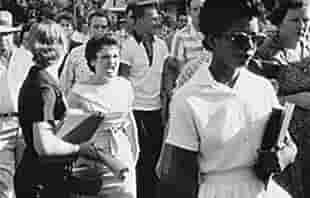
They organized through neighborhoods, schools, parent groups and community networks. Motherhood itself could become political authority: we are protecting our children, our schools, our communities.
Again, these women were not necessarily being offered equality with white men.
They were being offered something different.
A meaningful position inside the existing social order.
And that could be powerful enough.
The Story Behind Elizabeth Eckford and Hazel Bryan’s Iconic Photo
5. ⚠️ Being disadvantaged does not automatically prevent someone from helping disadvantage somebody else
This is one of history’s uncomfortable lessons.
White women experienced sex discrimination while participating in racial segregation.
Both things could be true.
Their lack of equality with white men did not prevent some of them from helping maintain institutions that placed Black women and men beneath them.
That is why we should be careful with the assumption:
“She experiences discrimination herself; therefore, she will naturally recognize discrimination against someone else.”
Human beings don’t always work that way.
Sometimes our own wounds increase solidarity.
Sometimes they can be redirected into competition over who deserves recognition, protection or belonging.
6. 🪞 Stereotypes are especially useful for creating those divisions
Now bring the lesson closer to women.
Imagine womanhood as a tiny cultural picture:
feminine.
Delicate.
Heterosexual.
Interested in beauty.
Motherly.
Soft-spoken.
Conventionally attractive.
Physically small.
Comfortable with traditional female presentation.
Millions of women have never fit that picture.
But here is the mistake:
Their failure to fit the stereotype does not mean they fail to be women.
It means the stereotype failed to describe women.
7. 👟 She was never standing outside womanhood
She was a girl.
The masculine lesbian was never standing somewhere near the border of womanhood.
She was a woman.
The female athlete whose strength makes strangers call her masculine is not “partially female.”
Likewise, the woman who never marries, never becomes pregnant, never wears makeup, never grows her hair long and never develops a traditionally feminine personality has not surrendered one ounce of her sex.
These women do not weaken the meaning of female.
They reveal how enormous the variation among female human beings actually is.
8. ✊🏾 Black women know something about being pushed outside stereotypes of femininity
Black women have lived with particularly ugly versions of this.
Our femininity has been questioned because of our bodies.
Our strength.
Our hair.
Our features.
Our independence.
Our voices.
Even our ability to endure circumstances we should never have been expected to endure has been turned into evidence that we supposedly require less tenderness or protection.
But the lesson from that history cannot be:
Perhaps we were never really women.
The lesson is:
Your stereotype of women was never large enough to contain us.
9. ♿ Neither illness nor disability moves a woman outside her sex
A woman can lose her breasts to cancer.
A woman can undergo a hysterectomy.
A woman can become infertile.
A woman can use a wheelchair.
A woman can lose her hair.
A woman can experience hormonal changes, menopause, injury or major alterations to her body.
None of these experiences makes her a lesser woman.
Women’s sex-based rights cannot depend upon successfully performing an idealized version of the female body.
Otherwise the women who most need protection from discrimination could become the women least capable of qualifying for it.
10. 🧱 Sex-based rights cannot belong only to stereotypical women
This is where the history becomes useful.
If rights protecting women depend upon femininity, then femininity eventually becomes an entrance examination.
Are you feminine enough?
Do you look sufficiently female?
Do you behave appropriately?
Are you attractive in the expected way?
Are you heterosexual?
Are you maternal?
Are you agreeable?
That would reproduce one of the oldest restrictions placed upon women:
You may receive the protections afforded to women provided you behave like the kind of woman society approves of.
Sex-based rights avoid that trap precisely because they apply across female difference.
11. 🔀 Divide-and-conquer works best when people stop recognizing their common interest
The feminine woman and the masculine woman can disagree about almost everything.
They may have completely different lives.
One may be a conservative Christian mother of six.
Another may be a lesbian mechanic who hasn’t worn a dress since somebody stopped making her.
Another may be a Black grandmother.
Another may be twenty years old and unsure where her life is headed.
Another may be disabled.
Another may be an elite athlete.
They don’t need a shared personality.
They don’t need shared politics.
They don’t need a shared religion.
They don’t need a shared aesthetic.
Sex-based rights were never supposed to be a personality club.
12. 🪤 One warning sign is when an old injury becomes the recruitment tool
This is where I become especially cautious.
Suppose a woman has spent her life being told:
You’re too masculine.
You’re not pretty enough.
You’re too aggressive.
You don’t act like a woman.
You don’t look feminine.
Then somebody arrives and essentially tells her:
“See? Those women never represented you anyway.”
That can feel liberating.
But there is another possible conclusion.
Those people were wrong about the range of women.
We should be extremely careful when someone’s history of exclusion from a stereotype becomes the reason she is encouraged to separate herself from other women.
13. 🤝 History also teaches us how division is overcome
Divide-and-conquer strategies lose some of their power when people refuse the premise that their differences require competing rights.
That requires recognizing common interests without pretending everybody has identical experiences.
Women do not have to become culturally identical to organize around sex discrimination.
Black women did not need white women to become Black.
Lesbians did not need heterosexual women to become lesbians.
Working-class women did not need wealthy women to surrender their wealth.
Disabled women did not need nondisabled women to acquire disabilities.
Solidarity doesn’t require sameness.
It requires recognizing where interests genuinely intersect. Female humanity.
14. 🌳 The answer to a narrow definition of femininity was never a narrower definition of women
Women spent generations pushing outward against restrictive expectations.
Women can work.
Women can vote.
Women can govern.
Women can remain unmarried.
Women can refuse motherhood.
Women can love women.
Women can wear trousers.
Women can shave their heads.
Women can build things.
Women can compete.
Women can lead.
Women can be physically powerful.
Women can be feminine.
Women can be masculine.
The great expansion was not discovering that some of these people weren’t really women.
It was discovering how many different ways there are to be one.
15. 🕊️ We do not have to abandon one another
History gives us examples of women helping maintain systems that restricted other people’s rights.
It also gives us women who crossed those divisions.
That second history deserves just as much attention.
Because the answer to divide-and-conquer is not finding another group of women to despise.
It is becoming harder to divide.
It is asking who benefits from the division.
It is recognizing when status is being mistaken for equality.
It is refusing to make dignity conditional upon conformity.
And it is remembering something women living outside traditional stereotypes have demonstrated for generations:
Women on the perimeter of female stereotypes are not on the perimeter of womanhood. They are evidence of how small the stereotype always was.
Sex-based rights belong to female human beings.
Not merely feminine ones.
Not merely heterosexual ones.
Not merely able-bodied ones.
Not merely mothers.
Not merely women whose bodies or personalities make other people comfortable.
All of them.
Women’s sex-based rights belong to all female human beings.
No Predator Has the Authority to Rename Violence As a “Right.” – WE Survive Abuse
If Stereotypes About Women Became Law, What Would Those Laws Look Like? – WE Survive Abuse
You Cannot Understand Women Through Shallow Stereotypes About Women – WE Survive Abuse
Red Flag #1: If They Won’t Let You Have Privacy, They Don’t See You as Human – WE Survive Abuse