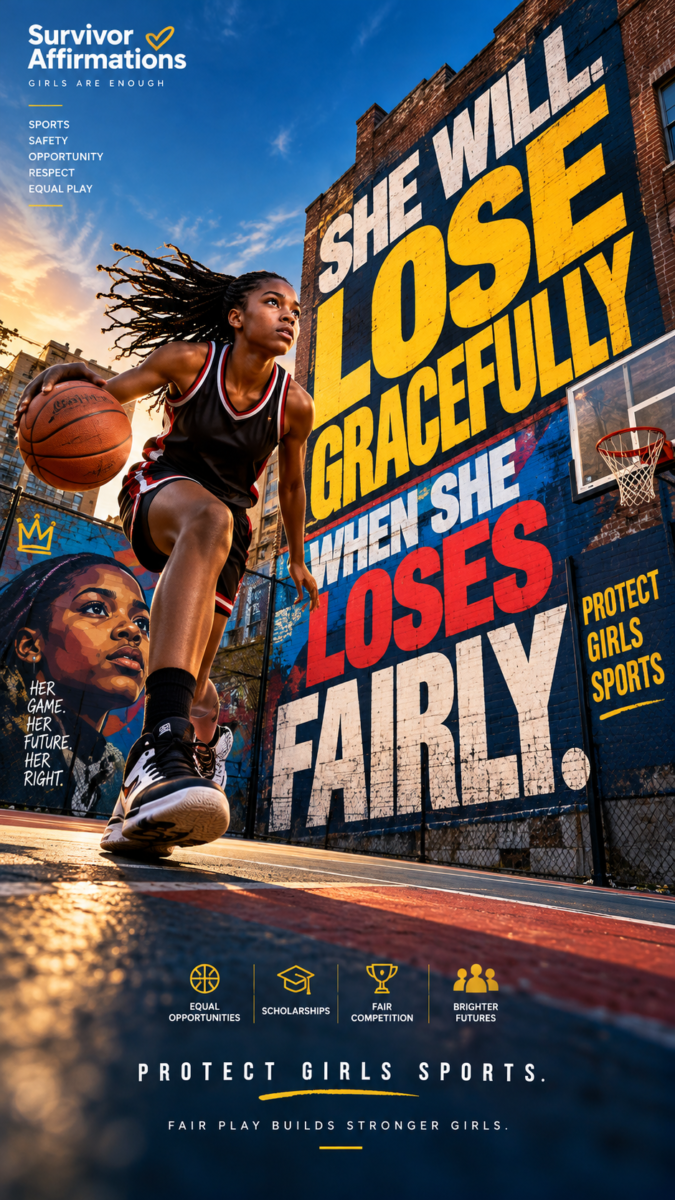
Not every person is used to or comfortable with people telling women and girls, “yes.” What an opportunity we have for growth right now.
Boys and men often grow up in spaces understood to belong to them, particularly in sports, recreation, and certain social institutions. Their desire for camaraderie, privacy, and competition is often treated as ordinary.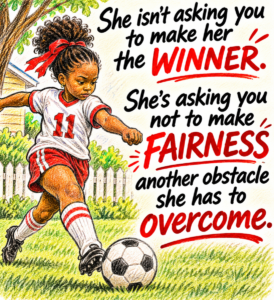
Yet when women and girls ask to preserve spaces for female privacy, safety, or athletic competition, those boundaries can become the subject of intense public debate.
And I think there’s an important distinction here: Wanting a space of your own is different from believing you’re entitled to someone else’s space.
A boy can value his own team, locker room, or social circle without needing access to every space girls use. Likewise, a girl can value female-only opportunities without suggesting boys are less deserving of respect.
Something to pay attention to in the question is whether institutions sometimes treat male access to female spaces as more important than female boundaries, while continuing to respect boundaries that benefit males. We didn’t discover that boys’ sports mattered. We spent generations teaching communities to treat them that way. We have spent enough generations teaching girls how to accommodate disappointment. Let’s teach institutions how to provide fairness.
A girl’s kindness is a beautiful quality. It is not an unlimited resource for other people to spend. When a girl asks whether something is fair, answer her question before you begin evaluating her attitude or deciding how she can do more for others while sacrificing to her own needs and wants. A girl who wants to win is not being difficult. She’s being an athlete
That is something we can examine through actual policies and their effects. There is also a lesson here that reaches well beyond sports. We teach girls to be good sports. We should be just as determined to make sure they have good sporting opportunities
A boundary isn’t automatically an injustice because somebody wishes to cross it.
Look at us, poised and ready to grow into encouraging, listening to, and unapologetically uplifting girls! What a time to be alive.
Sometimes a boundary protects privacy. Sometimes it supports fair competition. Sometimes it gives people a place to recover, participate, or simply enjoy being together.
The purpose matters. And perhaps the question we should ask more often is this:
When women and girls say a space was created to meet their needs, why does the conversation so quickly become about somebody else’s disappointment at being excluded?
In sports and in life, a fair loss can teach a girl resilience. An unfair contest can teach her that the rules weren’t written with her in mind.
Biological differences are not insults. Using those differences to declare women less valuable is.
We can respect every person’s humanity without pretending that every physical difference is irrelevant to athletic competition.
Did you know? In sports, several average sex-related differences can affect performance: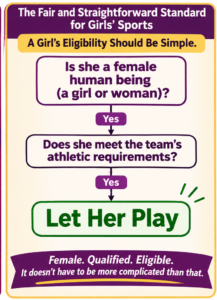
-
Skeletal structure: Males and females differ, on average, in pelvic geometry, shoulder breadth, bone dimensions, and skeletal proportions.
-
Muscle mass and distribution: Adult males typically have greater absolute muscle mass, particularly in the upper body, following male puberty.
-
Heart and lung capacity: Males generally have larger hearts and lungs in absolute terms, with differences in oxygen delivery and aerobic performance.
-
Blood composition: Average hemoglobin concentrations differ between adult males and females, influencing oxygen transport.
-
Strength, speed, and power: Male puberty produces developmental changes that contribute to average performance differences in many athletic events.
-
Joint structure and biomechanics: Sex-related anatomical differences can influence movement patterns and certain injury risks, although these relationships are complex.
Women do not need to be physically identical to men to deserve equal dignity, opportunity, and respect.
Seven ways women’s sports can be handicapped
1. Financial disadvantages. Women’s programs may receive less funding, sponsorship, equipment, and access to quality facilities.
2. Less media exposure. When girls and women receive less coverage, they have fewer opportunities to build public recognition, attract sponsors, and develop a following.
3. Historical exclusion. Women were denied access to many organized athletic opportunities for generations. Men’s sporting institutions had more time to develop traditions, audiences, facilities, and commercial relationships.
4. Unequal development opportunities. Girls may encounter fewer competitive leagues, experienced coaches, training opportunities, and pathways into professional sports.
5. Cultural expectations. Boys are often encouraged to view athletic achievement as a source of identity and pride. Girls may receive messages that sports should remain recreational, secondary, or less important than other responsibilities. An opportunity to “be kind”…. usually to boys.
6. Unequal professional infrastructure. Differences in salaries, travel arrangements, medical support, training resources, and career opportunities can affect athletes’ ability to develop and remain in their sport.
7. The burden of proving their worth. Women’s leagues are sometimes expected to demonstrate immediate profitability and public interest, even though established men’s leagues benefited from decades of investment, promotion, and institutional support.
Fair competition isn’t about pretending everybody has the same physical advantages. It’s about establishing rules that make achievement meaningful. Don’t call her sport specifically “recreational” simply because you never bothered to imagine her becoming great at it.
These disadvantages vary considerably by sport, country, institution, and competitive level. Women’s sports have also made substantial gains anyway.