Table of Contents
One of the questions that you get asked often during trainings on sexual abuse prevention, especially, is, “Well, how often does this happen anyway? Is it really that big of a deal?”(I’m specifically speaking of those asking not out of curiosity but to dismiss the issue)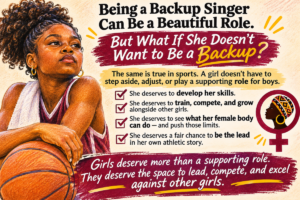
Then you, the trainer, ask the questioner, “Well, how many would be okay with you? Please give me a solid figure to work with? How many are you okay with before YOU are willing to consider it worthy and worthwhile?”
Why is it okay with people to treat girls like the “bad guy” when we are speaking about males in girls’ sports? There is something deeply disappointing about hearing a woman dismiss concerns that other women and girls have spent years trying to get people to take seriously.
Especially when that woman knows something about discrimination. Especially when she has a powerful platform. Especially when she knows how easily people can turn another human being’s concerns into a political inconvenience.
And yet, here we are.
Rachel Maddow’s recent comments about trans-identified athletes competing in women’s sports brought an old, familiar frustration to the surface for me.
We have heard it in police stations, courtrooms, churches, schools, hospitals, workplaces, and sometimes at our own kitchen tables.
“You’re exaggerating. It’s not that serious. Where’s your proof? How many people has this actually happened to? Why are you making such a big deal out of it?”
Sometimes those words come from men. Sometimes they come from women who believe they are standing on the right side of history.
But when women and girls are the ones being told to move aside, surrender a boundary, or accept an arrangement they consider unfair, be silent, reduce safety, and the experience of being dismissed can sound painfully familiar.
And I think it’s time we talked about that.
1. Rachel Maddow’s comments: When women’s concerns become somebody else’s political talking point
On November 6, 2026, Rachel Maddow appeared on the Pablo Torre Finds Out podcast, where she discussed the national controversy over trans-identified athletes participating in women’s sports.
Maddow described political campaigns surrounding the issue as efforts to scapegoat a small minority. She characterized the broader political controversy as a manufactured problem with little relevance to the everyday lives of most Americans.
She called the political campaign repulsive and criticized politicians for using it to generate hostility toward trans-identified people.
Now, people can certainly examine how politicians use controversial issues to win elections. Political opportunism is real.
But that doesn’t settle the underlying question.
What about the girls who actually play the sports?
What about the female athletes who have spent years developing their skills, training their bodies, and competing for opportunities?
What about the girls who want female sports categories maintained because they believe those categories protect meaningful competitive opportunities?
Those are not imaginary people with imaginary interests. After all, we are discussing THEIR sports. Not “children’s sports”. Girls sports.
Instead of hearing a serious examination of what female athletes are saying, we hear another discussion about whether the issue is “politically useful, statistically significant, or worthy of national attention.”
Women and girls deserve better than becoming background characters in a debate about their own opportunities.
2. The numbers game: Apparently, one woman isn’t enough
You know this one.
How many women are actually affected?
What percentage of the population is that?
Isn’t this a very small problem?
Numbers are useful for understanding how widespread something is. They help researchers, policymakers, and institutions make decisions. But numbers can also become a convenient way to avoid dealing with the person standing right in front of us.
A woman tells you something happened to her. Instead of listening, you ask how many other women experienced the same thing.
And if she is the only one?
Apparently, she is supposed to accept that her experience is too insignificant to matter.
Think about how strange that reasoning is.
We don’t ordinarily insist that a preventable danger must injure a large number of people before we are willing to examine it.
Yet women and girls routinely encounter arguments that treat the number of people harmed as though it determines whether the harm deserves concern.
One woman is not an acceptable casualty simply because the percentage is small.
And one girl should not have to find a thousand other girls who agree with her before adults take her concerns seriously.
3. The proof game: When listening becomes a courtroom interrogation
There is another familiar pattern.
A woman raises a concern, and somebody immediately demands proof.
Not because they are genuinely trying to understand what happened. Sometimes the questions are designed to exhaust her.
Are you sure?
Could you have misunderstood?
What evidence do you have?
Why didn’t you say something sooner?
Women who have reported abuse, harassment, intimidation, or threatening behavior know this routine.
Of course, evidence matters. We need evidence to establish disputed facts and make fair legal decisions.
But a woman does not need to prove a criminal case before somebody can listen to her, document her concern, or take reasonable steps to prevent harm.
And the same principle applies when girls raise questions about sports, privacy, or institutional rules.
Their concerns deserve examination, even when adults disagree about the appropriate policy.
Listening is not the same as automatically agreeing. But refusing to listen because a woman’s concern is inconvenient is not fairness, either.
4. “It never happened to me” is not evidence that it never happened
This one has always fascinated me.
Somebody hears a woman describe a harmful experience and responds by announcing that they have never experienced anything like it.
Well, that’s wonderful for them.
But what exactly does that establish?
A woman who has never experienced domestic violence cannot use her personal history to disprove another woman’s abuse.
A woman who has never experienced workplace sexual harassment cannot declare that harassment is exaggerated.
And a woman who has never encountered a particular problem in sports cannot assume that female athletes who describe that problem are inventing it.
Your experience tells us what happened to you. It does not establish the limits of what can happen to another woman.
We should know this by now.
Especially women who have had to fight to get others to recognize experiences that were once routinely ignored.
5. The reputation game: When a man’s good name becomes more important than a woman’s safety
On November 9, 2026, Russell Brand was sentenced to 10 years and six months in prison after being convicted of raping one woman and sexually assaulting three others.
The crimes occurred between 2004 and 2009.
In his sentencing remarks, Judge Joel Bennathan told Brand:
“Your status protected you until 2023.”
Think about that. The judge was describing years during which Brand’s fame helped shield him from accountability.
And this is why I want women and girls to understand something about the world we live in.
A man’s reputation can become a wall that women are expected to climb before anyone will hear what happened to them.
We see versions of this in families, churches, schools, athletic programs, and workplaces.
He’s such a good father.
He’s a respected pastor.
He’s done so much for this community.
He’s always been kind to me.
Perhaps he has. But none of those statements establishes how he treated the woman making the report.
A man’s public reputation is not evidence that a woman’s private experience is false.
And women should never have to compete with a man’s popularity to receive a fair hearing.
6. The people who stand around and do nothing
One of the most disturbing details in the Brand sentencing concerned a woman who was sexually assaulted while working at a radio station.
According to the judge’s account, Brand assaulted her in front of other people. She described struggling to get away while those around her failed to intervene. Someone laughed afterward.
The judge recognized the additional humiliation of the public assault and the laughter that followed. That detail stayed with me.
Because it reminds us that abuse, harm, and violence does not always happen in secret. Sometimes people see what is happening. They simply decide not to interfere.
Perhaps the man is powerful. Perhaps people don’t want to embarrass him. Perhaps they are worried about their jobs or their social standing.
Whatever the reason, the woman is left to deal with the behavior while other people protect their own comfort.
And then, years later, somebody asks why women don’t speak up.
Sometimes women did speak. Sometimes people were standing right there.
7. The compliance game: When being a good woman means making yourself smaller
There is an expectation that follows women throughout our lives.
Be accommodating.
Be understanding.
Don’t make everything about yourself.
Consider what other people need.
And when a woman finally says that something is unfair, uncomfortable, or unacceptable, she may discover that her refusal has become the problem.
This happens in abusive relationships when women are pressured to keep the peace.
It happens in families when daughters are expected to tolerate behavior that sons are never asked to endure.
It happens in institutions when women are expected to surrender privacy or accept changes to their spaces without meaningful consultation.
And it happens in sports when girls who want to preserve female competitive categories are treated as though their objections require a moral defense.
Girls are not born to be supporting characters in boys’ lives. Their athletic abilities deserve development. Their opportunities deserve protection. Their ambitions deserve respect.
A girl should be allowed to pursue excellence without being told that protecting her own competitive opportunities makes her unkind.
We should be teaching girls how to recognize unfair expectations, not training them to accept those expectations gracefully.
8. The character game: When a woman’s concern becomes an accusation against her
Here is another familiar maneuver.
A woman says something about safety, fairness, or boundaries.
Instead of discussing the concern, people begin discussing what kind of woman she must be to have raised it.
Is she hateful? Selfish? Intolerant? Difficult? Unkind?
Now the conversation has changed.
She came to discuss a problem. Suddenly, she is defending her character.
Survivors know how this works.
A woman who reports abuse may find herself questioned about her relationships, clothing, personality, previous decisions, or motives.
The original issue becomes secondary.
That doesn’t mean every concern is automatically correct or every proposed solution is fair. It means we should examine the actual concern rather than substituting a judgment about the woman who raised it.
A woman should not have to prove she is a good person before people will consider whether she has a good point.
9. When women repeat the same dismissive habits we recognize in men
This may be the most disappointing part of all.
Women know what it is like to be talked over.
We know what it is like when somebody decides our concerns are exaggerated before we finish explaining them.
We know what it is like to hear that a man’s intentions, reputation, opportunities, or feelings deserve more consideration than our boundaries.
And yet, we can turn around and repeat those same habits toward other women.
Sometimes our political loyalties become so important that we stop examining what women and girls are actually telling us.
Sometimes we become so committed to proving that we are compassionate that we forget to extend compassion to the women whose experiences complicate our positions.
That deserves some serious self-examination.
Because women have worked too hard to challenge the expectation that we must organize our lives around men, only to reproduce that expectation in new language.
We cannot keep teaching girls to speak up and then punish them when they say something we don’t want to hear.
10. Prevention means listening before the damage is done
This is where everything comes together for me.
In Survivor advocacy, we spend a great deal of time discussing what happened after somebody was harmed.
But prevention requires us to pay attention earlier.
When a woman says she is afraid of a man, we should not automatically dismiss her because he has never physically assaulted her.
When a girl reports inappropriate behavior by a trusted adult, we should not treat the adult’s reputation as the final word.
When women raise concerns about institutional policies, we should examine the concerns before announcing that they are too few in number to matter.
And when a woman tells us that something has already happened, our first responsibility is not to protect everybody else from the discomfort of hearing it.
A credible warning deserves assessment. A report deserves an appropriate response. A Survivor deserves dignity and support.
We cannot build effective prevention systems around the assumption that women must first suffer enough to become believable.
11. Girls are watching how we treat women who say no
I think about this often.
What are girls learning when they watch adults respond to women who assert boundaries?
What are they learning when female athletes express concerns and adults ridicule them?
What are they learning when a woman reports abuse by a respected man and the community rushes to defend him?
And what are they learning when women themselves participate in that dismissal?
Girls are watching who gets interrupted, who gets believed, and who is expected to make sacrifices.
They are learning whether speaking up is something adults genuinely encourage or merely something we praise when it costs us nothing.
I want girls to grow up understanding that kindness does not require self-erasure.
That fairness is not selfishness.
That their bodies are not public property.
And that they do not owe anybody silence as proof of their compassion.
12. We have to stop asking women and girls to disappear for somebody else’s benefit
The Russell Brand sentencing and Rachel Maddow’s comments concern different issues. They should not be treated as equivalent events.
One involves criminal sexual violence and a court judgment. The other involves a political disagreement about sports eligibility.
But they raise a broader question about how society responds when women speak about experiences or interests that powerful people would rather minimize.
Do we listen?
Do we investigate?
Do we give their concerns the weight they deserve?
Or do we begin searching for reasons why they should be quiet?
Women and girls have already spent generations being told that our interests must come second.
Second to a husband’s career.
Second to a father’s reputation.
Second to a church’s standing in the community.
Second to a school’s athletic success.
Second to somebody else’s political priorities.
And now, in another public controversy, we are once again hearing arguments about why the concerns of female athletes should receive less attention.
I find that profoundly disappointing.
Not because every woman must agree with me. But because we should have learned by now that dismissing women’s concerns is not a substitute for answering them.
A final word to Survivors
If you have ever been told that your experience wasn’t serious enough, that you were making trouble, or that you should have kept quiet to protect somebody else’s reputation, I hope you will carry something away from this conversation.
You do not need a crowd of women standing beside you for your experience to deserve consideration.
You do not have to surrender your boundaries to demonstrate kindness.
You do not have to accept somebody else’s definition of what should matter to you.
And you do not have to make yourself smaller so that somebody else can feel comfortable.
The world may continue to debate how much attention women and girls deserve. That debate does not determine your worth.
We should not have to become statistics before people recognize us as human beings.
And we should never confuse a woman’s silence with her consent.
Sources and further reading