
Table of Contents
Women have spent generations being told to cover themselves, behave themselves, and make everybody comfortable. Sometimes the problem was never the clothing.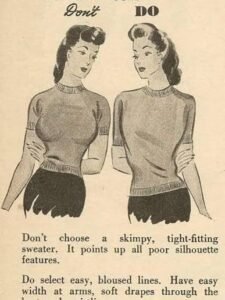
Imagine putting on a sweater, looking in the mirror, and heading out for the day.
You’re dressed. Your shoulders are covered. Your stomach is covered. Depending on the sweater, even your neck is covered.
But somebody has a problem. Your sweater fits your natural body.
That’s it. That’s the offense.
And if you think I’m exaggerating, allow me to introduce you to the American controversy surrounding the sweater girls of the 1930s, 1940s, and 1950s.
I find this little piece of women’s history fascinating because it reminds us how long women have been expected to manage other people’s reactions to our bodies.
Sometimes the rules change. Sometimes the fashions change. But the expectation that women should rearrange themselves to satisfy somebody else has a very long history.
When a Sweater Became Scandalous
The term sweater girl became famous in the late 1930s, particularly after a young Lana Turner appeared in the 1937 film “They Won’t Forget” wearing a fitted sweater.
Hollywood noticed. Audiences noticed. Soon, the phrase became associated with women whose sweaters emphasized their busts.
And naturally, people had opinions.
Some admired the fashion. Some considered it glamorous. Others worried that these young women were dressing provocatively.
But look at the photographs.
Many of these women were wearing clothing that would be considered modest by today’s standards. Sweaters, skirts, covered shoulders, high necklines.
The Rules Were Never Just About Clothing
One of the revealing things about the sweater girl controversy is how quickly a woman or girl’s fashion choice could become a moral judgment.
A woman wasn’t simply wearing a sweater somebody disliked.
People could interpret her appearance as evidence of her respectability, her intentions, or the kind of wife and mother she might become.
In 1949, Pittsburgh police superintendent Harvey J. Scott publicly criticized teenage sweater girls, connecting their clothing to concerns about their futures as wives and mothers. A teenage girl’s sweater could become an adult man’s opportunity to pronounce judgment on her future character.
This is what happens when adults turn ordinary features of girls’ developing bodies into public concerns.
The girl begins carrying responsibility for other people’s interpretations.
And sometimes, no matter what she wears, somebody will find something wrong.
Remember Those Books We Read Growing Up?
For those of us who grew up in the Gen X years, there is another part of this history that may sound familiar.
Remember the books about girls growing up?
The stories about puberty, changing friendships, first bras, boys suddenly paying attention, and girls trying to understand bodies that seemed to be changing faster than their lives could keep up?
And one thing that comes through in so many stories about adolescence is how quickly a girl’s naturally changing body can become everybody else’s business.
A girl develops breasts, and suddenly people have opinions about her clothing.
She gets her period, and there are new expectations about maturity and behavior.
She develops earlier than her friends, and people may treat her as though she is older than she actually is.
She develops later, and somebody may make her feel inadequate.
She is still a child, but the world begins reacting to her differently.
And that can be terribly confusing.
Because growing breasts is not a decision to become sexually available. Developing a woman’s figure is not an announcement that a girl is ready for adult attention.
Puberty is something that happens to a girl. It is not something she does to other people.
Girls Can Be Targeted From Several Directions at Once
One of the hardest parts of growing up female is that the criticism can come from almost anywhere.
Boys may comment on a girl’s body.
Adult men may begin looking at her differently.
Other girls may compare themselves to her or tease her.
Women may warn her about dressing in ways that attract attention.
Schools may impose clothing rules that make girls responsible for whether boys are distracted.
And sometimes even family members begin treating a developing girl as though her changing body has created a problem that everyone else must manage.
Imagine trying to navigate all of that while still learning who you are.
You may not even like the attention you’re receiving.
You may be frightened by it.
But instead of adults asking how to protect your dignity, they may begin instructing you on how to make other people more comfortable.
Wear this.
Don’t wear that.
Cover yourself.
Don’t draw attention.
Don’t embarrass anyone.
Don’t make people think you’re that kind of girl.
And what happens when a girl follows every instruction and still receives unwanted attention?
Too often, she is given another instruction.
That is why the sweater girl history deserves more than a passing mention in a discussion about vintage fashion.
It reminds us that girls can be held responsible for reactions they never invited.
Women Have Been Policed for Generations
The sweater girls were not the beginning of society’s attempts to regulate women’s appearance.
Women have faced restrictions involving hair, trousers, skirt lengths, cosmetics, undergarments, and even whether they could wear comfortable clothing while working.
Some restrictions were enforced through laws or institutional rules. Others operated through family pressure, religious expectations, workplace customs, and public humiliation.
And the expectations have not always been consistent.
Women have been criticized for appearing too feminine and not feminine enough.
For being too attractive and for failing to make themselves attractive.
For showing too much skin and for wearing clothing that covers their bodies but still reveals their natural shape.
That contradiction should tell us something.
Sometimes the objection is not really about the amount of fabric.
Sometimes it is about who gets to decide.
Who gets to determine whether a woman’s appearance is acceptable?
Who gets to question her character?
Who gets to decide that her comfort, preferences, or judgment are less important than somebody else’s reaction?
And why are girls so often expected to learn these lessons before they have even reached adulthood?
Sometimes You Have to Stop Trying to Please People
I keep returning to those old photographs of sweater girls.
Women in ordinary sweaters. Some smiling. Some posing for Hollywood publicity. Others simply participating in a fashion that became popular during their lifetimes.
And I think about how much meaning other people attached to what they were wearing.
How many women have spent their lives trying to escape somebody else’s interpretation of them?
How many girls have been made to feel ashamed of bodies that were developing exactly as bodies naturally do?
How many women have learned, much later in life, that the person they were trying so hard to satisfy was never going to be satisfied?
There is wisdom in recognizing when a request is reasonable.
There is also wisdom in recognizing when a demand has become an attempt to govern your life.
You can be considerate without becoming obedient.
You can dress appropriately without accepting shame.
You can listen to advice without surrendering your judgment.
And you can disappoint someone without having done anything wrong.
That last lesson may be one of the most important.
Because there will always be people who dislike something about the way a woman lives.
Her clothes. Her hair. Her voice. Her confidence. Her boundaries. Her decisions.
We cannot build women’s freedom around the hope that everyone will eventually approve.
Some people will never be satisfied because satisfaction was never the point.
And women and girls cannot spend their entire lives trying to make themselves acceptable to people who believe they should have the final say.
The sweater girls remind us that even a fully clothed woman could become the subject of public disapproval.
I hope the girls growing up today inherit something better than another set of impossible rules.
I hope they learn that consideration should travel in both directions, that their bodies belong to them, and that their comfort deserves attention too.
And I hope they understand something generations of women have had to learn, sometimes the hard way:
You do not have to spend your life making yourself smaller for people who are determined to find something wrong with you.
Sometimes the most reasonable thing a woman can do is put on her sweater and get on with her day.
A question to carry with you
Have you ever changed something perfectly reasonable about yourself to satisfy another person, only to discover that they simply found something else to criticize?
What did that experience teach you about the difference between consideration and control?
Is it Kindness or Obedience: A Lesson in Coercion – WE Survive Abuse
This Time is Teaching Us to Learn to Say “Yes” to Girls – WE Survive Abuse
“Lead with Love” Includes Women and Girls Safety Too (short audio message) – WE Survive Abuse
