
Table of Contents
It took a long time for my mother to be comfortable with me wearing pants. I think it was 3rd grade. A lot of GenX, Boomer and more blessed years women have that story.
In January 1970, a group of Florida schoolgirls stood before adults and asked for something boys could already do: wear pants to school when the weather turned cold. Their little piece of history deserves to be remembered.
Imagine being a junior high school girl in 1970.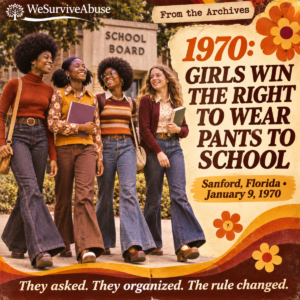
You’ve got your schoolbooks, your friends, your favorite music, and a whole life ahead of you. The world is changing. Women are challenging old expectations, and young people are questioning rules that earlier generations were told simply to accept.
But you’re still a child, and somebody else gets to decide what you can wear to school.
Now imagine it’s cold outside.
You want to wear long pants to keep warm. Nothing extraordinary. Nothing that interferes with your education. Just a practical piece of clothing.
Except your school has rules about that.
And if you’re a girl, you need permission.
Well, in Sanford, Florida, some girls decided to ask for it.
1. January 9, 1970: Girls make the newspaper
The Sanford Herald published a story with a headline that could almost make you laugh today:
“Under, Over? Girls Win Right To Pants.”
The article reported that a delegation of girls from Sanford Junior High School appeared before the Seminole County School Board.
Their leader was eighth-grader Debbie Dyess.
The girls wanted permission to wear long pants during cold weather, especially given the short dresses fashionable at the time.
That was their request.
They weren’t asking to change the curriculum, eliminate examinations, or rewrite the school’s entire dress code.
They wanted to dress warmly.
And the matter required a school board decision.
2. One woman on the school board understood immediately
School board member Jean Bryant listened to the girls.
She understood their concern and proposed allowing long pants for the remainder of winter and on forecast cold days throughout the county’s schools.
Bryant pointed out that some schools had already relaxed their rules.
She also spoke from personal experience as a woman.
Her point was wonderfully practical. Cold weather calls for clothing that provides adequate coverage.
Notice something here.
The girls didn’t need an elaborate philosophical argument about freedom or equality.
They had identified a problem in their daily lives and proposed a reasonable solution.
Bryant listened.
Sometimes respecting girls begins with believing that they know when they are uncomfortable.
3. But one school board member voted no
Board member Allan F. Keeth opposed Bryant’s motion.
According to the newspaper, his objection was that individual school principals should determine their own rules.
That distinction is important.
The article does not establish that Keeth believed girls should suffer in cold weather. His stated position concerned who should have the authority to make the decision.
But consider what that meant in practice.
If the school board refused to establish a countywide rule, a girl’s ability to wear pants could continue depending on which school she attended and what her principal permitted.
Two girls in the same county might face different restrictions simply because they attended different schools.
And once again, the question of what girls needed could become a question of what adults were willing to allow.
4. Then came the argument over what the girls should call their pants
Now, this part of the newspaper report is something else.
Keeth reportedly insisted that young Debbie Dyess stop referring to the garments as pants and call them slacks instead.
The newspaper reported that the exchange brought laughter.
Imagine that.
A girl had come before elected school officials to explain why she and her classmates needed warmer clothing.
And an adult was correcting her vocabulary.
It is a small detail, but it says something about the social expectations surrounding girls’ clothing at the time.
Even the words used to describe ordinary garments could become a matter of propriety.
Fortunately, the girls did not have to win a vocabulary contest to win their request.
5. The girls won
The school board approved the motion.
Keeth cast the only opposing vote.
Girls across Seminole County were permitted to wear long pants for the remainder of winter and on predicted cold days.
It was a limited victory, not a complete elimination of sex-based dress restrictions.
The decision still tied girls’ clothing choices to weather conditions.
But it was a victory nonetheless.
And it came because a group of junior high school girls recognized a problem, organized themselves, and took it to the people with the authority to change the rule.
They did not wait until adulthood to begin speaking for themselves.
6. Why were girls’ pants such a big deal?
For much of the twentieth century, American schools enforced different clothing expectations for boys and girls.
Skirts and dresses were associated with proper feminine appearance. Trousers were often treated as boys’ clothing, even as women increasingly wore pants in other parts of everyday life.
School dress codes reflected broader cultural expectations about how girls should look and behave.
Supporters of these restrictions sometimes appealed to tradition, discipline, modesty, and school authority.
But those explanations raise a reasonable question.
What educational purpose was served by making a girl wear a skirt when she was cold?
What did her ability to learn have to do with whether her legs were covered by a skirt or trousers?
And why did a clothing choice available to boys require girls to organize a delegation and seek permission?
The girls’ request exposed how an ordinary rule could become an unnecessary barrier.
7. This was happening elsewhere, too
The Sanford girls were not alone.
On January 8, 1970, an Oregon newspaper reported another extraordinary incident.
Girls had violated a school dress policy by wearing trousers in temperatures reaching 16 degrees below zero.
School officials sent them home.
After the girls challenged the decision, officials met with a student committee and agreed to permit certain trousers.
Think about that for a moment.
Girls were sent home from school for wearing clothing intended to protect them from extreme cold.
And the rule changed only after they resisted it.
These stories remind us that everyday discrimination did not always involve dramatic public confrontations.
Sometimes it involved a child standing outside in winter, wondering why adults considered a dress code more important than her comfort.
8. Girls were learning something about power
There is another lesson in the Sanford story.
The girls learned that school rules were not laws of nature.
Adults had created them.
Adults could change them.
And children could participate in making that happen.
That is a valuable lesson for any young person, especially girls growing up in a world where they are frequently encouraged to be agreeable, polite, and accommodating.
The girls were respectful enough to present their concerns through the school board process.
But they were also confident enough to question the existing rule.
Those two things are not opposites.
A girl can be respectful without surrendering her judgment.
9. The women and girls who changed ordinary life deserve recognition
We tend to remember women’s history through landmark court decisions, famous speeches, and major legislation.
Those achievements deserve their place.
But history was also changed by girls who wanted to take shop class, girls who wanted to play basketball, girls who wanted to study advanced mathematics, and girls who wanted to wear pants to school.
Their demands were sometimes treated as small matters.
Yet these rules shaped the daily lives of millions of girls.
And changing them helped expand what future generations could take for granted.
The Sanford girls may not have imagined that someone would be reading about their school board appearance more than fifty years later.
But here we are.
Remembering.
10. If it was such a small thing, why did the girls need permission?
This is the question I would leave with readers. Because that thing people do where they say that “it is no big deal” but they fight you over it like an MMA fighter? That is not new.
When people look back at historical restrictions on girls, they sometimes dismiss them as harmless customs from another time.
But harmless to whom?
The Sanford newspaper account does not show a school board unanimously defending the old restriction. Most members actually voted to relax it.
What it does show is that girls had to ask a governing body for permission to wear a basic article of clothing in cold weather.
And one member still opposed the countywide change.
That deserves examination.
Because when adults have the power to impose a rule, they also have a responsibility to explain why that rule is necessary.
The girls of Sanford asked a reasonable question.
They received an answer.
And because they spoke up, something changed.
The girls who came before us
Somewhere in the history of women’s rights are countless girls whose names we may never know.
They challenged school rules, questioned unfair treatment, and refused to accept that something was right simply because it had always been done that way.
We know the name of at least one girl in this story.
Debbie Dyess.
An eighth-grader who helped lead a delegation of girls before a Florida school board in January 1970.
I hope she and her classmates understood what they accomplished.
They were young, but their voices counted.
And the next time someone tells a girl that an unfair rule is too small to question, perhaps she should hear about those Florida schoolgirls who decided that being cold was reason enough to speak up.
Sometimes progress begins with a girl asking a perfectly reasonable question that adults have avoided answering for years.
From the historical archives
Primary source: The Sanford Herald, Friday, January 9, 1970, “Under, Over? Girls Win Right To Pants.” Preserved by the RICHES digital archive at the University of Central Florida.
Read the original 1970 newspaper
Additional source: Herald and News, Klamath Falls, Oregon, January 8, 1970, reporting on girls challenging school dress restrictions during subzero weather.
Oregon Newspapers
View the Oregon newspaper report
A question for readers: Did your school have different dress codes for girls and boys? Were girls allowed to wear pants, and do you remember when the rules changed?
Here is the original January 9, 1970, newspaper PDF from The Sanford Herald, preserved by the University of Central Florida’s RICHES digital archive.
Open the original 1970 newspaper PDF
Look for the article titled “Under, Over? Girls Win Right To Pants.”
