You told them you were scared. Somehow, the next thing out of your mouth was, “I’m sorry if I came across wrong.”
I want you to think about how much work you did in that little bit of time. You had to tell somebody what happened, figure out if they believed you, and then make them comfortable enough to keep listening. And you still needed help.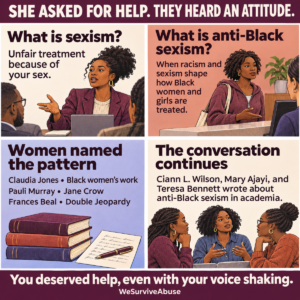
Sexism is unfair treatment because of your sex. A man gets to be firm, no matter his race, faith, partnership preferences, or personal identity. A woman says the same thing and gets pulled aside for a conversation about her tone.
Anti-Black sexism is what happens when racism and sexism shape how Black women and girls are treated. A Black woman walks in afraid, and the person behind the desk has already decided she’s angry. Now they’re watching her face instead of asking whether she has somewhere safe to sleep tonight.
Some women have been telling us where to look
In 1949, Claudia Jones asked people to pay attention to Black women workers. Look at who gets hired to clean the house. Look at what she’s paid. Then ask who’s looking after her family while she’s taking care of somebody else’s.
Pauli Murray gave us two words you could remember on the way home: Jane Crow. Murray knew what it was to sit in a law school classroom and have men laugh at an idea she came there to study and argue, same as they did. In 1965, she and Mary Eastwood put those words in the title of a law review article, Jane Crow and the Law.
Frances Beal took us to the hospital. In her 1969 essay Double Jeopardy: To Be Black and Female, she called attention to Black women who went in to give birth and were sterilized without their knowledge. Imagine how much trust it takes to put your body in somebody’s hands at that hour. Those women had every right to expect care and to make their own decisions about whether to have another child.
And in 2026, Ciann L. Wilson, Mary Ajayi, and Teresa Bennett put the words anti-Black sexism right in the title of their paper, “Angry, Mad, Sick and Tired” Black Women in the Academy. Two students and a faculty member talked together about what it costs to learn and work in Canadian universities, how it can wear on your health, and what keeps you doing work you care about. I appreciate that they made room for that last part. Black women have things we came to do. We deserve the time and the health to do them.
Your safety belongs in the conversation
Maybe you learned early to read a room before you said a word. Maybe there were times when choosing your words carefully helped you get through the day. You knew the room you were in. Give yourself some credit for that.
And when somebody makes your tone the subject, you can bring the conversation back to what you came for, if it feels safe to do so. “I’m telling you I’m afraid to go home. What help is available to me tonight?”
If you’ve already had that conversation and you’re still replaying it, wondering whether a softer voice would have changed things, give yourself a little rest. You asked for help. You deserved an answer while your hands were still shaking.
How Did Women and Girls Get Pushed Out of Our Own Conversations (audio) – WE Survive Abuse
The Black Women Who Built What They Were Denied – WE Survive Abuse
Domestic Violence in the Black Community By the Numbers – Black Health Matters