Some women are granted complexity after tragedy. Others are handed a number, a sentence, and a locked doorSomething haunting about the story of De
Some women are granted complexity after tragedy. Others are handed a number, a sentence, and a locked door
Something haunting about the story of Deasia Watkins has very little to do with what happened at the end.
It is everything that happened before.
Deasia was a young Black mother in Cincinnati when she gave birth to her daughter, Jayniah. Within weeks, something was terribly wrong. This was not a woman quietly struggling while everyone around her remained unaware. Police had been called. She had been hospitalized. She had been placed on a psychiatric hold. She was reportedly speaking about demons. Doctors diagnosed her with postpartum psychosis and prescribed an antipsychotic medication. Eventually, authorities determined that she should not be alone with her baby.
Read that again, not looking for a villain, but looking for the places where a tragedy might have been interrupted.
People knew. Doctors knew. The courts knew. Child welfare knew.
They knew enough to remove Jayniah from her mother’s care and place the baby with a relative. They knew enough to require supervision if Deasia was around her daughter. Doctors had determined that she was unsafe around her child unless she was taking her medication. Yet somehow this desperately ill young woman ended up living in the same home as the baby she had been ordered not to be around unsupervised.
Then came March 16, 2015, and something unspeakable happened. Three-month-old Jayniah was killed.
There should be no language soft enough to make a baby’s death disappear. Jayniah deserves to remain fully present in this story. She was not an unfortunate detail in an adult conversation about mental illness. She was a Black baby girl who deserved to grow up.
But loving Jayniah does not require us to stop seeing Deasia.
That is precisely where our humanity is tested.
Compassion does not require us to pretend nothing terrible happened. It asks us to remain human while looking directly at what did.
After the killing, Deasia was initially found incompetent to stand trial and received psychiatric treatment. Her attorney said that severe mental illness left her unable to understand the charges or assist in her own defense. Eventually she was restored to competency. She had originally pleaded not guilty by reason of insanity, but in 2017 she pleaded guilty to murder and was sentenced to 15 years to life in prison.
Now place her story beside the national conversation surrounding Lindsay Clancy.
Clancy is accused of killing her three children in Massachusetts in 2023. Her defense argues that she was suffering from postpartum psychosis; prosecutors strongly dispute that account and argue that she understood what she was doing. Whatever side someone takes in that courtroom dispute, something outside the courtroom is impossible to miss.
People have been trying to understand her.
Women have traveled to the courthouse. Her attorney says she has received letters of support from around the world, enough to fill boxes. Her former husband has publicly described her as ill rather than evil and spoken of forgiveness. Her case has become a national conversation about postpartum mental health, psychiatric treatment and whether a mother can commit an incomprehensible act while profoundly mentally ill.
And I keep coming back to Deasia.
Where was this country for her?
Not merely a defense attorney. Not merely a diagnosis written into a court record. Where were the crowds of women saying, I can see myself in how quickly a mind can become unrecognizable after childbirth? Where were the boxes of letters? Where was the sustained national examination of the medical system that encountered her before Jayniah died?
Deasia’s illness was not discovered after clever lawyers began preparing a defense. She had already been diagnosed with postpartum psychosis. Her deterioration had already become serious enough for hospitalization. Authorities had already decided her baby required protection.
If we cannot find room for both truths, something has gone badly wrong with us.
Jayniah needed protection. Deasia needed treatment.
Neither received enough of what she needed to prevent the ending.
That does not mean Deasia had no responsibility, and it does not tell us what verdict should be reached in somebody else’s case. It means punishment after catastrophe cannot be the only form of seriousness our society recognizes.
A child can deserve protection and her mother can desperately need help. We lose something precious when we convince ourselves that only one of those truths can live at a time.
If we can afford decades of incarceration after catastrophe, we can afford psychiatric care before it.
Carol Coronado, a Latina mother, was sentenced to three consecutive life-without-parole terms after killing her three daughters. Sonia Hermosillo, also Latina, was convicted after killing her infant son despite defense experts concluding that she had postpartum psychosis and was legally insane. Otty Sanchez, a Latina mother whose severe mental illness was recognized by the legal system, was found not guilty by reason of insanity and committed to a secure psychiatric hospital rather than prison.
Different women. Different facts. Different legal outcomes.
But look at what Lindsay Clancy’s case has demonstrated about compassion itself. It is possible for people to hold horror and empathy in the same hands. It is possible to mourn children without pretending that severe mental illness is imaginary. It is possible to ask what a woman did while also asking what happened to her.
All women deserve that complexity.
If we can afford decades of incarceration after catastrophe, we can afford psychiatric care before it.
And there is evidence of a larger problem. Research examining postpartum mental-health care has repeatedly found racial and ethnic disparities. One study of low-income women found that 9 percent of white women initiated postpartum mental-health care compared with 4 percent of Black women and 5 percent of Latinas. Even after beginning treatment, Black women and Latinas were less likely to receive follow-up care. More recent research across several American jurisdictions found Black, Hispanic and several other groups of women with postpartum depressive symptoms significantly less likely than white women to receive mental-health care.
That should trouble us long before anybody enters a courtroom.
Because we have developed a strange relationship with mental health in America. We talk about it beautifully after something terrible happens. We put ribbons on awareness. We tell people to reach out. We encourage women to ask for help.
But help has to be somewhere when she reaches.
It has to be affordable. It has to accept her insurance. It has to be nearby. It has to have an appointment before three months from Tuesday. It has to offer more than one treatment option when the first one fails. It has to take a frightened woman seriously without making her afraid that honesty will automatically cost her everything. It has to recognize that sometimes a person who looks functional is deteriorating, and sometimes the woman everybody thinks is “strong” is desperately sick.
Awareness without access is a promise with the door locked.
Black women in particular have reported barriers involving cost, time, mistrust and difficulty comfortably disclosing mental-health concerns to providers. Researchers studying Black women during pregnancy and postpartum have called for integrated care, trauma-informed treatment and approaches that actually reduce those barriers rather than merely telling women to overcome them.
And there is another uncomfortable contrast we should be willing to face.
We know how often women and families tell us that a man is frightening them long before the worst thing happens. There may be threats, stalking, escalating violence, coercive control, strangulation, weapons, terrifying messages, repeated police calls or a woman saying plainly, I think he is going to kill me.
Too often, everyone waits.
Wait until he violates the order. Wait until there is enough evidence. Wait until something more serious happens. Wait until the danger becomes undeniable.
Then, after the funeral, everybody suddenly understands urgency.
That same backwards logic haunts Deasia’s story in another form. We can spend enormous public resources investigating a death, prosecuting a defendant and imprisoning someone for decades while remaining unwilling to build mental-health systems strong enough, affordable enough and persistent enough to intervene when a human being is visibly falling apart.
That is not compassion competing with accountability.
That is prevention demanding a seat at the table.
Perhaps Lindsay Clancy’s case can leave us something larger than another argument about one woman. Perhaps all this public empathy can be stretched wide enough to reach backward toward women whose names never inspired boxes of letters and forward toward women we have not met yet.
Somewhere tonight, there is a mother who knows that something inside her mind does not feel right. She may be frightened by her own thoughts. She may be ashamed to tell anyone. She may have little money, no psychiatrist, unreliable transportation, inadequate insurance, or a family that does not understand what is happening.
We do not need her to become a headline before we decide she deserves serious help.
And somewhere there is a child whose safest future may depend upon us helping her mother before the illness becomes an emergency.
That is where compassion becomes more than a feeling.
It becomes something we fund.
Something we make available.
Something we refuse to ration according to race, income, geography or how sympathetic a woman appears to strangers.
Jayniah Watkins should have grown up. Jayniah deserved more than our grief. She deserved adults and institutions capable of intervening before there was anything to grieve.
And Deasia Watkins should have received every possible intervention capable of giving her daughter that chance.
We cannot change their ending. But we can refuse to learn the smallest possible lesson from it.
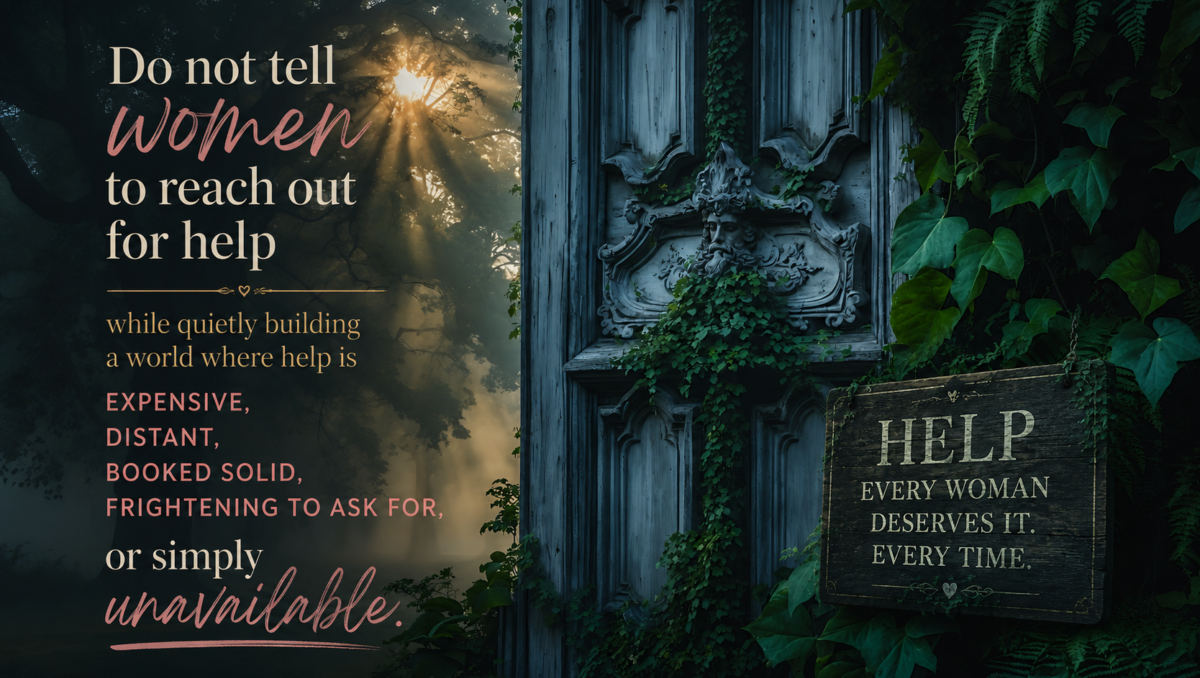
Do not tell women to reach out for help while quietly building a world where help is expensive, distant, booked solid, frightening to ask for, or simply unavailable.