Agreed, being a woman is not a social category.
Years ago, I sat in a meeting with a statewide sexual violence coalition—a small room full of people whose entire careers were dedicated to serving the unheard. During our discussion, I brought up a theory I had heard somewhere: that everyone is on the spectrum of being disabled.
At the time, I wasn’t coming from a place of ignorance. I had already worked directly with people with disabilities in my profession. To me, that theory sounded like a viable bridge. I wanted to make the issue relatable, reduce stigma, and bring everyone in the room together around a shared human experience. Some of the room seemed intrigued by the idea.
Except for one woman. She was the person hired specifically to address disability issues within our coalition.
She didn’t argue with me. She didn’t lay out a list of counterpoints. She just looked around the table, visibly upset, and shook her head back and forth.
At the time, I didn’t fully understand why an idea meant to build unity made her so angry. We were both trying to solve a problem. We were both trying to help. My heart was in the right place, and my intentions were good.
It took time and lived experience for me to finally catch up to what she already knew in her bones.
The Trap of Stretching a Reality Until Everyone Fits
In advocacy, business, and everyday conversation, we often reach for “universal” framing to make hard realities easier for others to swallow. We say things like:
-
“Everyone is a little bit disabled.”
-
“Everyone gets depressed; we all get sad.”
On the surface, stretching a definition until everyone fits inside it feels compassionate and inclusive. In practice, it can cause real harm—especially to the people who need protection the most. People have their own voices….. that aren’t being heard.
1. It flattens real, material barriers. Needing reading glasses or having a sore back after moving boxes is not the same thing as navigating a world structurally built to lock out someone who uses a wheelchair, is Deaf, or lives with a severe chronic illness. Equating clinical depression with “having a rough week” doesn’t normalize mental illness; it trivializes a serious medical condition and leaves people who are genuinely drowning without real support. And a distinguishable voice.
2. It shifts attention and resources back to the most comfortable voices. When “everyone” qualifies for a category, the same people always end up prioritized. Those with the most social capital, the mildest needs, or the easiest accommodations absorb the funding, the airtime, and the sympathy. Meanwhile, people with complex, stigmatized, or less visible realities get pushed right back to the margins. Generally, people do have a tendency to listen to and respond to the same people that have traditionally been prioritized.
3. It forces marginalized people to shrink their reality to be “relatable.” Looking back at that coalition meeting, I realized why my colleague was so put off. Watching a room full of advocates nod along to a theory that erased the distinct reality of disability felt like watching the floor drop out from under her work. She wasn’t being mean, hateful, or difficult. She was exhausted from carrying the weight of the unheard in a room that wanted a comfortable bridge instead of the hard truth.
Categories exist for a reason. Whether we are talking about disability, sex-based reality, race, or clinical health, specific words name specific vulnerabilities and specific needs. When we dilute language until a word means everything, it stops protecting the people it was meant to name in the first place.
Questions to Ask Before We “Universalize” an Issue
We don’t always get it right—even when we are doing the work and our intentions are pure. Growth happens when we stop defending our good intentions and start listening to the people closest to the ground.
The next time you hear—or offer—a “we’re all in the same boat” framing, pause and ask:
-
Who disappears when we widen this definition? If a label applies to everyone, whose specific, daily barriers are no longer being named or addressed?
-
Who is being asked to shrink so others feel comfortable? Are we stretching our own understanding to meet marginalized people where they are, or asking them to water down their reality so it feels relatable to us?
-
Where do the resources go next? When a broad group claims the same label, who naturally gets moved to the front of the line—and who gets pushed to the back again?
-
How do we respond to pushback from the trenches? When the person closest to the issue shakes their head, do we get defensive about our good intentions, or do we get curious about what they see that we don’t?
-
Who is still unheard in the rooms we sit in? Even in spaces built to help others, whose reality is still treated as “too complicated” or “too niche” to center?
*Note: This is also why I defend people’s right to have their own exclusive healing groups based on race, region, language, and faith beliefs. People need healing spaces where they have an opportunity to be seen, heard, and validated by people with similar obstacles to healing.
For the Unheard and Those Carrying the Weight
-
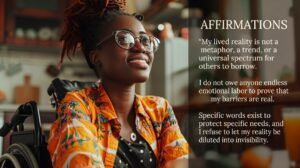
My lived reality is not a metaphor, a trend, or a universal spectrum for others to borrow.
-
I am allowed to feel exhausted when people in my own corner miss the point.
-
Protecting the truth of my experience is not being difficult—it is survival and clarity.
-
I do not owe anyone endless emotional labor to prove that my barriers are real.
-
Specific words exist to protect specific needs, and I refuse to let my reality be diluted into invisibility.
-
Even when the room wants a comfortable story, my truth still deserves to take up full space.
In a post on X on November 22, 2026, J.K. Rowling drew a sharp distinction between biological sex and what she described as a “social category”.
Her exact breakdown centered on two main points:
-
What women are: She stated, “Women are not a social category, but adult members of the sex class whose bodies are organised to produce large gametes.” She added that because women are “objectively, observably and verifiably female,” they do not need to “identify as” or “participate in” anything—such as conforming to stereotypical femininity or having children—in order to be women; “They simply are.”
Her core argument in that post—which she directed toward United Nations messaging around gender—was that membership in a “social category” is based on self-identification or declaration, whereas being a woman is an immutable, material reality that doesn’t require claiming a label or performing a social role.
10 Things I Applaud About J.K. Rowling’s Defense of Women’s Rights – WE Survive Abuse
What Does a Person’s Sex Have to Do with Safety? – WE Survive Abuse
Maleness Is Portable Power: 20 Reasons Women Are Still Asked to Move Over – WE Survive Abuse
The World Loves Powerful Men. Even When They’re Violent. – WE Survive Abuse
Women Have Been Violently Punished for Telling the Truth for Centuries – WE Survive Abuse
The Black Women Who Built What They Were Denied – WE Survive Abuse
Stop Calling It ‘Inclusion’ If You Aren’t Providing ‘Safety’ for ALL – WE Survive Abuse