Table of Contents
Frequency tells us how often harm happens. It does not tell us how much harm we should be willing to accept.
I have finally found the words for something I have openly despised for years: the strange math people do when women and girls raise safety concerns.
How many women does this really happen to?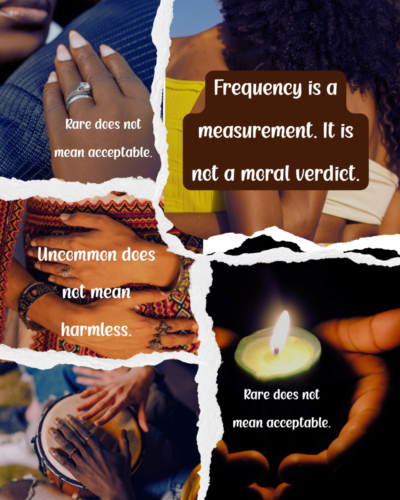
How often does that actually happen?
Isn’t that extremely rare?
Are there enough cases to justify doing something?
Sometimes those are legitimate research questions. We need to know prevalence. We need to know whether something is increasing or decreasing. We need good data to decide how many shelters, advocates, investigators, specialists, hospital beds, transportation programs, or prevention dollars are needed.
But there is another way those questions get used.
Sometimes “How often does this happen?” is being used to avoid answering “Why are we allowing this to happen?”
Those are not the same question. Rare is a description of frequency. It is not a synonym for acceptable. You really have to be careful about language nowadays. Actually, you always have.
I do not have to prove that thousands of women and/or girls share my experience before I take my safety seriously.
Frequency tells us how often something occurs.
Frequency does not tell us whether something is acceptable.
We understand it perfectly well when we want to.
- A rare airplane failure can still require an urgent safety response. They will land all the planes. No one is going anywhere.
- A small number of contaminated products can trigger a recall.
- One dangerous defect discovered in a building can lead to an inspection before anybody dies. Entire building condemned. Bright red sticker. Nobody going in.
Normally, we don’t insist upon a large pile of casualties before acknowledging that a foreseeable danger deserves attention.
But, then again, that’s when males are involved.
Yet women and girls are repeatedly introduced to another kind of mathematics.
Not enough of you.
Not enough women live there.
Not enough women have reported this.
Not enough girls are affected.
Not enough families experience this particular pattern.
Not enough disabled women need that service.
Not enough women in this rural community will use the program.
Not enough cases end in catastrophe.
Not enough. Never enough.
And somehow not enough becomes permission to leave women and girls exposed and unprotected. Indefinitely.
A girl should never need a statistically significant number of other girls standing beside her before adults decide her safety matters
The Fire Does Not Have to Consume the House Before We Call It a Fire
Think about a fire starting in a house.
At first, there is smoke.
Someone says, “It’s only smoke.”
Then there is a small flame.
“It’s contained to one room.”
The flames spread.
“Most of the house is still fine.”
The hallway catches.
“Well, statistically, the majority of the structure hasn’t burned.”
Eventually the house is engulfed.
Now everyone agrees there was a serious fire.
But what exactly were we waiting for?
That is what troubles me about the way we sometimes approach women’s safety. We can become so preoccupied with counting catastrophic outcomes that we fail to respond to the conditions producing them.
This becomes especially painful when we talk about violence inside families.
A family annihilation is, thankfully, not an everyday event. But rarity does not make the possibility meaningless when serious warning signs are accumulating inside a particular household.
The important question is not simply, “How many families end this way?”
We also need to ask:
“What is happening in this family?”
Those are two completely different kinds of risk assessment.
A relatively uncommon outcome can still become an increasingly serious possibility when danger is escalating in one particular situation.
That is why prevention cannot operate entirely through population averages.
The woman standing in front of you is not an average.
Neither are her children.
The first smoke deserves attention. The first warning deserves investigation. The first woman deserves to be heard
Some Women Live Inside the Small Numbers
There is another cruelty buried inside the phrase not that many. Somebody is always living inside that number. Women in rural communities know this particularly well.
A community may not have enough people to make a specialized domestic violence service appear financially attractive. The nearest shelter may be far away. Public transportation may be nonexistent. Confidentiality can be difficult in a place where everybody knows everybody. Specialized medical, legal, disability, or advocacy services may require traveling considerable distances.
From the outside, somebody can look at the numbers and see a small population.
A woman living there experiences something entirely different.
Distance.
Isolation.
Few options.
Long waits.
No ride.
No nearby specialist.
No safe place she can reach tonight.
The statistic describing how few women need the service can become the very reason the women who do need it cannot get one.
That is a terrible circle.
We cannot call it “prevention” if women must first accumulate enough suffering to make intervention worthwhile
Women and Girls With Disabilities Cannot Be Treated Like Statistical Footnotes
The same problem appears when services are designed around whoever is easiest and cheapest to serve.
A woman with a disability may need accessible transportation, communication assistance, a physically accessible shelter, specialized advocacy, additional planning, or a caregiver arrangement that does not place her back into dependence upon someone who is hurting her.
A girl with a disability may communicate distress differently. She may depend heavily upon adults. She may have fewer opportunities to disclose privately. She may need adults who understand her particular communication needs and vulnerabilities.
And here comes the math again.
How many people will actually use this accommodation?
How much will it cost?
Is this really common enough?
Those can be legitimate planning questions. They become dangerous when the answer determines whether someone’s basic safety deserves to exist at all.Accessibility sometimes costs more per person precisely because fewer people need a specialized service.
That does not make those people disposable.
Safety should not begin when the body count becomes statistically impressive.
High-Risk Populations Are Where This Logic Becomes Especially Backward
If a particular population of women is relatively small but faces unusually serious danger, simply counting the number of people affected can conceal what we most need to know.
Imagine two groups.
One contains 100,000 women, and 1 percent face a particular danger.
Another contains 1,000 women, and 40 percent face that danger.
The second group produces fewer total cases.
It also contains women facing dramatically greater individual risk.
If we only ask, “Which problem produces the biggest number?”, we can miss people standing in some of the most dangerous circumstances.
That is why good safety work asks more than one question.
How many people are affected?
How severe is the potential harm?
Who is particularly vulnerable?
What barriers make escape or prevention difficult?
Is the danger escalating?
What happens if we do nothing?
What reasonable intervention could reduce the risk?
Now we are actually assessing safety.
The woman inside the statistic experiences one hundred percent of what happened to her.
Prevention Means Acting BEFORE the Worst Thing Happens
This is perhaps the deepest problem I have with “not that many” thinking.
It can train institutions to wait.
Wait for more reports. Wait for more injuries. Wait for a larger sample. Wait for another woman.Wait for another girl.Wait until the pattern becomes undeniable. Wait until somebody produces research. Wait until funding becomes politically comfortable. Wait until the fire gets hotter.
Then, after catastrophe, everybody wants to know why nobody acted earlier.
But earlier is almost always the inconvenient part of prevention.
Earlier is when certainty is lower. Earlier is when the numbers are smaller. Earlier is when somebody has to take a warning seriously before everybody else agrees. Earlier is when a woman may be saying, Something is changing. I am afraid. Earlier is when a child may be behaving differently. Earlier is when controlling behavior may be escalating.
Earlier is when somebody may need transportation, confidential advice, somewhere safe to stay, legal information, financial help, disability accommodations, or simply a professional willing to listen carefully and assess what is happening.
Prevention lives in that uncomfortable space.
If our standard is “Come back when enough women have been seriously harmed,” we do not have a prevention system.
We have a body-count system.
The question is not only, ‘How often does the worst happen?’ The question is also, ‘What are we seeing before the worst happens?
Ask the Question They Keep Skipping
So from now on, when somebody answers a concern about women’s or girls’ safety by telling me how uncommon it is, I want to separate the questions.
You have told me something about frequency.
Now tell me about acceptability.
If this happens to only 100 women, why should those 100 women be left without protection?
If it happens to ten girls, why should those ten girls absorb the harm?
If one rural community cannot produce enough service users to make a program efficient, what are the women living there supposed to do?
If a relatively small population of disabled women requires specialized safety resources, what principle says their smaller numbers erase the obligation to make safety accessible?
If an extreme form of violence is uncommon, why would that prevent us from recognizing escalating danger in the households where warning signs are appearing?
Those questions expose what prevalence statistics cannot answer.
Frequency is a measurement. It is not a moral verdict.
Rare does not mean acceptable.
Uncommon does not mean harmless.
Small population does not mean small humanity.
And prevention should never require women and girls to accumulate enough suffering to become statistically interesting.
There is a point when constantly asking “But how many?” stops being caution and starts becoming an excuse for inaction.
Meanwhile, the fire is still burning.
Girls are still depending upon adults to notice smoke before the room fills with it.
Resources are still being rationed according to calculations that can make the people with the fewest alternatives easiest to abandon.
We should not need the whole house engulfed before deciding that the first woman who smelled smoke was worth listening to.
Sometimes the number really is small. That should change how we scale the response.
It should never decide whether the human beings inside that number are worth protecting at all.
Someone else’s calculation of probability does not require me to gamble with my well-being.