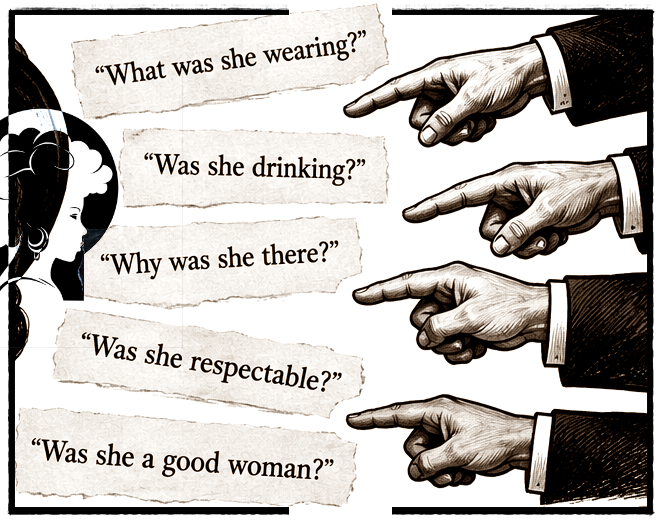
The crime was the perpetrator’s choice, not the victim’s failure to behave perfectly.There is something deeply troubling about the way we expect w
The crime was the perpetrator’s choice, not the victim’s failure to behave perfectly.
There is something deeply troubling about the way we expect women and girls to behave after sexual violence. Before some people are willing to consider what happened to her, they want to know what kind of woman she was. What she was wearing. Whether she had been drinking. Why she went to his home. Why she trusted him. Whether she had been sexually involved with him before.
And then come the questions about what she did afterward.
Did she scream? Did she fight? Did she tell somebody immediately? Did she go to the police? Did she cry enough? Did she cry too much? Why did she keep talking to him? Why did she wait so long to say anything?
A woman can spend years trying to recover from a sexual assault, only to discover that the people hearing her story are more interested in examining her decisions than the decisions of the person who assaulted her.
Somewhere along the way, we began treating a woman’s ability to establish her innocence as a condition of recognizing the harm done to her.
And that is a terrible burden to place on someone who has already been violated.
The Good Victim Is Someone Society Has Invented
The good victim is an imaginary woman.
She never drinks too much. She never misjudges anyone. She has no complicated relationships, no sexual history that makes people uncomfortable, and no personal behavior anyone can use against her.
When someone assaults her, she responds exactly as people imagine they would respond. She fights. She escapes. She reports immediately. She remembers every detail, and her account never changes.
Afterward, she is devastated in ways everyone recognizes. She is neither too angry nor too calm. She doesn’t make jokes, go dancing, return to work, or continue living in ways that confuse the people watching her.
She is respectable, agreeable, and appropriately broken.
A woman’s imperfections do not become someone else’s permission.
Yet our public conversations about sexual violence regularly suggest otherwise.
We Keep Putting the Woman on Trial Before We Examine the Crime
Consider how quickly a conversation about rape can become a conversation about a woman’s judgment.
- A woman says she was assaulted after accepting an invitation to someone’s home. Instead of beginning with whether she consented to the sexual activity, people begin debating whether she should have gone there.
- A young woman says she was assaulted after drinking at a party. Suddenly, the conversation becomes a lecture about alcohol, responsibility, and what young women ought to know.
- A wife reports that her husband raped her. Someone asks why she stayed married to him or why she continued sleeping beside him.
These questions may sound reasonable to people who have never considered what they are doing. Some may even believe they are helping women avoid danger.
But there is a difference between discussing safety and assigning responsibility for another person’s crime.
Safety advice asks how we might reduce danger. Victim-blaming asks why the woman failed to prevent someone else’s decision to harm her.
Those are not the same conversation.
And when we confuse them, the person who chose to violate another human being begins disappearing from the story.
The discussion moves from his actions to her judgment, from his responsibility to her precautions, until the assault itself becomes almost secondary.
Her clothing → Her drinking → Her decisions → Her credibility
Meanwhile, the central question waits patiently in the background: Did this person engage in sexual activity without her consent?
We should not have to search so hard to find the crime in a conversation about the crime.
We Expect Survivors to Behave as Though They Have Read a Script
One of the cruelest things we do is measure a Survivor’s response against what we imagine WE would have done. Or rather, what we think we would have done.
People confidently announce that they would have fought back. They would have called the police. They would never have spoken to the perpetrator again.
But imagining danger from the safety of an ordinary afternoon is not the same as experiencing it.
Fear can affect memory, attention, and behavior. During a traumatic event, a person may freeze, become compliant in an effort to survive, or focus on getting through the immediate danger. Others may resist physically or verbally. There is no single response that proves an assault occurred.
And afterward, the Survivor must still navigate the world in which the assault happened.
She may share a workplace, neighborhood, family, school, or social circle with the person who harmed her. She may depend on him financially. She may fear retaliation. She may still be trying to understand what happened.
Sometimes she may even communicate with him again.
That behavior can confuse people who expect a clean break between danger and safety. But human relationships, particularly relationships involving manipulation, dependence, or coercion, are rarely that simple.
A Survivor’s response to violence is not the standard by which we determine whether she deserved to be free from it.
She did not have to fight beautifully, flee immediately, or explain herself perfectly to possess the right to bodily autonomy.
That right existed before the assault. It did not disappear during it. And it does not depend on what she did afterward.
The Demand for a Perfect Victim Helps Keep Sexual Violence Hidden
I have spent decades working in spaces where women and girls are trying to survive violence, find safety, and make sense of what has happened to them. One of the lessons this work teaches is that people often imagine a much more supportive society than the one Survivors actually encounter.
We like to believe that when someone reports sexual violence, concerned people will gather around her. We picture compassionate families, responsible institutions, careful investigations, and communities eager to protect the vulnerable.
Sometimes those things happen, and they should.
But we also know about the families that pressure women into silence, the friends who defend perpetrators, the institutions concerned about reputation, and the people who turn a disclosure into an interrogation of the person asking for help.
Then, when another woman hesitates to report, we ask why she did not come forward sooner.
We ask as though she has never watched what happened to someone else.
Women and girls learn about the cost of disclosure by watching how other women and girls are treated.
They see whose private life becomes public entertainment. They see who loses friends, employment, housing, community support, or peace of mind. They see people expressing more outrage about an accusation than about the possibility of sexual violence.
And they learn that telling the truth about an assault may require defending every unrelated decision they have ever made.
This is one of the ways rape culture protects itself.
It does not always require people to openly defend rape. Sometimes it survives by creating so much uncertainty about what counts as sexual violence, and so many conditions for recognizing a victim, that the person reporting the harm becomes exhausted before the conversation reaches the perpetrator’s conduct.
Believing Survivors Does Not Mean Abandoning Fairness
We should be able to have a mature conversation about this without pretending that compassion and fairness are enemies.
Taking a rape allegation seriously does not require abandoning evidence, careful investigation, or the rights of an accused person.
An allegation should be examined responsibly. Facts should be established as carefully as possible. Contradictions that bear on the allegation may need to be explored. Criminal guilt must be proven to the required legal standard.
But none of that requires humiliating a woman, treating her sexual history as evidence of consent, or assuming that an imperfect response makes her dishonest.
There is a difference between investigating what happened and searching for reasons to disqualify the person who reported it.
| A fair investigation asks | A good-victim test asks |
|---|---|
| What happened, and what evidence is available? | Why did she put herself in that situation? |
| Was there consent to the sexual activity? | Had she been sexually active before? |
| What can witnesses and other evidence establish? | Why didn’t she behave the way I would have? |
| What can be determined responsibly? | Is she the kind of woman I find believable? |
The first approach seeks facts. The second allows prejudice, stereotypes, and personal expectations to influence credibility.
And the consequences can be devastating. A Survivor should not have to surrender her dignity to participate in an investigation. Nor should an institution mistake cruelty for thoroughness.
We can respect due process without making humiliation part of the process.
A Woman Can Make a Mistake Without Becoming Responsible for a Crime Against Her
There is something we need to become more comfortable saying. A woman may have made a poor decision before she was assaulted.
She may have trusted someone she should not have trusted. She may have ignored a warning, underestimated a risk, or entered a situation she later regretted.
We do not need to rewrite her life to make her deserving of compassion.
People make mistakes every day. We make mistakes about money, friendship, employment, family, travel, and the people we allow into our lives.
Those mistakes do not authorize other people to commit crimes against us.
If someone leaves a door unlocked and a thief enters, we may discuss better security. But the unlocked door did not transfer ownership of the property to the thief.
And a woman’s body deserves far more consideration than property.
The decision to drink is not consent to rape. Accepting a date is not consent to rape. Entering someone’s home is not consent to rape. Previous sexual activity is not permanent consent.
Even agreeing to one sexual act does not mean agreeing to every other act someone may want. We should not have to make a woman appear incapable of error before we can recognize another person’s capacity for wrongdoing.
A mistake can belong to the woman. The assault still belongs to the person who committed it.
Both things can be true without confusion.
We Must Stop Teaching Girls That Protection Must Be Earned
Girls pay attention to how adults speak about women who report sexual assault.
They hear the questions about clothing, drinking, dating, and reputation. They notice when a popular boy’s future receives more sympathy than the girl who says he harmed her. They notice when adults become uncomfortable with a girl’s anger but remarkably patient with explanations for a boy’s behavior.
They are learning something about the world they are growing into.
A girl should be taught how to recognize danger, trust her judgment, seek help, and establish boundaries. Practical safety education is valuable, particularly when it gives children tools they can actually use.
But safety education becomes something else when we teach girls that failure to follow every precaution makes them responsible for the violence of others.
We cannot promise girls that good behavior will protect them from every person who chooses to do harm.
We can promise to take their safety seriously, listen carefully when they report harm, and refuse to make their humanity conditional on perfection.
And we can teach boys, clearly and consistently, that another person’s vulnerability is never permission.
What Would Change If We Stopped Looking for the Perfect Victim?
We would begin with a much more reasonable understanding of human beings.
We would recognize that Survivors come from every kind of family and background. Some are confident. Some are shy. Some have complicated histories. Some are respected in their communities, while others have spent their lives being misunderstood.
We would understand that a person’s credibility must be evaluated through relevant facts and evidence, not whether we approve of her personality, sexuality, appearance, or choices.
Families could offer support without demanding silence. Schools and workplaces could respond to disclosures without immediately protecting their own reputations. Investigators could ask necessary questions without treating shame as a tool.
And ordinary people could stop turning every report of sexual violence into an opportunity to explain how they would have avoided becoming a victim.
There is room for prevention. There is room for evidence. There is room for difficult questions.
There should also be room for a woman to be a human being.
A woman who was assaulted does not owe the public an inspirational story, a spotless past, or a flawless response to trauma.
She deserves to have what happened examined fairly, and she deserves to be treated with dignity throughout that process.
We Do Not Need Better Victims. We Need Better Responses to Sexual Violence.
Perhaps one of the most damaging things about the good-victim standard is how easily it allows us to imagine that sexual violence happens only when women fail to do something correctly.
It offers a comforting illusion of control. If we can identify the woman’s mistake, we can reassure OURSELVES that the same thing would never happen to us or someone we love.
But that comfort comes at someone else’s expense. It requires us to overlook the fact that sexual violence involves a person choosing to violate another person’s autonomy.
We can teach caution without teaching shame. We can encourage sound judgment without suggesting that judgment determines who deserves protection. We can investigate allegations thoroughly without turning Survivors into defendants in the court of public opinion.
And we can stop requiring women to prove they are good enough to have been wronged.
A rape Survivor should not have to prove she behaved perfectly to deserve to be taken seriously.
Her dignity did not begin when she reported the assault. Her right to bodily autonomy was never dependent on her reputation.
And the responsibility for rape belongs to the person who committed it.
Not to the woman who trusted him. Not to the woman who loved him. Not to the woman who froze, remained silent, or struggled to find the words afterward.
We do not need women to become perfect victims. We need a society capable of recognizing sexual violence without demanding perfection from the people who survive it.
Affirmations for Survivors
My dignity does not depend on a perfect past. I am a human being with the right to bodily autonomy, safety, and respect. Another person’s decision to violate me does not become my responsibility because I trusted them.
I do not have to perform my pain to make it real. I am allowed to laugh, rest, work, love, and experience joy while finding my way through what happened. My healing belongs to me.
I am allowed to be a complicated human being. I have made decisions, learned lessons, and lived through experiences that other people may not understand. None of those things cancels my right to be free from sexual violence.
I can tell my story without surrendering every private part of my life. I deserve to be treated with care, and I am allowed to seek support that respects my boundaries. My humanity is not something I must prove before receiving compassion.