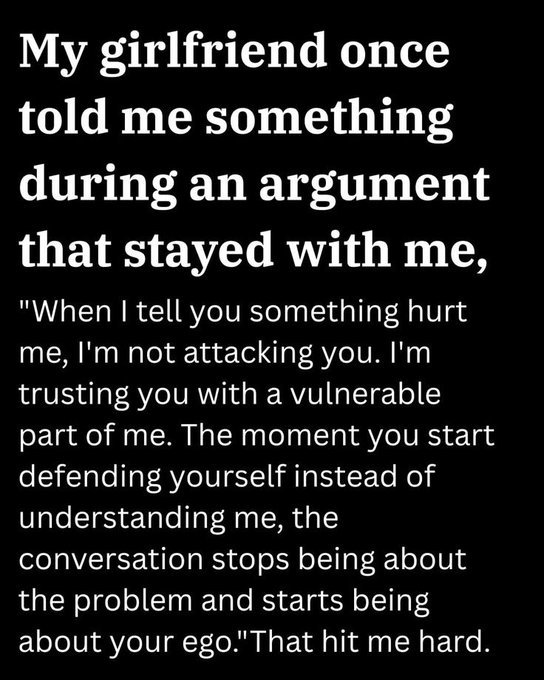
As an advocate, you find that women are often relieved to talk with someone about the "red flags" we might ignore because we aren't sure whether we're
 As an advocate, you find that women are often relieved to talk with someone about the “red flags” we might ignore because we aren’t sure whether we’re being too harsh or critical. Especially when people around you might be telling you that “this is why you don’t have a man.”
Some of the earliest warning signs are conversational. Nothing is quite large enough to point at, yet she keeps leaving conversations thinking, That is not what I said. Why am I defending myself now?
Here are some of the quieter tactics worth paying attention to:
Reductionist straw man.
She says, “I want some time alone tonight.” He responds, “So you don’t want to spend time with me anymore.” Her limited statement is inflated into a sweeping rejection.Turning a boundary into a character defect.
“I don’t want you reading my messages” becomes “Why are you so secretive?” The conversation moves from whether he should respect her privacy to whether something is wrong with her.Turning disagreement into cruelty.
“I don’t agree with you” becomes “You really don’t care how I feel.” Now agreement is being treated as proof of love.Making his interpretation more authoritative than her meaning.
She says, “That’s not what I meant.” He answers, “Yes, it is. You just don’t want to admit it.” Pay attention when someone repeatedly claims greater authority over a woman’s thoughts, motives, memories, or intentions than she has herself.The impossible inference.
“You didn’t answer for an hour, so obviously you don’t care about me.” A fact may be real. The conclusion attached to it is manufactured.Injury-to-obligation conversion.
“It hurts me when you go out without me” quietly becomes “Therefore, you shouldn’t go.” His feelings are converted into obligations for her without the obligation ever being openly argued for.Boundary inversion.
She says, “Please don’t yell at me.” He responds, “You’re trying to control how I’m allowed to express myself.” Her attempt to establish protection becomes evidence that she is controlling.Punishing precision.
She corrects something he says about her: “No, I didn’t say that.” He calls her argumentative, difficult, technical, or obsessed with semantics. Over time, she learns that correcting the record costs more than allowing the distortion.Demanding immediate answers.
“Why can’t you answer me right now?” “It’s a simple question.” “Why do you need time to think?” Urgency can prevent someone from examining what she actually wants.Treating hesitation as consent waiting to happen.
She says, “I’m not comfortable with that.” He hears, “Convince me.” Her uncertainty becomes the beginning of negotiations rather than information deserving respect.
These are things that men and women may overlook, especially if we really like the person. Those early feelings of attraction are powerful and magnetic.
Women’s group facilitator: Well, we may be talking openly about things like ovaries, vaginas, female reproductive health issues etc… We just want to make sure that by staying with us today you understand that. It is important for women to have spaces to speak openly about issues unique to women.
Someone: So women are only ovaries, vaginas, and female reproductive health issues. Don’t you feel like that is reducing women to a set of body parts?
This isn’t all that uncommon. Someone turns recognition into reduction. Someone mentions something distinctive about women, and the person who doesn’t like it for whatever reason falsely treats the mere recognition of that distinction as though the speaker has reduced women to it. The statement wasn’t wrong, but sometimes things get sticky, and it has nothing to do with you.
And these things aren’t isolated to one-on-one situations. Y’all know that.
I once gave a training at a church for a group of moms. A woman came in late, and you know how that is. You always feel behind. You could feel that she still felt uneasy. This particular woman was challenging quite a few things I was saying about sexual violence. Not a problem. People do that. This stuff is heavy and deep. But a little ways into the training, she chose to disclose that she was a Survivor. She wasn’t aware that I would be there discussing that topic, and it hit her. It was painful for her.
I felt …bad. I always make grounding announcements in the beginning, but she missed that.
We kind of had to regroup a bit and slow down. The dynamics changed. We just had to come together. She could leave and we would all keep supporting her. I offered her that, but she wanted to stay. So with that in mind, we kept going so that everyone still felt “together.” But, I did slow my pace a bit and remembered to check in with her.
*To be clear there wasn’t any manipulation here. I simply used this example to show that sometimes we don’t really understand where people are coming from or why.
A woman’s group educator says, “…and that’s how you know that women are the only ones capable of giving birth. Because if men could, this whole process would be better.”
Someone: “So you’re saying women are nothing more than baby-makers.”
Meanwhile, Ms. Group Leader did not say that every woman gives birth, must give birth, wants to give birth, or that giving birth defines the entirety of a woman’s worth. She simply spoke facts.
The assertion creates a peculiar dilemma, though. If you say pregnancy is specifically relevant to women, you’re accused of defining women by pregnancy. But if sex-specific realities cannot be named without supposedly “reducing” women to them, then it becomes difficult to talk precisely about maternal mortality, pregnancy discrimination, abortion, obstetric violence, female reproductive health, or reproductive exploitation. How often do women get time to come together in spaces designated just for their care? That’s pretty precious and necessary.
She could say: “Only women can X” is not the same proposition as “All women X,” and neither proposition means “Women are only valuable because they X.”
Or she might say what some of the women I know would say: “This is a group for women. Now whoever is staying, let’s get started so we can get out of here on time.”
So what is this called? This thing that happened in the women’s group examples?
I’ve seen it called a few things, but playing a reductionist straw man is one of my favorites.
Taking a statement about a characteristic, capacity, or material reality of a group/individual and falsely rewriting it as a statement that the characteristic constitutes the group’s ENTIRE identity or worth.
Women don’t need to conduct a trial every time something feels strange. You don’t have to feel that you have to “call it out.” Sometimes you can notice. You can remember. You can watch what happens next. Maybe something was going on that you didn’t know about and you’ll get that opportunity to address it, iron it out, and start fresh like I did that day.
Healthy people have misunderstandings. Healthy people can become defensive. Healthy people can say something foolish. The revealing information often comes after clarification.
A red flag is information, not a verdict. Decide for yourself. Based on what works for you. AND what will keep you safe.
One troubling exchange doesn’t require a woman to diagnose somebody, label him an abuser, or prove malicious intent. It gives her permission to notice. Does it happen again? What happens when she corrects him? Does he/she repair the misunderstanding, or work harder to make his/her own version of her reality prevail?
Keep your voice.
**Just FYI if you also facilitate groups, this is another reason to try to always use the ‘co-facilitation’ model that I was trained to use. Always two facilitators. I admit that I don’t always, and every time I don’t…. 😳
A co-facilitator could have been a big help with a busy mom shocked to learn that her normal mom’s group was having a guest speaker talk about sex abuse.
Identicide: The Violence of Erasing Who a People Are – WE Survive Abuse