A door can be legally open while everyone inside is still trying to make you leave.Something about the story of Levittown refuses to stay in 1957.
A door can be legally open while everyone inside is still trying to make you leave.
Something about the story of Levittown refuses to stay in 1957.
William and Daisy Myers were not trying to make history when they moved their family into Levittown, Pennsylvania. William was an engineer and a World War II veteran. They had children to raise and a life to live. They bought a house.
That ordinary act became extraordinary because they were Black.
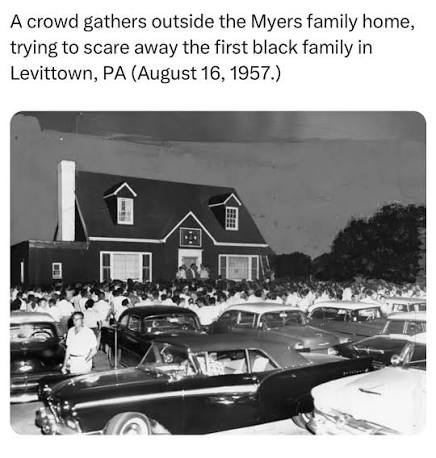
When the Myers family arrived, hundreds of white residents gathered in opposition. Rocks came through their picture window. Horns and loud music disturbed their home. A Confederate flag appeared. A cross was burned in the yard of a neighbor considered too friendly toward them. Pennsylvania eventually sent state troopers to protect the family, and the disorder ended only after a court injunction and indictments against several people accused of instigating a riot.
It would be comforting to leave this story there, framed safely in black and white photographs.
But history does not always disappear when the photographs turn color.
Sometimes it changes clothes.
The modern Levittown does not necessarily have a front lawn. It may have an office door.
Of course, a Black family enduring a racist mob outside its home and a Black professional encountering hostility at work are not identical experiences. We do history no favors by pretending they are. The Myers family and their children lived through sustained intimidation serious enough to require police protection.
Some people are comfortable supporting equality at a distance. The test comes when equality moves next door, takes the desk beside them, enters the classroom, or sits at the leadership table.
Backlash to equality is still backlash to equality.
For generations, American institutions could openly decide who belonged. Housing developments could exclude Black families. Employers could keep Black workers out of desirable positions. Universities could restrict admission. Professional organizations could close their doors. Women could be told that certain jobs belonged to men.
Then the doors began opening. And that is where we should pay attention.
We often tell the history of equality as though opening the door ends the story. It does not. Sometimes the most revealing chapter begins when somebody walks through it.
A Black professional enters a workplace where few Black people have ever held positions of authority. Perhaps she has the education. Perhaps she has years of experience. Perhaps she has been doing excellent work for quite some time.
Still, something shifts around her.
People who never investigated how every white colleague got hired suddenly become deeply curious about how she got hired. Someone wonders whether she was a “diversity hire.” Her qualifications are examined with an intensity that was never applied to everyone else. A mistake that would make another employee human can become evidence that she never belonged there. A promotion can produce whispers about favoritism rather than congratulations for work well done.
Sometimes nobody says anything explicitly racist at all.
That is part of what makes the modern version difficult to explain.
When you have mistaken exclusive access for normal life, somebody else gaining access can feel like something has been stolen from you.
There may be no racial covenant to point toward. No crowd on the lawn. No Confederate flag hanging next door. Instead, there may be isolation, excessive scrutiny, withheld information, jokes that land a little too hard, invitations that mysteriously stop coming, mentoring offered freely to others but not to her, or an ever-moving definition of what she must accomplish before she is considered good enough.
And because each incident can be explained away individually, the person living through the pattern can begin questioning herself.
Maybe I misunderstood.
Maybe I’m being too sensitive.
Maybe everybody gets treated this way.
Survivors will recognize something important here. Human beings can endure a great deal while trying to determine whether what they are experiencing is “bad enough” to name. We are often taught to examine each incident separately when the pattern is telling us far more than any single incident could.
History teaches us to look at patterns.
In Levittown, the Myers family had not taken anyone’s house. Their presence did not prevent their white neighbors from having homes. Yet some residents experienced the arrival of one Black family as a threat serious enough to organize against them. One neighbor reportedly explained his opposition in financial terms, saying that when he looked at William Myers, he imagined the value of his own home falling.
There is something painfully revealing in that statement.
The Myers family could be perfectly decent people and still be considered a problem because equality had arrived somewhere valuable.
That idea did not die with segregated suburbs.
Today, something similar can happen when historically excluded people gain access to good jobs, prestigious schools, leadership positions, contracts, professional networks, investment, decision-making power and other places where opportunity accumulates.
This is where conversations about diversity, equity and inclusion often become too shallow.
We argue about an acronym.
History asks us to look underneath it.
Who had access before?
Who was missing?
How were people selected?
Whose networks opened doors?
Whose mistakes were forgiven?
Who received mentoring before anybody called mentoring unfair?
Who was presumed competent before proving anything at all?
And when an institution finally begins noticing that some people have been standing outside the gate, why does their entrance suddenly produce such intense anxiety about merit?
Yesterday they questioned whether you belonged in the neighborhood. Today they may question whether you belong in the office. The address changes. The gatekeeping can survive.
The Black employee is not your DEI policy. The disabled coworker is not your accommodations debate. The woman beside you is not your argument about changing times. They are people trying to live and work.
Those are fair questions. They are not accusations against every white worker, nor do they require us to pretend every diversity initiative is good simply because somebody attached the word “equity” to it.
Any policy can be poorly designed. Any institution can become performative. People can misuse good ideas. Genuine unfairness should be challenged no matter who benefits from it.
But there is another truth we cannot sacrifice in our desire to sound reasonable.
Bigotry does not become acceptable because somebody has a complaint about DEI.
Bullying does not become principled because somebody believes workplace diversity has gone too far.
Humiliating a coworker, assuming incompetence, spreading rumors, withholding opportunities, deliberately isolating someone or treating an entire group as suspicious newcomers is not a courageous stand for merit.
We can debate policies without making human beings pay for our politics.
That is precisely where the Myers family reaches across nearly seventy years and touches the present.
They were people before they were symbols.
Daisy Myers was a woman trying to make a home. William Myers was a veteran, engineer, husband and father trying to raise his family. Their children deserved to look through their own windows without seeing a crowd gathered to frighten their parents.
And Black people walking through today’s newly opened doors are people before they are demographic categories too.
They have mortgages.
Parents getting older.
Children who need braces.
Private grief.
Inside jokes.
Ambitions.
Bad mornings.
Brilliant ideas.
Bills sitting on the kitchen counter.
They came to work.
There is a special cruelty in turning an individual human being into the battlefield upon which society decides to fight its argument about equality.
If someone believes a hiring policy is unfair, challenge the policy. If a promotion system needs reform, reform it. If an organization has confused representation with competence, demand both.
But do not turn the Black woman sitting three desks away into your personal referendum on DEI.
She did not write the company’s policy.
And she should not have to spend eight hours a day proving that generations of Black people deserved an unlocked door.
Perhaps this is one of the quieter lessons Levittown leaves us.
Exclusion does not always end when the rule disappears.
Sometimes the rule disappears first, while the expectation of exclusion remains behind.
Then someone crosses the old boundary, and suddenly we discover how many people had mistaken that boundary for the natural order of things.
Equality can feel like loss when advantage has been mistaken for birthright.
That is why history is useful here. Not because 1957 and 2026 are the same. They aren’t.
History gives us something better than an easy comparison. It gives us a pattern to recognize.
Yesterday the disputed place might have been a house on a quiet suburban street.
Today it might be the executive floor, the university laboratory, the writers’ room, the construction site, the hospital, the technology company, the courtroom or the corner office.
The address changes.
The human question follows us:
When somebody who was once kept outside finally walks through the door, will we experience her presence as another person’s freedom, or as the loss of something we thought belonged to us?
Levittown already showed us what can happen when people choose the second answer.
We do not have to repeat it indoors.
The question is not only who was finally allowed through the door. History must also record what happened to them once they entered.
I am not trespassing simply because someone remembers when people like me were kept outside.