Table of Contents
It isn’t hard for leaders to protect girls, but they have to act. To whom much is given, much is expected. We gotta start expecting more from leaders when it comes to girls. Otherwise they might as well stand in the back and do nothing from there.
Girls deserve protection. Not hesitation. Not endless debate. Not another committee studying dangers we already understand. Protection. Period.
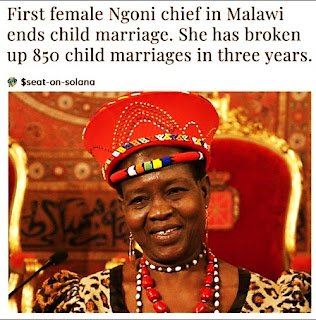
In Malawi, a traditional leader named Chief Theresa Kachindamoto became internationally known for confronting child marriage. She belonged to the Ngoni people and served as paramount chief in Dedza District.
She saw a practice that deprived girls of their childhoods, interrupted their education, and exposed them to serious harm.
And she decided that something had to change.
She did not accept the argument that because something had been happening for generations, it should continue happening to another generation of girls.
She acted.
Her leadership offers a powerful lesson for every community, government, school, religious institution, and organization that claims to care about children.
When we know girls face preventable harm, our responsibility is to prevent it. Not wait for more evidence in the form of more harmed girls.
1. She Refused to Treat Child Marriage as an Untouchable Tradition
Chief Kachindamoto understood that a practice does not become acceptable simply because people have tolerated it for generations.
Child marriage was familiar. It had cultural and social roots. Some families and community leaders supported it.
But familiarity did not make it safe. She challenged the practice directly. We must stop treating longstanding practices as though they deserve more protection than the girls who suffer under them.
A tradition that harms girls is a tradition adults have a responsibility to change.
2. She Used the Authority She Already Had
Chief Kachindamoto did not simply give speeches about the importance of girls.
She used her position as a traditional leader to confront child marriage within her jurisdiction.
She worked with subordinate chiefs to establish rules against the practice and demanded that local leaders uphold them.
How often do we hear powerful people express concern about the safety of girls while doing very little with the authority they possess?
They issue statements. They announce awareness campaigns. They promise further discussions.
Meanwhile, girls continue living with dangers that adults have already identified. Chief Kachindamoto demonstrated something different.
Leadership is not merely recognizing harm. Leadership means using your power to interrupt it.
3. She Held Other Leaders Accountable
Reports of her work describe how she removed four subordinate chiefs who continued permitting child marriages.
She did not place the entire burden of resisting child marriage on young girls. She expected adults with authority to change their behavior. (How refreshing.) And when leaders refused to uphold protections, she took action against those leaders.
Too often, institutions teach girls how to avoid danger while allowing the adults who create, permit, or excuse that danger to continue operating.
Girls receive the warnings.
Girls receive the restrictions.
Girls must change their routines, clothing, movements, and expectations.
But what happens to the adults who allow the danger to continue?
Chief Kachindamoto’s leadership reminds us that accountability must travel upward toward those with power, not downward onto children with the least power.
4. She Helped Girls Return to School
Ending a child marriage was not the end of the work.
Girls needed opportunities to rebuild their lives, continue learning, and imagine futures beyond early marriage and motherhood.
Chief Kachindamoto supported efforts to return girls to education. This is what meaningful protection looks like.
We cannot simply remove a girl from one harmful situation and leave her without resources, education, community support, or a safe future. Protection must open doors. A girl deserves more than survival.
She deserves childhood, education, friendship, rest, discovery, and the freedom to grow into the woman she chooses to become.
5. She Understood That Prevention Requires Action Before Another Girl Is Harmed
This may be the most important lesson of all.
We have developed a troubling habit of treating preventable harm as something we must continue observing until enough people suffer to justify intervention.
We wait for more complaints.
We wait for another investigation.
We wait for another devastating incident.
We wait for public outrage.
And then we announce that something “must be done.” But girls should not have to become casualties before adults decide a known danger deserves attention. By the time leaders get around to change, we are grown women facing the same crappy excuses.
We do not need to sacrifice another generation of girls to establish that girls deserve protection.
Where credible evidence identifies a serious danger, leaders should assess it promptly, take proportionate protective measures, and hold responsible adults accountable.
That is prevention. Not a promise to care after the damage. Promises that are broken by the way.
6. She Challenged Adults Instead of Asking Girls to Accommodate Harm
Consider how often adults tell girls to adjust themselves around dangerous conditions.
Be careful.
Be polite.
Do not upset anyone.
Understand the circumstances.
Respect the tradition.
Do not embarrass the family.
Do not cause trouble.
But what happens when the circumstances themselves are unacceptable?
What happens when the tradition places a child at risk?
What happens when keeping the peace means leaving a girl unprotected?
Chief Kachindamoto did not ask girls to become more accommodating toward a practice that threatened their futures.
Girls cannot be the group society continually asks to adjust while adults refuse to change the conditions creating the danger.
7. She Showed That Protecting Girls Is a Community Responsibility
Chief Kachindamoto did not work in isolation.
Her campaign involved traditional authorities, families, community structures, and efforts to support girls’ education.
That is important because protecting children requires more than one determined person.
Schools have responsibilities.
Families have responsibilities.
Religious leaders have responsibilities.
Lawmakers have responsibilities.
Police and child protection agencies have responsibilities.
And communities have responsibilities.
A child should never have to persuade an entire community that her safety deserves consideration.
Adults should already understand that responsibility.
When a girl reports danger, the question should not be how much discomfort protecting her might cause other people.
The question should be what responsible adults must do to keep her safe.
8. Her Work Produced Measurable Change
Chief Kachindamoto became known internationally as the “Terminator of Child Marriages.”
Reports credited her leadership with helping annul thousands of child marriages. By 2024, accounts of her campaign reported 2,449 annulments.
Those figures represent more than a public achievement.
Behind them were girls whose circumstances could change because adults finally confronted a harmful practice.
Her work did not eliminate child marriage throughout Malawi. Nor did one leader possess the power to solve every underlying problem, including poverty and unequal access to education. But she demonstrated that existing practices were not beyond challenge. She showed that leadership could move beyond expressions of sympathy and produce concrete intervention.
9. She Left a Lesson for Leaders Everywhere
Chief Theresa Kachindamoto died in August 2025, leaving a legacy that deserves to travel far beyond Malawi.
Her story challenges us to examine what our own institutions tolerate.
When a school knows girls face harassment, why should intervention require another incident?
When an organization identifies a serious safeguarding failure, why should children bear the risk while administrators delay corrective action?
When lawmakers have credible evidence that a practice endangers girls, why should political convenience take priority over reasonable protections?
And when community leaders know children face exploitation, why should preserving reputations matter more than stopping the exploitation?
These are not questions for Malawi alone. They belong to every society that claims to value children.
10. Girls Deserve Protection Without Having to Prove How Much Harm They Can Endure
We need to confront a dangerous idea.
The idea that protecting girls is somehow excessive until something terrible happens.
That adults must wait until danger becomes injury.
That reasonable safeguards are unnecessary until someone suffers.
That girls should learn to endure conditions adults have the authority to improve.
No.
A girl’s safety is not an experiment. Her childhood is not a testing ground. Her suffering is not the price society must pay before adults take prevention seriously.
We can investigate concerns fairly, respect due process, and still act promptly to protect children.
We can respect communities without excusing harmful practices.
We can listen to competing opinions without allowing endless disagreement to become an excuse for inaction.
And we can recognize that children’s protection is not a favor adults grant when circumstances become convenient. It is an obligation.
The Legacy of Chief Theresa Kachindamoto
I want us to remember this woman because she demonstrated a form of leadership that we desperately need more of.
She recognized that girls were being harmed by an established practice, and she used the authority available to her to confront it.
She did not make girls responsible for protecting the feelings of adults who supported that practice.
She did not treat generations of acceptance as proof that nothing could change.
She helped make change possible.
And here is where I want to leave this conversation:
Protect girls before the injury.
Protect girls before the scandal.
Protect girls before the funeral, the criminal trial, the documentary, and the public apology.
Do not wait until a girl becomes another terrible story that everyone claims should never have happened.
Girls are not asking adults for extraordinary privileges.
They deserve to grow up safe.
No dragging feet. No calculated hesitation. No waiting for another girl to pay the price.
When the danger is known, take action. Protect girl children. Period.
Sources and further reading
- United Nations Population Fund (UNFPA), Remembering Chief Kachindamoto and Her Fight for Girls’ Rights, a tribute to her leadership and legacy.
- UNICEF, research and resources on child marriage, its consequences, and prevention.
- UNFPA–UNICEF Global Programme to End Child Marriage, research on coordinated community action, education, and child protection.
Historical note: Reported annulment totals vary by publication date and the period covered. Chief Kachindamoto’s work should be understood as a sustained community campaign, not a claim that child marriage ended throughout Malawi.
People Don’t Just “Ignore Red Flags” — They’re Protecting Something – WE Survive Abuse