
Mobility restriction is a term widely used in human rights, disability studies, public health, criminology, and violence prevention because mobility is directly connected to safety, opportunity, and citizenship.
Think of mobility as the ability to move through the world independently and safely. Restrictions can be legal, social, economic, or physical.
Mobility restriction exists on a continuum.
Institutional mobility restrictions
Organizations can also limit movement by:
-
Requiring unnecessary permission.
-
Failing to remove harassers.
-
Punishing women who report abuse.
-
Designing unsafe housing or campuses.
-
A workplace ignores stalking complaints, leading an employee to resign.
-
A university fails to address repeated harassment, causing students to avoid parts of campus.
-
A hospital lacks private examination areas, discouraging some women from seeking care.
-
Court delays force victims to repeatedly encounter alleged offenders, causing some to stop participating in proceedings.
Legal mobility restrictions
A government may require a male guardian’s permission to:
-
Obtain a passport.
-
Travel abroad.
-
Move between regions.
-
Rent housing.
-
Drive (historically).
-
Leave prison or shelters.
-
Access certain jobs.
Physical mobility restrictions
Someone intentionally limits where a woman can go by:
-
Taking her car keys.
-
Confiscating her phone.
-
Locking doors.
-
Hiding identification.
-
Monitoring transportation.
-
Preventing her from learning to drive.
This is a classic form of coercive control in abusive relationships.
Economic mobility restrictions
Freedom of movement depends on resources. Someone may:
-
Control all the money.
-
Refuse bus fare.
-
Prevent employment.
-
Sabotage transportation.
-
Destroy a driver’s license.
-
A woman cannot afford reliable transportation to work.
-
An abusive partner takes the family car.
-
Night shifts become impossible because there is no safe way home.
-
Childcare costs prevent accepting promotions requiring travel.
A woman may technically be “free” but have no practical way to leave.
Social mobility restrictions
Instead of laws, communities create invisible boundaries through:
-
Constant chaperoning.
-
Requiring permission.
-
Reputation policing.
-
Threats of shame.
-
Honor expectations.
-
Family surveillance.
Many women learn there are simply places they are “not supposed” to go.
Safety-based mobility restrictions
Ironically, violence itself restricts mobility.
Women may stop:
-
Walking after dark.
-
Hiking alone.
-
Traveling for work.
-
Accepting promotions.
-
Going to college.
-
Taking public transportation.
The law has not confined them. Fear has.
This is why violence against women has enormous economic consequences. When women cannot move freely, their education, employment, income, health care, and civic participation all shrink.
Educational mobility
-
Girls skip school because they lack menstrual products.
-
Students avoid certain buildings and spaces because harassment goes unaddressed.
-
Young women decline study-abroad opportunities because of safety concerns.
-
Parents refuse to let daughters participate in extracurricular activities because transportation is unsafe.
Environmental mobility
This is one of the most overlooked categories.
-
Poor street lighting.
-
Broken elevators that isolate disabled women.
-
Unsafe parking garages.
-
Apartment buildings with insecure entrances.
-
Long isolated walkways.
-
Public housing designed without attention to women’s safety.
These are environmental design choices that influence movement.
Sex-based facilities
The healthiest communities do not ask women to carry heavier burdens. They remove the unnecessary weight. Examples of concerns raised by some women include:
-
Choosing not to use a communal changing room because they no longer feel they have adequate privacy.
-
Avoiding a women’s shelter if they believe it does not meet their expectations for a female-only environment.
-
Leaving a gym because they are uncomfortable using shared locker facilities.
-
Declining to participate in support groups if they feel the setting no longer provides the environment they sought.
The result is often that women adapt their movements while those creating the danger continue as before. Living peacefully and unbothered. While others with authority claim that there is “nothing that they can do.”
At one end is Afghanistan, where the state itself may require male accompaniment. At the other end are societies where women are legally equal but routinely alter their routes, careers, schedules, clothing, or housing because they anticipate harassment or violence.
The mechanisms differ, but the outcome shares a common thread: someone other than the woman is determining where she can safely or permissibly go.
Rather than asking only, “Was she allowed to go?” the deeper question becomes:
Who controlled her ability to move freely through the world?
If you think about mobility as a continuum of control over women’s movement, participation, and access, then access to sex-based spaces can be analyzed as one component of mobility.
For example:
-
At one end, the state explicitly prevents women from moving freely without male permission.
-
In the middle are policies or institutional decisions that affect where women can safely go, change clothes, sleep, recover, compete, or seek services.
-
At the other end are informal pressures, harassment, intimidation, or violence that lead women to avoid certain places even when no law requires them to.
From that perspective, if a woman decides not to use a changing room, shelter, prison program, support group, or other female-designated space because she believes it no longer provides the privacy, dignity, or safety she expected, then her practical mobility has been affected. The mechanism is different from a legal ban, but the result can still be that she changes her behavior or forgoes services.
Women’s freedom of movement is shaped not only by whether they are legally allowed to enter a space, but also by whether that space remains usable, private, safe, and accessible for them. When women stop using services or public facilities because those conditions no longer exist in their view, their mobility has been constrained, even if the mechanism is different from a formal legal prohibition.
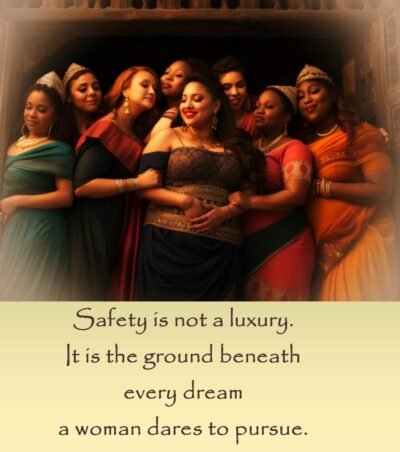
There is nothing extraordinary about wanting to move through life with privacy, dignity, and peace. That is simply what freedom looks like. The world becomes more beautiful for everyone every time a woman walks through it without calculating her escape.
Every Woman Has the Right to Say ‘No Thanks – WE Survive Abuse
We Don’t Police Each Other—We Challenge Power – WE Survive Abuse