Table of Contents
Some Survivors of abuse become particularly unwilling to participate in narratives they believe are false, especially after they have spent years being pressured to distrust their own observations, memories, and judgment.
You can see this in accounts from Survivors of coercive relationships, high-control religious groups, cults, and other environments where maintaining the group’s preferred version of reality was a condition of belonging.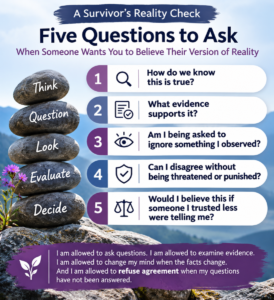
What may look like stubbornness to an outsider can sometimes be a hard-earned healthy boundary.
A Survivor may have spent years hearing:
-
“That never happened.”
-
“You’re remembering it wrong.”
-
“Everybody else understands. Why can’t you?”
-
“You’re hurting people by questioning this.”
-
“If you really cared about us, you would agree.”
-
“You’re creating division.”
-
“You need to trust the leadership.”
Eventually, some Survivors recognize that the pressure to agree was itself part of the control. And when they begin rebuilding their lives, they may become much more careful about what they are willing to affirm.
They have learned that agreeing to something merely to keep the peace can carry a tremendous personal cost.
The Survivor who no longer agrees just to keep the peace
One of the most revealing aspects of recovery from a high-control group is the rebuilding of independent judgment.
Research involving former cult members describes how questioning was discouraged, personal doubts were treated as weaknesses, and members learned to rely on group authority instead of their own reasoning. For some, recognizing contradictions in the group’s teachings became part of the process of leaving.
psichi.org
That helps explain why a Survivor might respond differently to pressure after recovery.
Imagine a woman who once belonged to a group where the leader’s interpretation of events always prevailed. She was expected to overlook contradictions, defend the leadership, and repeat explanations she privately doubted.
Years later, someone tells her she must publicly affirm a claim she does not believe.
She asks for evidence.
They tell her she is being difficult.
But this time, she doesn’t apologize for asking.
She has learned something about the difference between being cooperative and being controlled.
There is a name for part of this: rebuilding epistemic agency
Epistemic agency refers to a person’s capacity to participate actively in forming, evaluating, and revising beliefs.
In everyday language, it means recovering confidence in your ability to ask:
-
How do we know this is true?
-
What evidence supports it?
-
Am I being asked to ignore something I observed?
-
Can I disagree without being threatened or punished?
-
Would I believe this if someone I trusted less were telling me?
Recovery from coercive influence can involve rebuilding critical thinking, decision-making, and personal autonomy. The International Cultic Studies Association specifically identifies these as important areas of recovery support.
Healing does not make anyone automatically correct or immune to misinformation. Some Survivors become more skeptical; others continue to struggle with trust or uncertainty. Recovery is not linear.
The achievement is not becoming someone who can never be mistaken. It is becoming someone who is allowed to examine the evidence and reach an independent conclusion.
A Survivor may recognize pressure tactics because she has encountered similar methods before. That recognition deserves to be heard, although the facts of the new situation still need independent examination.
And sometimes a Survivor’s refusal is quite simple:
I am not going to say something I believe is false just because everyone around me wants me to say it.
That is a boundary, not necessarily an accusation against anyone else.
Original affirmations worth keeping
“After spending years being told what to believe, I am allowed to ask how we know something is true.”
“I do not have to exchange one authority figure for another. I can listen, examine the evidence, and decide for myself.”
“My recovery does not require me to agree with everyone. It gives me room to think without fear.”
“I can admit when I am wrong without surrendering my right to question.”
“Some people may call my questions resistance. I call them questions. They deserve answers, not punishment.”
And perhaps the strongest:
“I did not fight my way out of a world where questioning was forbidden just to enter another one where agreement is the price of belonging.”
International Cultic Studies Association’s recovery guidance. It provides a foundation for explaining coercive influence without assuming every disagreement is manipulation.