
This post was inspired in part by this article……Russell Brand and the tyranny of the Greater Good – spiked
Some people have not abandoned the expectation that women should sacrifice. They have simply changed what they expect women to sacrifice for
Modern misogyny does not always announce itself as hatred of women. Sometimes it arrives dressed as “compassion, inclusion, justice, or progress.” The language may change, but the question remains: Are women and girls being treated as fully human beings with rights, boundaries, voices, and interests of their own?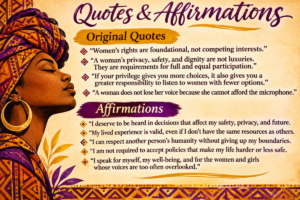
Women’s voices, boundaries, and consent
1. Female boundaries dismissed. Women are told that setting boundaries makes them selfish, prejudiced, or unkind. Instead of considering whether a boundary is reasonable, critics may concentrate on how it makes someone else feel. A woman’s boundary becomes a test of her goodness.
The question is not whether your intentions are beautiful. The question is whether women are free to say “no.”
2. Male feelings prioritized. A woman’s discomfort is treated as something she should overcome, while a man’s discomfort is treated as something everyone else must accommodate. This creates an unequal standard of compassion.
3. Women’s concerns trivialized. Women raise concerns about privacy, safety, fairness, or dignity and are accused of exaggerating. Sometimes the conversation becomes more focused on correcting their language than examining the problem they identified.
4. Girls’ objections ignored. Girls are taught to speak up when something feels wrong. Yet when they object to an arrangement involving an adult or another student, they may discover that their objections are less welcome than their obedience. Teaching girls to use their voices means being prepared to listen.
Silencing does not always look like a locked door. Sometimes it looks like a meeting where everyone is permitted to speak except the person most affected.
5. Female privacy negotiable. Privacy is treated as important until women request it in circumstances involving undressing, sleeping, bathing, or intimate care. Then they may be expected to justify why privacy matters to them. A serious privacy policy should consider everyone affected.
6. Male entitlement normalized. Men may be encouraged to regard access to women’s attention, labor, spaces, or emotional support as something they deserve. When women decline, the refusal itself becomes the controversy. Respect means recognizing that another person’s participation is not automatically owed.
7. Women’s dignity conditional. Women are celebrated when they are agreeable, generous, and accommodating. The same women may be insulted when they refuse a demand. Dignity should not depend on compliance.
Women are allowed to be compassionate without volunteering themselves as the solution to everybody else’s discomfort.
8. Women’s speech policed. A woman raises an issue, and suddenly everyone is discussing her tone. Her words are dissected while the original concern receives little attention. Civility should never become a substitute for accountability.
9. Women’s fears mocked. Women who describe risks may be ridiculed as paranoid or hysterical. Their critics may demand certainty about future harm before accepting any precaution. Prevention often requires taking reasonable concerns seriously before something terrible happens.
The recurring question is not whether every policy disagreement constitutes misogyny. It is whether women and girls are consistently expected to absorb costs, surrender choices, or remain silent so that other people’s interests can prevail.
When an institution calls itself “progressive”, ask what has actually progressed for the women who depend upon it.
Progress that requires women to stop asking questions about their own rights deserves more questions, not fewer.
