
Table of Contents
If your decisions impact women and girls, expect women and girls to have something to say. Don’t waste everybody’s time asking why we’re involved. We live with the consequences….so we speak.
Imagine being told that you are intelligent enough to raise children, manage a household, teach morality, and help shape the next generation, but not qualified to make decisions about the laws governing your own life.
That was the contradiction many women faced in nineteenth-century America.
Men were supposed to belong to the public world of politics, business, government, and law. Women were supposed to belong to the private world of home and family.
This arrangement had a name.
The Separate Spheres Ideology.
You may disagree with what women are saying. That’s your right. But don’t confuse your disagreement with the authority to silence us
And understanding it helps explain why women had to fight for opportunities that men were already expected to pursue.
1. What Was the Separate Spheres Ideology?
The Separate Spheres Ideology was a widespread belief that men and women had different, supposedly natural roles in society.
Men were associated with public authority, paid employment, politics, and economic decision-making.
Women were associated with domestic responsibility, motherhood, religion, and moral guidance.
These ideas became especially influential in nineteenth-century Britain and the United States, although distinctions between men’s and women’s responsibilities existed long before then.
It wasn’t a single organized movement with a leader or membership. It was a social ideology promoted through religious teachings, publications, education, and family expectations.
2. What Were the Rules for Women?
There was no universal rulebook, but women, particularly those in white middle-class households, encountered expectations such as these:
- Leave politics to men. Voting, holding public office, and making laws were widely considered men’s responsibilities.
- Make the home your primary responsibility. Marriage, child-rearing, and household management were supposed to come before public ambitions.
- Respect male authority. Husbands were commonly regarded as heads of households.
- Limit your professional ambitions. Many careers and leadership positions were considered inappropriate for respectable women.
- Use education for domestic purposes. Women’s education was often defended as preparation for becoming better wives, mothers, and moral instructors.
- Avoid appearing too assertive. Public argument, political activism, and forceful disagreement could attract criticism.
- Preserve your reputation. A woman’s conduct outside the home could be judged against expectations of modesty and feminine respectability.
These expectations were not enforced equally everywhere. Women worked, owned businesses, organized communities, and participated in public debates despite them.
3. Who Decided These Rules?
You don’t get to make decisions about our lives and then act surprised when we show up with questions, objections, and a few ideas of our own.
No single person invented the Separate Spheres Ideology.
It developed through longstanding legal traditions, religious beliefs, economic arrangements, and changing ideas about family life.
As industrialization separated some paid work from the household, the distinction between men’s paid employment and women’s domestic responsibilities became especially prominent in middle-class culture.
Religious leaders, educators, politicians, and writers helped reinforce it.
Some women defended the arrangement, believing domestic influence gave women an important moral responsibility.
But there was a serious imbalance.
Women could be held responsible for raising good citizens while being denied an equal voice in choosing the government those citizens would live under.
4. Did These Rules Apply to Black Women?
Not in the same way.
For enslaved Black women, the supposed division between protected domestic life and public labor was fundamentally different. Enslaved women were forced to work, frequently outside their own households, while being denied control over their labor and family relationships.
Free Black women also worked in occupations that contradicted the ideal of the economically dependent housewife.
For many working-class women, regardless of race, remaining outside paid employment was never a realistic option.
The ideology described an influential social ideal, not the actual circumstances of every woman.
5. What Happened When Women Refused to Stay in Their Sphere?
Women and girls do not need to explain why we care about matters affecting our safety, freedom, dignity, and future.
We belong in the conversation because we belong in the world.
Women challenged the division directly.
In the 1830s, abolitionists Sarah and Angelina Grimké spoke publicly against slavery. Their public activism attracted criticism from religious leaders who believed women should not address mixed audiences.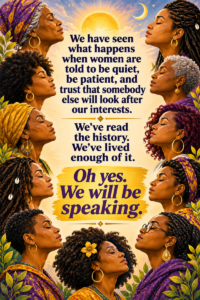
In 1848, women gathered at Seneca Falls to challenge their exclusion from political and legal equality.
And in 1851, Sojourner Truth addressed a women’s rights convention in Akron, Ohio, challenging prevailing assumptions about women’s abilities and social position.
These women demonstrated something that opponents of women’s public participation often resisted acknowledging.
Women were already thinking about politics, confronting injustice, and contributing to public life.
They wanted the freedom and authority to do so openly.
6. What Should New Feminists Understand?
The Separate Spheres Ideology helps explain why women’s participation in public life was treated as something requiring justification.
Women were not merely excluded from certain institutions. They were taught that wanting to enter those institutions could violate their proper role.
And the ideology created a contradiction that lasted for generations.
Women were expected to care deeply about the welfare of their families and communities, yet their ability to influence public decisions affecting those families and communities was restricted.
The lesson is not that domestic life lacks value. Caring for children, maintaining a home, and supporting loved ones are important forms of work.
The lesson is that women should never have to surrender their public independence to prove their value within their families.
7. The Lesson We Should Carry Forward
The women who challenged separate spheres helped establish a principle that can seem ordinary today.
A woman’s place in society should not be decided for her simply because she is female.
She can be a mother and a political leader. She can care about her family and pursue a profession. She can be religious, outspoken, ambitious, nurturing, independent, or any combination of those things.
And she can choose domestic life without accepting the idea that every other woman must make the same choice.
The women who challenged these boundaries were not asking to abandon their humanity or their families.
They were asking why being women should place limits on their freedom.
Women’s lives were never too small for the public world. The rules were too small for women’s lives.
If the subject is women and girls, our participation is not an interruption. We are not visitors in conversations about our own lives.
Historical Sources and Further Reading
- National Humanities Center: The Cult of Domesticity — Historical documents illustrating expectations about women’s domestic responsibilities.
- National Park Service: Women’s Rights National Historical Park — The Seneca Falls Convention and the early women’s rights movement.
- Library of Congress: American Women’s History — Primary sources and research collections documenting women’s work, activism, and public participation.
You Can’t Protect Survivors and Still Make Space for Predators – WE Survive Abuse
Women Exist Before a Man Comes Up with an Explanation for Us – WE Survive Abuse
