
I’ve started speaking up when people try to decenter women and girls. Search engines, a tech app, a meeting, a casual conversation—whatever…. When I am discussing social problems that are STILL impacting women and girls, dammit, I mean women and girls. How will we ever solve dangerous and life-threatening problems if we can’t discuss the people most impacted?
Women and girls are not to be side-chicked in our own conversations. We belong at the center. WE belong.
Inclusion Should Not Require Women’s Disappearance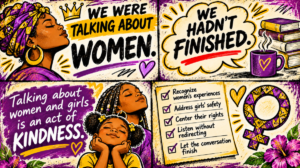
I believe people can care about more than one population.
I believe we can learn from one another’s experiences.
I believe a conversation can become richer when someone introduces a relevant perspective we had not considered.
But I do not believe that every discussion must become a discussion about everybody.
There is a reason we study particular populations. There is a reason we examine specific patterns of violence, discrimination, poverty, and institutional failure.
Different people encounter different problems. Sometimes the causes overlap. Sometimes the solutions overlap. Sometimes they do not.
If we cannot allow ourselves to examine those differences, we risk producing answers that sound inclusive but fail the people who actually need them.
Women need space to discuss female experiences.
Black women need space to examine what happens at the intersection of racism and sexism.
Girls need adults willing to examine their particular vulnerabilities without immediately changing the subject.
None of those conversations requires hostility toward anyone else.
A conversation does not become unjust simply because it has a specific subject.
Notice the Difference
There was a time when I might have followed every conversational detour because I wanted to be fair.
I might have spent another twenty minutes explaining that I cared about people who were never the subject of the original discussion.
I might have felt responsible for making certain nobody misunderstood my intentions.
But there is something freeing about growing older.
You begin to understand that you can be fair without surrendering your attention.
You can care about someone without making that person the center of every conversation.
You can recognize suffering without treating all suffering as interchangeable.
And you can notice when someone repeatedly asks women to move aside, even if the request arrives wrapped in the language of kindness.
These days, I am especially interested in the people who remember women without having to be reminded.
The people who ask about girls.
The people who notice when women’s safety concerns are dismissed.
The people who recognize that women have histories, bodies, vulnerabilities, knowledge, and experiences worthy of sustained attention.
I want to hear more from those people.
And I want women to have more opportunities to finish the conversations they started.
Not because nobody else matters.
Because women matter too, without an additional explanation, a qualifying paragraph, or a reminder that somebody else has suffered.
I have spent enough years remembering everybody else to recognize when women are being forgotten.
And I am not going to pretend I don’t notice anymore.
The Conversation Was About Women. What Happened?
Have you ever been in the middle of a conversation about women’s safety, rights, or experiences, only to find yourself discussing somebody else’s needs before you’ve even finished making your point?
In this episode of the WeSurviveAbuse Podcast, we’re talking about the subtle, familiar ways women and girls get pushed out of the center of conversations about their own lives.
Drawing on years of advocacy and the experience of growing older as a Black woman in America, we explore the expectation that women, particularly those working in caring professions, must continually remember everybody else’s struggles, feelings, and circumstances.
But who remembers us?
At a time when millions of women and girls are experiencing sexual violence, discrimination, exploitation, and restrictions on their freedom, we have serious questions to ask about where our attention goes and whose concerns keep getting interrupted.
We’ll talk about male privilege, the difference between compassion and constant accommodation, and why acknowledging other people’s suffering should not require women to abandon discussions about their own.
We’ll also consider the girl each of us once was, the lessons she learned about making room for others, and what we owe the girls growing up today.
This isn’t about caring less about other people. It’s about recognizing that women and girls deserve the same sustained attention we are so often expected to give everyone else.
We have not run out of things to say about women and girls. We have barely given ourselves enough time to listen.
Join us for a thoughtful conversation about women’s voices, reciprocal consideration, and the importance of staying with the subject when that subject is us.
The World Health Organization reported in 2025 that approximately 840 million women worldwide had experienced physical or sexual intimate partner violence, non-partner sexual violence, or both during their lifetimes. Nearly one in three women. The organization also found that progress in reducing intimate partner violence had been painfully slow, averaging just a 0.2 percent annual decline over two decades.
UNICEF estimated in 2024 that more than 370 million girls and women alive today had experienced rape or sexual assault before turning 18. When other forms of sexual violence were included, the estimate rose to 650 million.
And here in the United States, the CDC’s 2023 Youth Risk Behavior Survey found that 17 percent of female high school students had experienced sexual violence during the previous year.
These are girls going to school. Women going to work. Mothers, daughters, grandmothers, neighbors, and friends.
I think about the women who never reported what happened to them. The girls who were not believed. The women who had to leave jobs, homes, and communities because somebody else decided to harm them.
And I wonder how we can have this much evidence of suffering and still find ourselves repeatedly struggling to keep women’s experiences at the center of discussions about their own rights.
The statistics do not tell us that every conversational interruption caused these harms. But they tell us something we should not ignore: the problems affecting women and girls remain enormous, and our progress in addressing some of them has been terribly slow.
We cannot afford to keep losing focus. Women and girls are not to be side-chicked in our own conversations.
Women and Girls Are Not Supposed to Be Assigned to Dangerous Men for Life – WE Survive Abuse
📵 Why So Many Social Media Platforms Are Against Naming Harm – WE Survive Abuse
How People Prompt or Lure Women to Prove Their Worth – WE Survive Abuse
She Lied to Herself First: How Women Protect Harmful Men—And Turn on Other Women – WE Survive Abuse
Is it Kindness or Obedience: A Lesson in Coercion – WE Survive Abuse
The Separate Spheres Ideology: Who Decided Public Life Belonged to Men? – WE Survive Abuse
Conniving Distractions: What Was She Wearing? – WE Survive Abuse
When Identity Becomes a Shield: Why Accountability Must Stay Human-Centered – WE Survive Abuse
