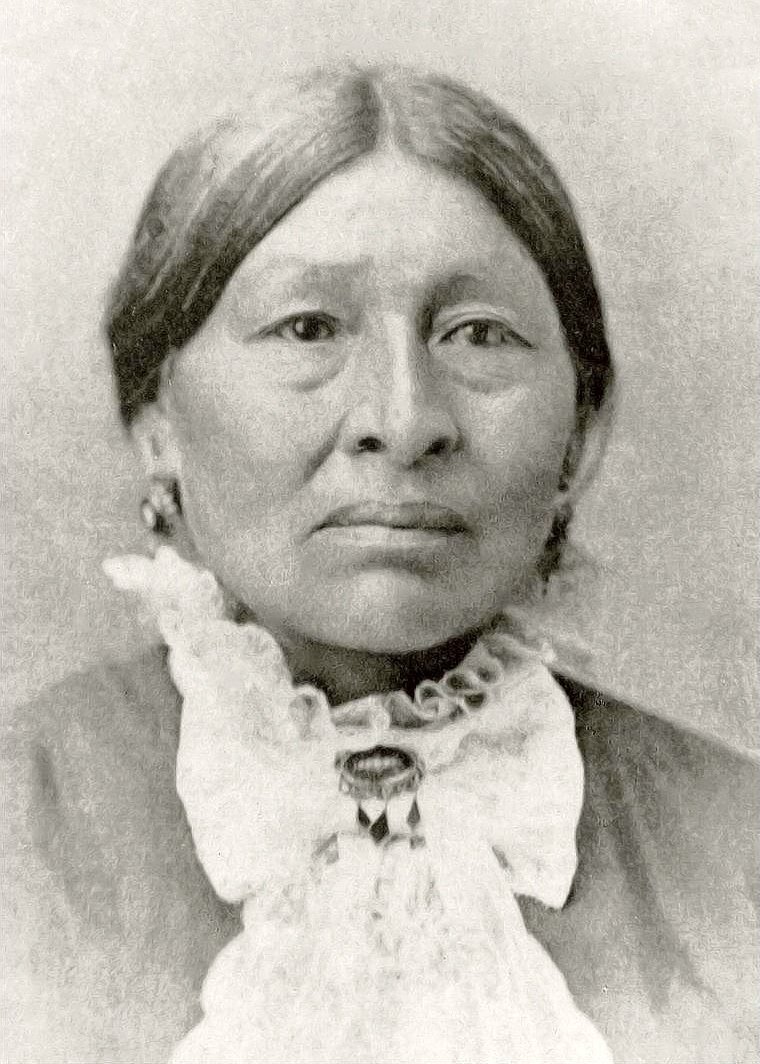
She demonstrated wisdom across a lifetime. She died a wise woman. And still people took advantage of her and her people. She Was Wise. They Broke
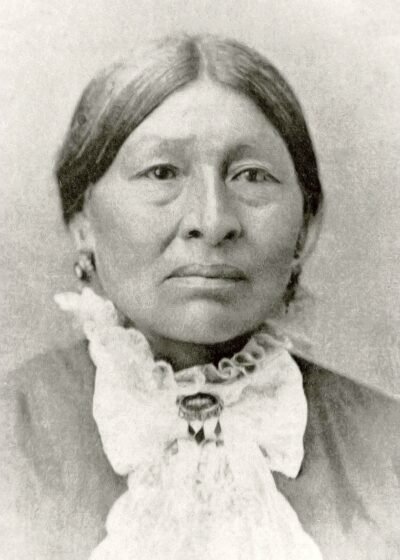
http://sdexcellence.org/Eagle_Woman_Who_All_Look_At_2010
She demonstrated wisdom across a lifetime. She died a wise woman. And still people took advantage of her and her people. She Was Wise. They Broke Their Word.
Wambli Autepewin, Eagle Woman That All Look At, was a Lakota woman known for wisdom, diplomacy, and extraordinary political skill.
She spent much of her life trying to protect her people through negotiation rather than war. She carried messages. She mediated conflict. She dealt with new-to-the-Americas white officials. She witnessed treaties and promises made as settlers and the United States pushed deeper into Lakota lands.
She understood the power of an agreement.
And she lived long enough to learn something painful:
An agreement can be honorable on one side and still be broken by the other.
She was not foolish for believing that words should have meaning.
She was wise when she entered those negotiations.
She was wise when she tried to prevent bloodshed.
She was wise when she expected agreements to be honored.
And she remained wise as she watched promises to her people broken.
The broken promise does not prove that the person who trusted it lacked wisdom. Sometimes it proves that the person who made it lacked honor.
That is where I want to begin our conversation about women, law, and the meaning of the word woman.
Because women have agreements with their governments, too.
We call them rights.
The WNBA now has a task force studying questions around sex and gender. Oh sigh. Think about that for a minute.
I’ve served on numerous task forces. We create task forces when ordinary rules are no longer enough. Violence. Public health emergencies. Missing people. Serious social conflicts. Problems that require people to sit around a table and figure out what happens next.
And now institutions are sitting around tables discussing woman.
Women’s rights advocates keep saying something much simpler:
Words written into law have to mean something.
This is not about being cruel to anybody.
It is about whether women can depend upon the promises written into law, policy, regulations, and civil rights protections.
Because a right you cannot define can become a right you cannot defend.
1. Because laws need definitions.
We’ve all collectively awaited jury decisions and Supreme Court decisions as a country. You know how this goes. Every word, comma, and period placement matters in law. From the ancient to the new.
Imagine a law saying:
Women have the right to X.
The first legal question is obvious:
Who does the law mean by women?
Courts cannot protect a category that government agencies are free to redefine whenever they please.
“Definition is not decoration in law. Definition tells us who the promise belongs to.”
2. Because women organized for specific protections.
Women fought for voting rights.
Employment protections.
Equal educational opportunity.
Maternity protections.
Protection from sex discrimination.
Female prisons.
Domestic violence shelters.
Rape crisis services.
Women’s sports.
These things did not fall from the sky.
Women fought for them because being female had consequences.
Our history explains why the category exists.
3. Because policy depends on knowing who a policy protects.
Suppose the government announces a program to reduce violence against women.
Who is being counted?
Suppose researchers report that women are experiencing more workplace discrimination.
Who are they measuring?
Suppose a hospital studies maternal deaths among women.
Who is included?
Definitions affect statistics.
Statistics affect funding.
Funding affects programs.
Programs affect lives.
“A category that becomes impossible to measure eventually becomes difficult to protect.”
4. Because guidelines become real life.
A guideline can decide who enters a shelter.
Who enters a prison.
Who competes for a scholarship.
Who changes beside your daughter.
Who receives funding.
Who qualifies for a program.
Who appears in government statistics.
Who gets searched by whom.
Words on paper eventually become somebody’s Tuesday afternoon.
That is why women pay attention to definitions.
5. Because government protection is a promise.
There was a Lakota woman known as Wambli Autepewin, Eagle Woman That All Look At.
She spent years trying to prevent war and build peaceful relations as American expansion or takeover ultimately colonized and consumed Indigenous lands.
There is something important in her story for women today.
She negotiated. She reasoned. She tried diplomacy.
She worked from the belief that agreements should mean something.
When powerful people failed to honor agreements made with Native peoples, that failure did not make the people who trusted those agreements foolish.
The dishonor belonged to those who broke their word. Yes, but that was of little comfort to her people after. She lived to see the ‘promises’ broken. The story of so many women and children. (Domestic violence; femicide; child abuse; sexual assault, including those covered up by institutions….)
“When honorable people believe an agreement will be honored, their trust is not the wrongdoing. Breaking the agreement is.”
6. Because women should not have to renegotiate old rights forever.
Imagine spending generations winning protections and then hearing:
We need another committee to decide what the words in those protections mean.
Women are allowed to ask:
When does the agreement become settled?
There must be some point when women can build upon rights instead of repeatedly returning to the negotiating table to prove that the protected class exists.
7. Because power changes the meaning of generosity.
Women are often encouraged to be accommodating.
Be welcoming.
Make room.
Don’t hurt anyone’s feelings.
But law cannot operate on the expectation that one protected group will continually surrender boundaries to prove its kindness.
“Generosity freely given is kindness. Generosity demanded by power can become surrender.”
Women can be compassionate without signing away protections.
8. Because exceptions have consequences.
A rule rarely changes in only one place.
Change a definition in sports and questions appear in education.
Change it in education and questions appear in employment.
Then prisons.
Shelters.
Healthcare.
Statistics.
Anti-discrimination law.
In law you may have heard it referred to as “precedent.”
Women are not unreasonable for asking where a legal principle eventually leads.
Good policy thinks three doors ahead.
9. Because women deserve certainty from their government.
A woman should be able to read a law protecting women and understand whether it protects her.
A girl should grow up knowing what protections follow her into adulthood.
Women should not require a law degree, a government memo, and a newly appointed task force to discover whether they still belong to their own civil-rights category.
“Rights should not become riddles in the hands of the people responsible for protecting them.”
10. Because keeping your word is one of the oldest questions in human history.
Native peoples learned terrible lessons about agreements with governments.
Black Americans learned terrible lessons about constitutional promises that existed beautifully on paper while segregation, racial violence, and discrimination continued outside the courthouse.
Women have learned the same basic lesson in another form:
A promise is only as strong as the willingness of powerful institutions to honor it.
That does not mean oppressed people were foolish for believing in law.
It means law must become worthy of belief.
And that is why definitions matter.
Women are not merely arguing over a word.
They are asking whether the agreement still stands.
An Affirmation for Wiser Women
I will not call myself foolish because another person failed to honor their word.
I came to the table believing that words carried responsibility.
I chose peace without surrendering my dignity.
I spoke because my people were worth defending.
I negotiated because tomorrow was worth protecting.
What another person does with their promise belongs to their character.
What I do with mine belongs to me.
I will remember what was promised.
I will remember what happened.
And I will teach the women coming behind me that compassion needs memory, agreements need boundaries, and peace is strongest when it walks beside truth.
We may come to the table in peace.
But we do not come without memory.
She demonstrated wisdom across a lifetime. She died a wise woman. And still people took advantage of her and her people. She Was Wise. They Broke Their Word.
Does Naming Ourselves Hurt Anyone? No. Erasing Us Does. – WE Survive Abuse
Women Are Not a Feeling. We Are Not Yours to Define. – WE Survive Abuse
Silencing Is Always the First Strike – WE Survive Abuse
🚨 Control of Language Is a Red Flag for Abuse—And Many Miss It – WE Survive Abuse
Columbus Day: As Long as You Know What You Are Celebrating – WE Survive Abuse