updated from 4/5/24
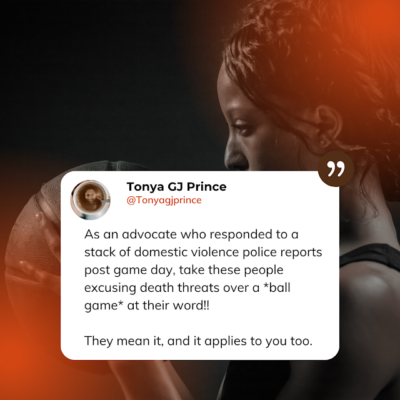
You know these people.
They’re not on the team.
They hold no stock in the game.
Maybe they don’t even have money riding on it.
The players, the coaches, the trainers, the staff, the custodians — none of them know these “fans.”
And yet…
They feel entitled.
Entitled to scream curses.
To throw threats.
To clutch onto rage when their team loses.
What they do off the court is potentially dangerous — not just a blown fuse, but a prelude to abuse: domestic violence, sexual violence, threats… even murder.
🏀 When Real Life Doesn’t Pause for Sports
The latest attacks on Angel Reese expose something ugly: racism and toxic attitudes toward outspoken women.
Because if you’re a male star — Kobe Bryant, Michael Jordan — trash talk is part of the spectacle. You’re hyped. Celebrated. Even romanticized.
But when a young Black woman speaks with fire — they tell her she “deserved it,” she “earned it,” she “disrespected the game.” Her confidence becomes an offense.
Hatred. Death threats. Racist commentary. The kind that compares a Black woman to “a dog.” From people like Emmanuel Acho, among others.
Because there’s big money in sports.
And some believe protecting the “bags” is worth more than protecting flesh and blood.
🎯 Why “It’s Just Sports” Is a Dangerous Excuse
Because violence tied to games doesn’t stay on the field or in the arena. It spills into homes, neighborhoods, communities.
Because the same aggression that rallies fans can become rage against loved ones, strangers, the vulnerable.
Because blaming it all on alcohol or saying “not all fans do this” hides the truth:
For too many, sports become permission to shift pain into power.
We patch up the narrative about abuse when we say “only players” are at risk — but ignore the fans in the seats, the sidelines, the streets. That is denial.
✊ Women’s Rights — Human Rights — Must Demand Real Accountability
As someone who’s stood with survivors for decades, I know this clearly:
We can’t allow the myth of “harmless sport aggression” to give cover to predators.
We can’t let record-breaking numbers as “viewership,” “merch,” or “ticket sales” stay more important than human lives.
This isn’t just about fans acting out.
It’s about culture condoning silence, aggression, and the devaluation of women — especially Black women.
📣 To My Brothers in the Crowd, the Mic Holders, the Armchair Coaches
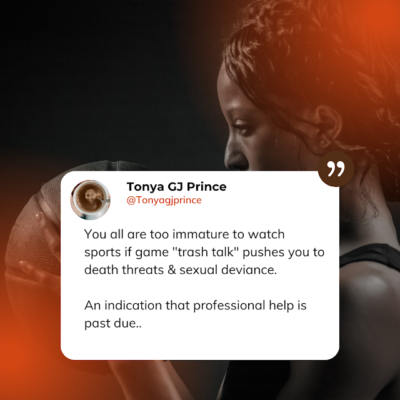
If you feel entitled by a game loss — your rage is not about the scoreboard. It’s about something deeper.
Ask yourself:
Why does losing a game make me feel weak — so weak that I want to lash out?
Who hurt me so badly that I believe I need to punish someone else to feel safe?
When did cheering stop being about love for the game — and become about reasserting control?
There’s another way to be tough:
Standing down when anger hits too close to home.
Holding each other accountable before someone else pays the price.
Reminding other men: you don’t get to treat women like an audience for your pain.
Because abuse is never just a game. It has real names. Real bodies. Real consequences.
🔥 It’s Time to Change the Narrative
Sports can be beautiful. Glory, strength, community.
But that light can’t blind us to the dark corners lurking at the edges — the men claiming power with threats, with violence, with hate.
Let’s stop ignoring the scene off the court.
Let’s stop protecting the “bags.”
Let’s start protecting people.
Because a scoreboard doesn’t heal a broken body, a broken spirit, a broken home.
Only accountability and truth can do that.