I believe the children are our future. Teach them well and let them lead the way...You can agree to an experience without agreeing to be treated
 I believe the children are our future. Teach them well and let them lead the way…
You can agree to an experience without agreeing to be treated as disposable.
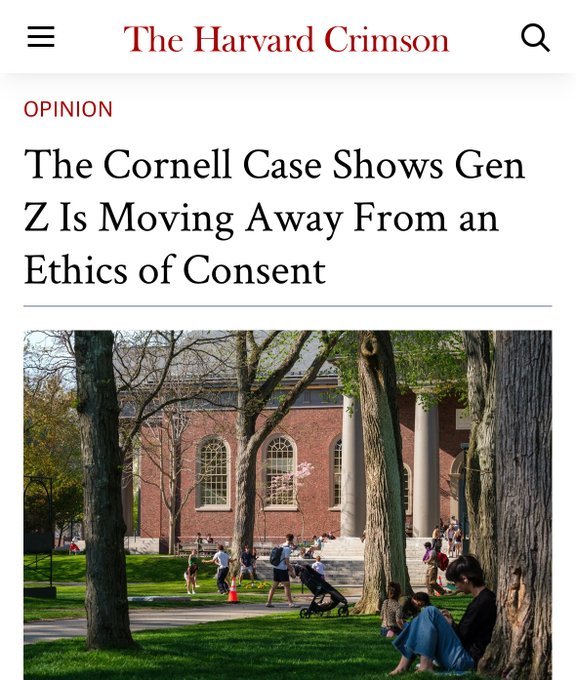
The author of The Harvard Crimson opinion piece, “The Cornell Case Shows Gen Z Is Moving Away From an Ethics of Consent,” makes a compelling argument about something we may have neglected while teaching young people about sex, relationships, and personal freedom.
We taught young people to ask whether something was consensual. But did we adequately teach them to ask whether it was humane, respectful, dignified, or exploitative?
The author is not arguing that consent should disappear. The argument is that consent is a necessary standard, but it cannot carry the entire weight of sexual ethics.
Here are the strongest points from the article along with some implications for how we prepare young people.
10 ways we may have failed to prepare Gen Z for healthy relationships
I am allowed to expect more than the absence of harm.
Kindness, honesty, consideration, and respect are reasonable standards for the relationships, connections and spaces that I choose.
1. We taught consent without teaching enough about human dignity.
Consent answers a necessary question: Did this person freely agree?
But it does not answer every question about how someone was treated.
Two people can agree to an encounter, yet one person may still behave with cruelty, contempt, dishonesty, or disregard for the other’s humanity.
The author’s point is that being permitted to do something does not automatically make it decent to do. That is a lesson young people need well beyond sexual relationships.
2. We confused what is legal with what is ethical.
The author distinguishes between the law and our responsibilities toward other human beings.
The law establishes minimum standards and consequences. Ethics asks what kind of conduct we should expect of ourselves and others.
A person can behave selfishly, manipulate another person’s emotions, or treat someone as disposable without necessarily committing a crime.
We should not need a criminal statute to recognize every form of human mistreatment. And we should not confuse conduct that is legal with conduct that deserves our approval.
My consent does not erase my humanity.
I remain a whole person with feelings, boundaries, and dignity in every circumstance.
3. We may have taught sexual freedom without equally emphasizing responsibility.
Much of the modern conversation about sexual liberation has focused on removing shame, challenging restrictive expectations, and defending personal choice.
Those goals can coexist with an expectation of responsibility.
Yet young people may hear far more about their right to pursue sexual experiences than about their responsibility to consider how their conduct affects another human being.
Freedom does not eliminate responsibility for how we treat people. The author wants those conversations brought back together.
I do not have to participate in something simply because others call it normal.
My comfort, values, and judgment belong to me.
4. We normalized language that treats people like products.
The example of body count is especially useful.
Think about what that language does. It turns intimate experiences involving actual human beings into a numerical score. People become evidence of experience, status, or desirability.
And when a culture repeatedly talks about people as sexual achievements, it becomes easier to overlook their feelings, dignity, and individuality.
The author cites NYU student Colette Yehl’s criticism of this language. We can teach young people to recognize dehumanization even when it arrives disguised as humor, slang, or ordinary conversation.
There is something deeply incomplete about a culture that can explain sexual permission in great detail but struggles to explain why cruelty is wrong.
5. We did not sufficiently challenge the idea that another person exists for our experience.
One of the strongest expressions in the excerpts is “experience machines.”
It describes an attitude in which another person becomes a means of obtaining pleasure, validation, excitement, or status.
Their interior life becomes secondary. That attitude can appear in casual encounters, dating relationships, and marriages. It is not confined to any one relationship structure. The ethical question is whether we recognize the person in front of us as someone whose humanity remains intact regardless of what they have agreed to share.
When we teach girls that freedom means being available for anything,
we have simply dressed an old expectation in modern clothing.
6. We may have failed to give young people the language to identify mistreatment.
This is one of the most useful points in the article.
Young people need words beyond consensual and nonconsensual.
They need to recognize humiliation, coercion, exploitation, objectification, emotional manipulation, disrespect, and degradation.
These concepts are not interchangeable, and some conduct crosses the line into abuse or criminal behavior. But without a broader vocabulary, young people may struggle to explain why an experience felt wrong, particularly when they initially agreed to participate.
Having the words helps people identify what happened and decide what boundaries they want going forward.
I am allowed to recognize disrespect without having to prove that a crime occurred.
I can decide that someone’s behavior is unacceptable to me.
7. We sometimes treated sexual openness as evidence of progress without asking whether respect improved.
The author raises a difficult question.
Has greater openness about sexuality produced greater respect for sexual partners?
Those are two different outcomes. A society can become more comfortable discussing sex while continuing to tolerate humiliation, sexual double standards, pressure, and exploitation. Greater openness may make honest conversations possible. It does not guarantee that people will treat one another better.
We have to teach that separately.
8. We may have neglected the difference between participation and genuine willingness.
Young people need to understand that someone can participate in an experience while feeling pressured, intimidated, afraid of rejection, or uncertain about their ability to refuse.
Some of those circumstances can invalidate consent. Others may reveal troubling relationship dynamics even when a legal violation cannot be established.Teaching consent properly means examining freedom to refuse, the absence of coercion, and the ability to withdraw agreement.
Consent is not simply the absence of the word no. And dignity requires us to care about the conditions under which someone makes a choice.
9. We have not done enough to teach young people that they can reject what their peers normalize.
There is tremendous pressure to appear sexually “sophisticated, adventurous, desirable, or unbothered.”
Young women in particular may encounter expectations to prove that they are liberated by tolerating experiences they do not actually want.
But liberation should expand a woman’s choices, not establish a new set of expectations she must satisfy. A young woman should feel equally entitled to pursue intimacy, decline it, change her mind, establish limits, or decide that a particular relationship is not for her.
She does not owe anyone an explanation that makes her boundaries acceptable to the group.
10. We placed too much responsibility on rules and not enough on culture.
The author closes by calling on cultural leaders, mentors, friends, and ordinary people to help establish an ethic of dignity.
That is a worthwhile challenge.
Schools can establish policies. Legislatures can define offenses. Universities can investigate misconduct.
But families, friendships, entertainment, pornography, social media, and peer groups also shape what young people come to regard as normal.
A young person can memorize a consent policy and still participate in a culture that humiliates or exploits people. The work of teaching dignity has to extend beyond institutional compliance.
Where I would challenge the author
There are two places where I would push the argument further.
First, consent and dignity should not be positioned as competing standards.
In the excerpt about the Cornell case, the author suggests it would be better to frame Jane Doe’s experience as wrong because her dignity was violated rather than because it was nonconsensual. I would not accept that as an either-or choice.
If an act was nonconsensual, that is already a fundamental violation of a person’s autonomy and dignity. We should not weaken that finding to make a broader ethical point.
We can say that an act was nonconsensual, degrading, and dehumanizing when the evidence supports those descriptions.
The larger failure: We may have taught young people how to negotiate access without sufficiently teaching them how to recognize disregard.
We should be teaching girls and young women that they do not have to wait until someone commits a crime before they are entitled to object to how they are being treated.
They can recognize disrespect early. They can leave relationships that diminish them. They can decline experiences that do not reflect their values. They can establish standards that go beyond what the law requires.
And boys and young men need direct education about their responsibility not to exploit another person’s compassion, vulnerability, uncertainty, affection, or desire for acceptance.
There is another distinction worth preserving: A woman can consent to an experience and later decide that she did not like how she was treated. That does not automatically mean the encounter was nonconsensual, nor does her original consent mean she must approve of everything that occurred.
We need the language to discuss both truths.
The author’s central argument is a valuable one: We cannot build a humane sexual culture by teaching people only what they are legally prohibited from doing.
We must also teach them what respect looks like when nobody is threatening punishment.
And I would add one more lesson for the next generation:
Your right to say no is not the outer limit of your dignity. You are entitled to expect humane treatment even when you say yes.
The Cornell Case Shows Gen Z Is Moving Away From an Ethics of Consent | The Harvard Crimson
20 Common Misconceptions About When and Why Survivors “Should Be Over the Pain”