Table of Contents
JK Rowling has money and work invested where her mouth is.
There is something I would like to hear from wealthier women who have a great deal to say about what other women should accept in the name of inclusion.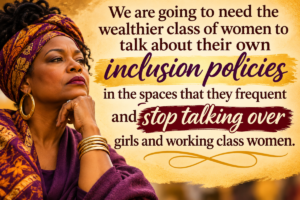
Tell us about the policies in the spaces you frequent.
Tell us about your private clubs, exclusive gyms, expensive schools, spas, and the places where you receive healthcare.
What are the privacy arrangements? What choices are available to women? And what happens when a woman says she is uncomfortable? Are males free to come and go in the female spaces that you frequent?
Because I have noticed that conversations about inclusion can sound very different depending on who has the money to walk away.
It’s Easier to Make Demands When You Have Options
Did you all know that many unhoused women choose not to sleep in designated shelters out of reasonable fear of violence in mixed sex spaces? Many of the women without homes have already been victims of repeat violence, abuse, and harm….since their childhood years.
A wealthy or upper-middle-class woman may be able to change facilities, find another provider, or pay for private accommodations.
A working-class woman in a homeless shelter may have nowhere else to sleep.
A woman in prison cannot simply leave. A girl attending her neighborhood public school may not have another school available to her.
These women and girls deserve to have their concerns about privacy, dignity, and sex-based boundaries taken seriously.
And they should not have to endure lectures about kindness from people who will never be required to live with the same arrangements.
Let’s Talk About Your Spaces, Too
I would genuinely like to know how inclusion policies operate in the exclusive spaces wealthier women use.
Are the same expectations applied there? Are women offered private alternatives? Are their objections heard without ridicule?
These are reasonable questions.
Because if an arrangement is considered good enough for a woman sleeping in a communal shelter or a non-private hospital room, we ought to be willing to examine how that same arrangement would operate in a luxury retreat.
And if there are additional protections in the luxury setting, why aren’t women with fewer resources entitled to comparable consideration?
Avoid Speaking Over the Women Who Have to Live With These Decisions
I have spent years working with women affected by violence and abuse. One lesson stays with me: the people living with the consequences deserve a meaningful voice in the decisions.
Women’s rights are fundamental. They are not favors granted to women who have enough money, influence, or social standing to insist upon them.
Trans-identified people deserve dignity and protection from mistreatment. Recognizing that does not require dismissing women’s concerns about sex-based privacy and safety.
We can discuss inclusion without expecting women and girls to remain silent about policies that affect them.
And we can certainly do it without wealthier women appointing themselves the voice of women whose circumstances they do not share.
If your money buys you choices that other women do not have, your responsibility is to listen before deciding what those women should be willing to accept.
Working-class women and girls are not practice grounds for policies that influential people can afford to avoid.
They deserve a seat at the table.
And when they speak, they deserve to be heard.
Women do not all have the same ability to speak publicly, challenge institutional decisions, obtain private accommodations, or leave unsafe environments.
And What About the Women Who Aren’t Even Online?
There is another group of women we rarely hear from in these debates.
Women who cannot afford reliable internet access. Women who don’t own smartphones. Girls who have no meaningful way to participate in the conversations being held about their lives.
According to the International Telecommunication Union, only 71% of women worldwide were using the internet in 2025, compared with 77% of men.
UNICEF’s research found that 90% of girls and young women ages 15–24 in low-income countries were offline.
And here in the United States, Pew Research Center found that only 54% of adults in households earning under $30,000 subscribed to home broadband, compared with 94% of those in households earning $100,000 or more.
Sources: ITU, Facts and Figures 2025; UNICEF, Bridging the Gender Digital Divide; Pew Research Center, What We Know About Internet Use, Smartphone Ownership and Digital Divides in the U.S., January 2026.
Think about what that means when public conversations about women’s rights take place on social media.
Who gets heard? Who can organize? Who can challenge a policy before it takes effect?
And who is missing because she doesn’t have the money, technology, or opportunity to participate?
We cannot assume these women agree with us or disagree with us. We have not heard from them.
That is precisely why institutions need to listen beyond social media, professional advocacy circles, and the people who can afford to attend conferences.
Women and girls without digital access are still affected by decisions made in their names.
A woman does not lose her voice because she cannot afford the microphone.
1. There are approximately 280 million more men than women using the internet worldwide.
The ITU estimates that 77% of men and 71% of women were online in 2025. The disparity is especially important when digital platforms are treated as though they represent everyone’s voice.
ITU
2. In low-income countries, 9 in 10 adolescent girls and young women are offline.
UNICEF’s research found that 90% of girls and young women ages 15–24 in low-income countries were not using the internet, compared with 78% of boys and young men.
This is one of the strongest statistics for your article because it concerns girls whose perspectives are so often discussed by others.
UNICEF DATA
3. In the United States, income makes an enormous difference in home internet access.
Home broadband subscription by household income, 2025
Only 54% of adults in households earning under $30,000 reported home broadband, compared with 94% in households earning at least $100,000.
That’s a 40-percentage-point gap. These are figures for all U.S. adults, not women specifically, but they demonstrate how income shapes access to digital participation.
Pew Research Center
4. Approximately 800 million adult women were offline across 81 low- and middle-income countries studied.
The World Bank’s 2026 analysis of Global Findex data found that about 1.4 billion adults in the 81 countries were not using the internet, including approximately 800 million women.
Many lived in areas with broadband coverage. Having a network nearby did not mean they could afford or use it.
World Bank Gender Data Portal
5. Women in lower-income countries face a substantial mobile internet gap.
The GSMA’s 2026 report estimates that 810 million women in low- and middle-income countries do not use mobile internet, compared with 595 million men.
Affordability, digital literacy, safety concerns, and unequal access to smartphones are among the documented barriers.
GSMA
6. About 700 million women worldwide lack a financial account.
The World Bank’s Global Findex 2025 findings highlight the number of women without access to an account at a bank or another financial institution or mobile-money provider.
Financial access is relevant to women’s ability to pay for transportation, communication, alternative accommodations, and other resources, although account ownership alone does not establish financial independence.
World Bank Blogs
7. Homelessness among women in the United States increased by 19% from 2023 to 2024.
The National Alliance to End Homelessness reports this increase using HUD’s point-in-time homelessness counts. The estimated rate in 2024 was 18 women per 10,000.
This establishes the vulnerability of a population whose housing choices are severely constrained, although it does not measure opinions about inclusion policies.
National Alliance to End Homelessness
You Want Men Who Identify as Women in Our Spaces. What About Yours? – WE Survive Abuse