Table of Contents
Whether or not a woman on this planet has read feminist authors or understands what others mean by terms like “intersectionality” or the difference between “misogyny” and “sexual harassment,” one thing remains true. Her “no” means no without further explanation. 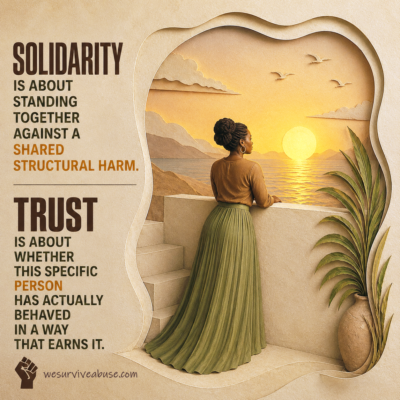
For anyone processing what healthy consent looks like — especially Survivors rebuilding a sense of authority over their own bodies and time — it helps to have language for something that can otherwise feel murky: the difference between someone’s disappointment and someone’s oppression. This piece uses Black radical womanist thought (Alice Walker, bell hooks, Patricia Hill Collins) to work through that difference point by point.
During this time when there is a vigorous and active effort to blur the lines around the boundaries, it helps to keep going back to basics.
The Core Claim
A woman’s right to say no — to a date, to attention, to access to her body or her time — is not oppression. It is the exercise of personal autonomy. Oppression describes something else entirely: systemic, institutional control over a group’s access to resources, safety, or power. A personal refusal doesn’t reach that level, and treating it as though it does blurs a distinction worth protecting.
Below are the places where this gets confused, paired with what’s actually true.
What Gets Confused / What’s Actually True
1. Confused: Rejection causes real pain, so it must be a form of harm equivalent to oppression.
What’s actually true: Pain and oppression are different categories. Rejection can hurt without being unjust. Womanist thought doesn’t deny that a refusal carries emotional weight for the person turned down — it simply refuses to let that weight redefine a personal boundary as a systemic wrong. Conflating hurt feelings with oppression actually weakens the term “oppression” itself, making it harder to name real oppression when it happens.
2. Confused: If society shapes who women find desirable, then rejection is really systemic bias, not free choice.
What’s actually true: Either “people are different and entitled to their own partner choices” or they are not.
The moment you allow “your preference is culturally conditioned, therefore your refusal is illegitimate” as a valid argument, you’ve built a tool that doesn’t stay contained to one group. It’s fully transferable.
That exact logic is the scaffolding of conversion therapy: your attraction to men is just trauma, just conditioning, just something you learned — so it doesn’t count as real, and we’re entitled to work on changing it, or you owe it to yourself/us to test the alternative.
Same structure. Same move. Just pointed at a different “no.”
- With women’s dating preferences: your reasons are shaped by bias; therefore, you owe access anyway.
- With gay people: your orientation is shaped by conditioning/trauma/environment, therefore it can and should be corrected, and your refusal to “try” the alternative doesn’t count.
3. Confused: Because minoritized men also face systemic dehumanization, a woman’s rejection rooted in racialized stereotypes must be reproducing oppression.
What’s actually true: This is the most serious version of the objection, and it deserves real engagement rather than a quick dismissal. bell hooks and other womanist thinkers do interrogate how racism can shape romantic and social exclusion.
But the answer isn’t to override a woman’s consent — it’s to hold two things at once: society can and should be critiqued for racist desirability standards, and an individual woman still retains full authority over her own choices. The structural critique belongs to culture and media. It does not transfer into a claim on any one woman’s personal veto power.
4. Confused: Womanism over-individualizes what should be a communal duty — marriage, family, partnership.
What’s actually true: Womanism was never built as pure individualism. Alice Walker distinguished it from earlier feminist frameworks precisely because it holds self and community together — but holding community doesn’t erase self-definition. A woman declining a date isn’t abandoning her community. She’s exercising the self-definition the tradition centers from the start.
5. Confused: Consent and autonomy are Western liberal imports, not organic to Black radical thought.
What’s actually true:
Women like Alice Walker, bell hooks, and Patricia Hill Collins didn’t get their ideas about bodily autonomy from white feminist or liberal rights theory. They built it from something more specific and more painful: the actual history of enslaved Black women, whose bodies could legally be used by anyone with no requirement of consent. Refusal wasn’t just discouraged — it wasn’t legally recognized as a right at all.
So when womanist thinkers say “a woman’s body belongs to her,” that claim isn’t an import from outside Black tradition. It comes directly out of that history. It’s Black women saying: we know exactly what it looks like when a body is treated as available by default, because our great-grandmothers lived it. Never again.
This matters because it means bodily autonomy isn’t a borrowed, abstract, “everyone has rights” kind of idea in this tradition. It’s rooted in specific memory — a direct answer to a specific historical horror.
That’s different from, say, a philosophy textbook version of bodily autonomy, which starts from a general principle (“individuals own themselves”) and applies it outward.
Womanist theory starts from the opposite direction: it starts from we were once denied this completely, and builds the principle up from that lived, remembered refusal-that-wasn’t-allowed. The claim to autonomy carries the weight of that specific history inside it — it’s not generic, it’s inherited.
6. “Shared or unique identity should override individual scrutiny.”
In practice it shows up as arguments like:
- “He’s Black too — you’re supposed to have his back, not call him out.” (racial solidarity as a shield from accountability)
- “He’s part of the same faith community — questioning him is airing dirty laundry / betraying the group.”
- “He’s gay/bi — he can’t be a threat to women, so your guard is misplaced or even homophobic.”
- More broadly: “You’re both marginalized, so you owe each other automatic trust/loyalty/leniency.”
The confusion is treating group solidarity and individual trustworthiness as the same thing. They’re not.
Solidarity is about standing together against a shared structural harm.
Trust is about whether this specific person has actually behaved in a way that earns it.
The talking point smuggles in an implied obligation: if you don’t extend automatic trust/leniency to men who share your identity category, you’re being disloyal to the group, or you’re the one with the bias problem.
Shared identity can be real, can matter, can build genuine understanding — but it is not a credential. It doesn’t discharge the requirement that he show up as trustworthy through his actual conduct. The standard doesn’t get lowered because he checks a box she also checks.
A woman doesn’t have to change how she treats men based on shared identity — race, religion, how a man expresses his sexuality — none of that earns automatic trust or different treatment.
Sharing a category with someone isn’t the same as proving yourself safe to them.
Being an ally — actually being safe, respectful, and trustworthy — isn’t inherited through shared identity. It’s earned through behavior.
Shared identity might build understanding. It might build solidarity on certain issues. It does not build automatic exemption from having to prove he’s actually trustworthy.
Why This Matters for Survivors
Understanding this distinction isn’t just an academic exercise. For Survivors, relearning that “no” is a complete sentence — and that saying it doesn’t make you the one at fault — is often part of reclaiming safety after abuse. The confusion between someone’s disappointment and your obligation is exactly the kind of confusion that abusive dynamics rely on. Naming the difference clearly is protective.