
Table of Contents
I want to talk about something that deserves a little tenderness.
Sometimes, when we talk about recognizing danger, the conversation can begin sounding as though people who have been abused should have known better. As though there was some obvious warning they missed, some decision they should have made differently, or some moment when they could have prevented another person’s cruelty.
That’s not what we’re talking about here.
Many Survivors were children when the abuse began. Others were deceived by people they loved and trusted. Some recognized the danger but had nowhere safe to go. And some never received a warning at all.
So this isn’t about looking backward and finding another reason to question yourself.
It’s about moving forward and building a relationship with yourself where your observations, feelings, experiences, and boundaries have a place at the table.
Because one of the things abuse can take from a person is the confidence to believe what they are seeing.
And that is something worth rebuilding.
1. You Don’t Have to Wait for Someone to Become Mean Before You Pay Attention
I think many of us were taught to recognize dangerous people by their personalities.
We expected someone cruel, angry, or obviously threatening.
But people are more complicated than that. Someone can be pleasant company and still behave in ways that compromise another person’s safety.
Maybe they are wonderful around other people but repeatedly disregard your privacy. Maybe they become irritated when you ask an ordinary question. Or perhaps they are generous and affectionate until you disagree with them.
You don’t have to decide they’re a terrible person to recognize that something deserves your attention.
Being nice and being safe are not always the same thing.
2. Your Discomfort Doesn’t Need Everybody Else’s Approval
Have you ever mentioned something that bothered you, only to have someone explain why it shouldn’t?
“Oh, that’s just how he is.”
“She didn’t mean anything by it.”
“You’re reading too much into things.”
Sometimes people are genuinely trying to reassure us. Other times, they are protecting a relationship, reputation, or arrangement they don’t want disturbed.
Either way, their comfort with a situation doesn’t automatically settle the question of yours.
You are allowed to consider their perspective without surrendering your own.
And sometimes the healthiest thing you can say is, “I hear you, but I’m still not comfortable.”
3. You Can Trust Yourself Without Assuming You’re Always Right
This is one of my favorite things about healthy self-trust.
It doesn’t require perfection.
You can misunderstand a situation. You can learn new information. You can change your opinion about someone.
Trusting yourself means believing you are capable of working through those experiences without automatically dismissing your own judgment.
Think about how we treat a good friend. We don’t stop respecting her because she misunderstood something. We listen, talk it through, and give her room to reconsider.
You deserve that same patience from yourself.
4. A Boundary Doesn’t Have to Be a Judgment About Someone’s Character
Sometimes people feel they must prove someone is dangerous before they’re allowed to establish a boundary.
But imagine a woman who simply doesn’t want a particular person visiting her home.
She may have reasons she can explain. She may have concerns she hasn’t fully worked through. She may simply prefer to keep that relationship outside her private space.
She doesn’t need to accuse anyone of wrongdoing to make that decision.
We make ordinary choices about access, privacy, and personal space every day.
Survivors deserve the same freedom without being made to feel that every boundary is an accusation.
5. Pay Attention to What Happens When You Say No
A person’s response to a boundary can sometimes tell us more than their response when everything is going their way.
Maybe you tell someone you aren’t available this weekend.
A respectful person might be disappointed, but they understand.
Someone else may keep pressing, demand an explanation, or make you responsible for their hurt feelings. RED FLAG, RED FLAG, RED FLAG.
One disappointing reaction doesn’t tell us everything about a person. But repeated pressure, intimidation, or punishment for ordinary boundaries deserves attention.
And for Survivors who were once taught that saying no was selfish, learning to notice these responses can be an important part of healing.
6. You Don’t Have to Explain Away Every Safety Concern
Sometimes we become so accustomed to making excuses for other people’s behavior that we hardly notice ourselves doing it.
“He was tired.”
“She’s under a lot of pressure.”
“He had a difficult childhood.”
Those things may all be true.
But understanding why someone behaves a certain way doesn’t automatically make the behavior safe.
A person can deserve compassion while still needing to take responsibility for what they do.
And you can understand someone’s struggles without agreeing to absorb the consequences.
7. Self-Trust Also Means Knowing When to Ask for Help
There is a misconception that trusting yourself means handling everything alone.
I don’t believe that.
Sometimes the wisest thing we can do is talk with someone who has more experience, better information, or a different perspective.
A Survivor may benefit from speaking with a counselor, advocate, trusted friend, or someone knowledgeable about a particular situation.
That doesn’t weaken self-trust.
It strengthens your ability to make informed decisions.
The difference is that you’re seeking information to support your judgment, rather than handing someone else permanent authority over it.
8. You Can Recognize a Safety Culture Breach Without Taking Responsibility for Fixing Everything
Imagine working somewhere that encourages employees to report concerns.
The posters are beautiful. The handbook promises confidentiality and protection.
But when someone actually reports inappropriate behavior, management discourages further discussion because the accused employee is important to the organization.
That is a safety culture breach.
The written promises and the everyday practices are no longer aligned.
A Survivor may recognize that something is wrong without having the power to correct the institution.
And that distinction is important.
We should never confuse recognizing a problem with being responsible for solving it.
Sometimes protecting yourself means documenting what happened, seeking outside assistance, or leaving when a safe opportunity becomes available.
The responsibility for maintaining a safe institution still belongs to the people running it.
9. You Are Allowed to Take Precautions Before Harm Becomes a Pattern
I think about how differently we approach safety in other areas of life. 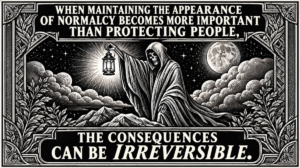
We don’t tell people to wait for several house fires before checking a smoke detector.
We don’t expect an airline to ignore an engineering concern until an aircraft has failed repeatedly.
We understand that credible warnings deserve attention because prevention is part of protection.
Yet in personal relationships, people are sometimes encouraged to tolerate repeated boundary violations before taking precautions.
Human relationships require more nuance than mechanical safety systems, of course. A feeling alone cannot establish another person’s intentions.
But we can still learn something valuable from prevention.
You don’t need a history of repeated harm to justify a reasonable safety precaution.
And if harm has already occurred, the responsibility remains with the person who caused it.
10. Building Self-Trust Should Make Your Life Bigger, Not Smaller
I hope this is where more Survivors eventually find themselves.
Not living in constant suspicion. Not examining every smile for hidden motives or treating every uncomfortable moment as a warning of disaster.
But enjoying their lives while knowing they can respond when something concerns them.
Maybe you begin speaking up a little sooner. Maybe you stop apologizing for needing privacy. Maybe you give yourself permission to leave a conversation without rehearsing a perfect explanation.
And maybe, after years of questioning yourself, you begin noticing how peaceful it feels to make an ordinary decision without asking five other people whether you’re allowed.
That’s a beautiful kind of progress.
You are learning that your relationship with yourself deserves care, honesty, and respect.
A Final Thought for Survivors
There are people who noticed every warning and were harmed anyway.
There are people who never saw danger coming.
There are people who stayed because leaving would have placed them in greater danger. And there are people who were so young when the abuse began that they had no meaningful way to protect themselves.
Their experiences are not failures of self-trust.
We must never turn safety education into another set of impossible expectations for people who have already endured too much.
What we can do is help Survivors reconnect with their own voices.
We can encourage children to speak about discomfort without making them responsible for adult behavior. We can build communities where people are taken seriously when they report concerns. We can stop treating someone’s popularity, charm, or reputation as evidence that another person’s experience must be wrong.
And we can remember that everyone deserves safety, not just the people whose concerns are convenient to hear.
If you’re rebuilding trust in yourself, you don’t have to get everything right tomorrow.
You can begin with something small.
Listen when something bothers you. Give yourself permission to ask questions. Be willing to learn more. Notice how people respond to your boundaries.
And when you discover that you misjudged something, offer yourself the same understanding you would give someone you love.
You’ve probably spent enough time being hard on yourself.
You deserve a relationship with yourself where you are heard, where your concerns are welcome, and where you don’t have to be hurt repeatedly before your safety becomes important.
That’s not living in fear.
That’s learning to live with yourself as someone you can trust.
When We Expand Access, Are We Actually Expanding Protection? – WE Survive Abuse
🚩 Entitlement to Women’s Choices Is Misogyny—No Matter Who It Comes From – WE Survive Abuse
🚨 Control of Language Is a Red Flag for Abuse—And Many Miss It – WE Survive Abuse
