Table of Contents
“History did not begin when Europe started writing about women’s rights. Across the African continent, women had long been educating, organizing, governing, protecting communities, and shaping history in ways the world is still catching up to.”
For generations, many people have been taught a version of history that begins women’s political leadership in the West.
That history is incomplete.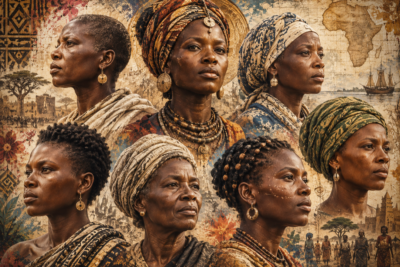
Long before modern conversations about women’s rights gained international attention, African women were leading armies, negotiating political alliances, organizing market economies, preserving knowledge, educating girls, defending their communities, and building networks of women that changed history.
They did not need permission to become leaders.
They became leaders because their communities needed them.
This isn’t about which group of women started the work of “feminism” first. Those error-filled conversations are often instigated by males. For Black women: “Oh, you don’t want to be like those women. Get back in your place.”
I AM saying that it is very important to understand how mighty women have always been. That nurturing has meant serving different roles in the community and not the few select important roles that males feel comfortable handing off to women. The ones more easily managed and overseen by males. Women have ALWAYS used their intuition, nurturing, empathy, compassion, and caretaking in a multitude of ways.
And also, it is important that we all “see” one another. Women of Africa deserve to be seen too.
Here are five African women whose lives remind us that women’s leadership has deep roots across the African continent.
- Yaa Asantewaa (Ghana)
When British officials demanded the Ashanti Golden Stool in 1900—a sacred symbol of the Ashanti nation—many leaders hesitated.
Yaa Asantewaa did not.
As Queen Mother of Ejisu, she challenged the men around her to defend their nation.
According to historical accounts, she declared that if the men would not fight, the women would.
She then led the War of the Golden Stool, one of the last major anti-colonial wars in West Africa.
Although she was eventually exiled, her courage transformed her into one of Africa’s greatest military leaders.
Legacy
Yaa Asantewaa reminds us that leadership is not determined by gender.
It is determined by courage.
-
Funmilayo Ransome-Kuti (Nigeria)
Many people recognize the name Fela Kuti.
Far fewer know the extraordinary woman who raised him.
Funmilayo Ransome-Kuti was a teacher, organizer, and one of Nigeria’s most influential political leaders.
She organized thousands of market women, challenged unfair taxation, founded women’s organizations, and advocated for girls’ education long before women’s political participation became widely accepted.
Her work demonstrated that economic power and political power are deeply connected.
In 1978, soldiers attacked her son’s home and threw the 77-year-old activist from a second-story window. She later died from her injuries.
Even in death, her influence continued to shape Nigeria’s democratic history.
Legacy
Before many people spoke about women’s economic empowerment, Funmilayo was already building it.
- Mekatilili wa Menza (Kenya)
Mekatilili wa Menza understood something colonizers often understood as well:
If you change a people’s children, language, traditions, and education, you change their future. (Please notice that a lot of the pattern of resistance for women wasn’t about simply resisting change. It was about resisting change that only benefitted a select group of men. It was about having a very compelling reason for change that serves the betterment of the community and especially the women and children.)
She resisted forced labor, challenged colonial authority, and encouraged the Giriama people to preserve their cultural identity.
After being arrested and exiled hundreds of miles away, she reportedly escaped and returned home to continue organizing.
Whether every detail of that journey belongs to documented history or oral tradition, one fact remains:
Her leadership inspired generations.
Legacy
She understood that protecting culture is also protecting future generations.
-
Charlotte Maxeke (South Africa)
Charlotte Maxeke believed education could transform society.
One of the first Black South African women to earn a university degree, she devoted her life to expanding education, improving healthcare, organizing women, and advocating for justice.
She founded organizations that encouraged women to become active participants in shaping their communities rather than passive observers.
Legacy
Education was never simply about earning a diploma.
It was about creating opportunities for others.
-
Kimpa Vita (Kingdom of Kongo)
More than three centuries ago, Kimpa Vita challenged political division and called for the reunification of the Kingdom of Kongo.
She preached that Christianity could be understood through African cultural experience and believed faith should strengthen—not erase—her people’s identity.
Her growing influence threatened powerful interests.
She was executed in 1706.
Yet her ideas outlived those who tried to silence her.
Legacy
Ideas rooted in dignity often survive longer than the systems that oppose them.
6. Nana Asma’u (Present-day Nigeria)
This is one of my favorite stories because almost no one outside African history circles knows it.
Nana Asma’u was a scholar, poet, linguist, and educator born in 1793.
She believed knowledge should travel.
Rather than waiting for women to come to schools, she trained a network of women teachers known as the Yan Taru. These educators traveled from village to village teaching women literacy, religion, health, ethics, and practical knowledge.
Think about that.
She created a mobile network of women teaching women in the early nineteenth century.
Legacy
Nana Asma’u understood that educating one woman could strengthen an entire community.
She didn’t simply teach. She multiplied teachers.
7. Nzinga Mbande (Angola)
Nzinga Mbande is often remembered as a warrior queen.
She was that.
But she was also an extraordinary diplomat.
She negotiated treaties, built political alliances, reorganized her kingdom after war, welcomed refugees, and spent decades preserving her people’s independence against Portuguese expansion.
She ruled for nearly forty years.
Legacy
Nzinga reminds us that leadership is not only about winning battles.
Sometimes leadership is keeping a nation alive long enough for another generation to inherit it.
The History We Weren’t Taught
One of history’s greatest oversights is the assumption that women everywhere simply followed Western models of leadership.
The historical record tells a richer story.
Across Africa, women organized communities.
They led armies.
They governed kingdoms.
They managed complex market systems that sustained regional economies.
They negotiated with political leaders.
They educated children.
They preserved languages, traditions, and spiritual knowledge.
They built institutions that strengthened families and communities.
They organized other women—not because someone else had shown them how, but because their own societies called upon their leadership.
Recognizing these histories does not diminish the contributions of Western women’s movements. At all. In my opinion, it expands it. Adds texture to it.
It reminds us that women’s leadership has never belonged to one country, one continent, or one tradition. We female human beings are as amazing as we think we are.
Across the world, women have been finding ways to lead, organize, educate, and protect their communities for centuries.
History is more complete—and more truthful—when we make room for all of their stories.
In Safety-Centered Spaces—Let’s Tell the Truth About Invasion – WE Survive Abuse
5 African Women Who Changed History Before the World Was Ready – WE Survive Abuse
Radical Self-Worth: A Woman is a Miraculous Human BEING – WE Survive Abuse
Why I Resist Diluted Language: Part 3 – WE Survive Abuse
⭐ Why I Resist Diluted Language Like “Birthing People” Part 1 – WE Survive Abuse
✋🏽10 Ways Men Have Tried to Define Womanhood (w/audio) – WE Survive Abuse
Our History Teaches Us to Protect What Remains – WE Survive Abuse