Table of Contents
For generations, women have been told they were imagining “it.”
You can fill in the blank for millions of untold “it” things.
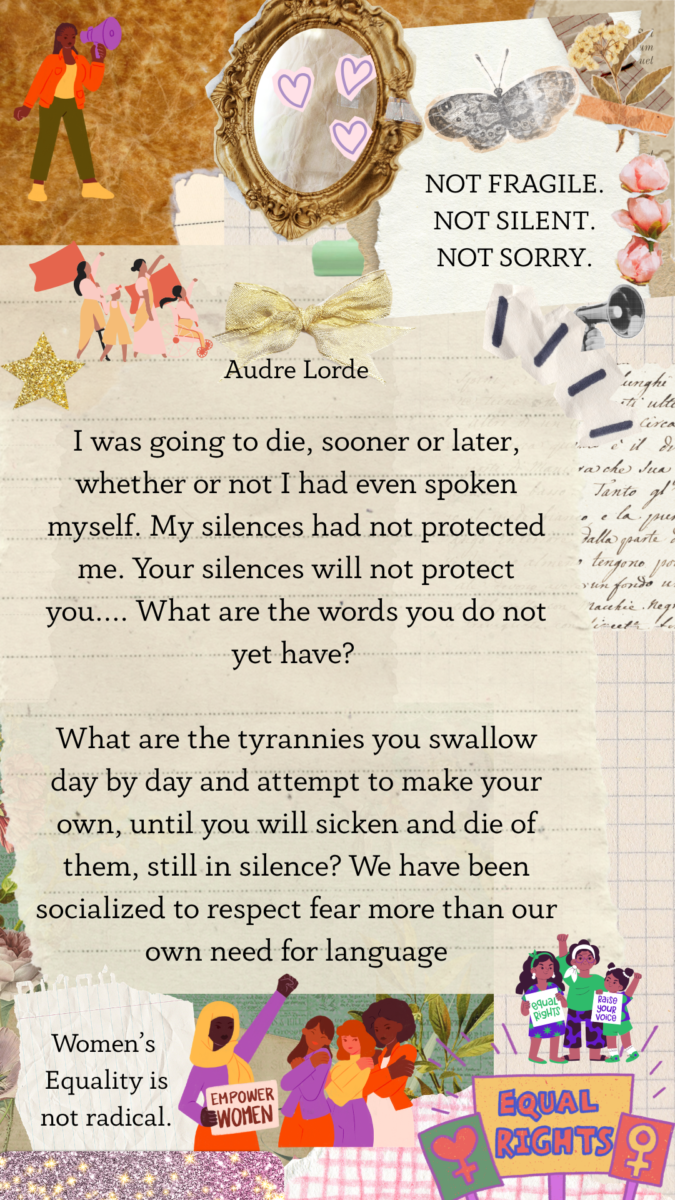
Audre Lorde writing after being diagnosed with breast cancer.
“If you speak up, you’re difficult.”
“If you lead, you’re intimidating.”
“If you set boundaries, you’re hateful.”
“If you ask for justice, you’re angry.”
Yet history tells a different story. Long before many of us were born, people were already trying to describe the discomfort that arises when women refuse to remain small.
This is not about making enemies of men. It is about understanding a pattern that women have lived with for centuries so that we can stop blaming ourselves for it.
When women speak about what hurts them, what scares them, and what concerns them, they are often questioned before they are heard. When they lead, they are often judged before they are respected. When they set boundaries, they are often accused of cruelty instead of recognized for their wisdom.
Audre Lorde understood this deeply.
After her breast cancer diagnosis, Lorde confronted not only illness but also the cost of silence. She examined what she had hidden, what fear had taken from her, and what truths still demanded to be spoken.
For Lorde, speaking was not simply expression.
It was survival. It was liberation without anyone else’s approval or comfort being the precursor. Like so many that I deeply appreciate, she offered greater and better not because she centered men but because men could also readily avail themselves of the truths that she was courageously speaking and writing about.
It was refusing to let fear have the final word. Even facing death, she was picking up her sword and defending herself.
History tells us that the discomfort women experience today is not new. Long before many of us were born, women were already naming what happened when they refused to remain small.
This is not about creating enemies. It is about recognizing patterns. Acknowledging that nearly everything in life has patterns and rhythms.
It is about understanding that when women claim their voices, their freedom, their safety, and their independence, resistance often follows.
And it is about finally releasing women from the burden of believing they caused the discomfort created by their own liberation.
1. Affirmation: I have the right to exist without making myself smaller for someone else’s comfort.
More than one hundred years ago, writers began using words like femiphobia and later feminophobia to describe hostility toward women and fear of women’s growing independence.
In 1914, British suffragist Nina Boyle used the term feminophobia while criticizing the ways governments and institutions restricted women’s freedom, education, work, and political participation.
Soon afterward, another newspaper described feminophobia as opposition to women becoming men’s equals and competitors.
These writers were describing something women already understood:
Sometimes the strongest resistance appears when women begin claiming what should have belonged to them all along.
Journal Questions
- Where in my life have I felt pressure to become smaller so that others would feel more comfortable?
- What part of myself deserves more room to breathe?
2. Affirmation: My boundaries are not cruelty. They are wisdom.
Women have often been praised for their ability to endure while being criticized for their ability to protect themselves. (“They let you do it.”)
History shows that resistance toward women is not always loud.
Sometimes it appears as ridicule and dismissal.
Sometimes: “You’re overreacting.”
Sometimes: “Why can’t you just let it go?”
Women have often been taught that protecting themselves is somehow less admirable than sacrificing themselves.
Healthy boundaries interrupt expectations of unlimited access.
That interruption can make people uncomfortable.
Their discomfort is not proof that your boundary is wrong.
Journal Questions
- Which boundary have I apologized for that never required an apology?
- What would protecting my peace look like this week?
3. Affirmation: My voice deserves to be heard even when it makes people uncomfortable.
Throughout history, women who challenged injustice were often described as emotional, bitter, irrational, or dangerous instead of having their concerns seriously examined. You could put the truth in song, like Billie Holiday did. Put the truth inside of one of history’s greatest vocal performances, and still…problems in the form of dangerous tantrums.
A woman’s tone has often become the focus so that people can avoid addressing the truth she is naming.
This pattern continues today.
Truth is extraordinarily offensive because a woman said it, they say.
Truth does not become less true because it is spoken by a woman.
Journal Questions
- Have I ever softened the truth to avoid upsetting others?
- What truth have I been carrying that deserves to be spoken?
4. Affirmation: I have the right to safety without earning it.
Women do not have to prove they are “good enough” before deserving protection.
Safety is not a reward for perfect behavior.
It is a human right.
Whether discussing violence, harassment, coercion, stalking, or abuse, women deserve systems that begin with dignity instead of suspicion.
A just society asks how to protect women.
An unjust one often begins by asking women to explain themselves.
Journal Questions
- Where have I confused being believed with having worth?
- What does genuine safety feel like to me?
Dear Survivor: You Were Not Born to Absorb Abuse or Protect Harmful Men – WE Survive Abuse
5. Affirmation: My femininity belongs to me.
People sometimes confuse several different ideas.
Misogyny refers to hostility toward women.
Sexism refers to discrimination based on sex.
Femmephobia refers to contempt for or devaluing femininity itself, whether expressed by women or others.
Historically, feminophobia was used to describe fear or hostility specifically toward women becoming more independent and exercising greater freedom.
These are related ideas, but they are not identical.
Understanding the language helps us better understand the patterns.
Language gives women the ability to say:
“This is what I have experienced.”
“This is what I have witnessed.”
“This is what has been happening.”
If language doesn’t empower women to firmly and plainspokenly assert vital and life-saving truths about women’s conditions, women have no choice but to reject it wholesale. You don’t understand when I’m keeping it plain. I most certainly will not allow you to “teach me” vague and foggy language so you can feign more confusion. Pretend not to understand what the hell I am saying so you can keep delaying and denying. But make it more socially acceptable.
Journal Questions
- Have I ever felt pressure to change who I am in order to be taken seriously?
- Which parts of myself deserve to be celebrated instead of hidden?
Why I Resist Diluted Language: Part 3 – WE Survive Abuse
6. Affirmation: Black women have always deserved to be seen in our full humanity.
The earliest discussions of feminophobia came largely from white British suffragists. Their observations about resistance to women’s freedom were important. … gratitude and appreciation.
The women who first wrote about feminophobia helped begin an important conversation. Since then, women from many cultures and communities have added their own experiences, giving us a richer understanding of what women’s freedom has meant across different times and places.
And we can honor that contribution while also telling the fuller story. I believe that is our duty. When others started a fire that gives warmth to humanity, we could at least keep the fire burning. To contribute another layer, Black women have long lived with another reality. Our stories add another layer to that history, one shaped by both racism and sexism.
We have often been expected to carry extraordinary burdens while receiving little protection.
Our strength has too often been mistaken for invulnerability.
Our boundaries have too often been treated as rebellion.
Our wisdom has too often been mistaken for hostility.
Black women were never meant to be symbols of endless endurance.
We were always human, and we just happen to be some of the best humans known to humanity.
Giving love, nurturing, validation, encouragement, and light where we ourselves have been deprived of it.
Naming these patterns is not about division.
It is about telling the whole truth.
Journal Questions
- Where have I been expected to be endlessly strong instead of fully human?
- What would honoring my humanity look like today?
Closing Affirmation and Reflection
I wonder if the women who built the foundation beneath our feet would recognize us as careful stewards of the torches they placed in our hands.
Would they see us protecting the freedoms they fought for?
Would they see us speaking the truths they were punished for naming?
Would they see us refusing to shrink ourselves after generations of being told that our existence was too much?
Because the torch was never passed to us so we could hold it quietly.
It was passed to us so we could keep the light moving forward.
I am not difficult because I have dignity.
I am not threatening because I have boundaries.
I am not dangerous because I speak truth.
I am not less worthy because someone fears free women.
I will not measure my humanity by another person’s discomfort with my freedom.
We have only come this far by speaking and voicing what is actual and factual…and what is true and real.
What truth have I been carrying quietly because I was afraid of what my voice might change?
- “I am deliberate and afraid of nothing.”
— Audre Lorde -
“When I dare to be powerful… then it becomes less and less important whether I am afraid.”
— Audre Lorde, Sister Outsider -
“I have come to believe over and over again that what is most important to me must be spoken.”
— Audre Lorde, Sister Outsider -
“The transformation of silence into language and action is an act of self-revelation.”
— Audre Lorde, Sister Outsider -
“I cannot hide my anger to spare you guilt.”
— Audre Lorde
Women Are Not Small Men: How Sex-Based Disparities Are Still Impacting Women – WE Survive Abuse
The Difference Between Female Vulnerability and Female Weakness – WE Survive Abuse
How Audre Lorde Taught Us to See Women Fully – WE Survive Abuse
Epistemic Control: When Someone Else Tries to Become the Author of Your Reality – WE Survive Abuse
Because She Sang, We Speak: Honoring Billie Holiday’s Legacy of Truth – WE Survive Abuse
Dear Survivor: You Were Not Born to Absorb Abuse or Protect Harmful Men – WE Survive Abuse
UnSilenced: Betty White – WE Survive Abuse
Why I Resist Diluted Language: Part 3 – WE Survive Abuse
When the “Safe” Place Becomes Part of the Trauma – WE Survive Abuse