Listen to her side of this tragic story. She begins with the pastoral picture: open spaces, animals, flowers, fields. It sounds like memory
Listen to her side of this tragic story. She begins with the pastoral picture: open spaces, animals, flowers, fields. It sounds like memory softened by sunlight. Then you notice who is doing the remembering.
She is not describing freedom.
She is describing comfort built on captivity.
She remembers the dairyman April as someone who “didn’t do anything else but love us and skim cream.” That line is chilling because it turns a human being’s forced labor into a sentimental childhood accessory. April becomes an atmosphere. April becomes sweetness. April becomes cream on top of a plantation memory. His inner life, his family, his exhaustion, his lack of legal freedom, and his vulnerability to sale or punishment—all of it disappears.
That is how plantation nostalgia works.
It does not always deny that Black people were present. Sometimes it mentions them constantly. It names them as cooks, nurses, drivers, dairymen, “friends,” helpers, and beloved figures. But it refuses to name the structure holding them there. There were about 100 enslaved human beings on that plantation.
The word “friends” is doing dirty work.
Because friendship requires freedom.
Friendship requires the ability to leave.
Friendship requires equal humanity.
Friendship cannot exist where one person’s family owns the other person’s body, time, labor, movement, children, and future.
The final quote exposes the old paternal lie: enslaved Black people were “like children,” supposedly happy, lazy, playful, naturally dependent. That was not innocent language. That was one of the moral excuses of slavery. If the enslaved were “children,” then enslavers could cast themselves as guardians instead of profiteers.
If Black adults could be imagined as childish, then white domination could dress itself up as care. (Pretending to be in charge of others who need supervision.)
And that is the insult beneath the sweetness.
She is not merely remembering childhood. She is remembering racial power from the nursery window. What a time. That time when she didn’t have to see human beings as people and could simply see people as objects of servitude.
Oppressive systems often preserve themselves through sentimental storytelling. People will call domination “tradition.” They will call control “protection.” They will call unpaid or underpaid labor “family.” They will call hierarchy “the way things were.” And when challenged, they will say, “But we loved them.”
That is another reason why people get angry when you remember, speak, or tell the truth. “How can I keep this lie that is working for me going if you just insist on telling the truth?”
I reject arguments that center this thinking in debates around girlhood and womanhood. Don’t ever tell me that we are on the same team because people who thought this way “didn’t see Black women as women.”
That argument only seeks to put Black women back in a time and place that did not see us, hear us, or respect us. An attempt to say “know your place.”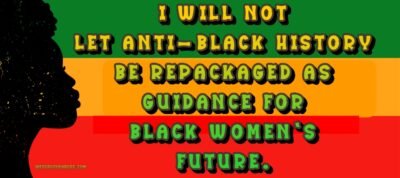
People who thought this way also treated slavery as “service” they were entitled to receive. They treated domination as order, exploitation as tradition, and human suffering as the natural cost of their comfort.
So no, their ideology is not a wise authority on womanhood, girlhood, safety, dignity, or human relations.
They did not see Black people, including Black children, as fully human.
They saw us as objects of service, comfort, labor, pleasure, profit, and commerce. They built entire social, legal, religious, and economic systems around that lie.
So I have a question.
Does the entire people who survived enslavement, torture, family separation, sexual violence, forced labor, and genocide inherit a permanent to-do list from those who once denied our humanity?
Or is that burden only handed to Black women?
Are Black women the only ones expected to keep proving loyalty, softness, usefulness, generosity, and “team spirit” to people who keep trying to define womanhood, safety, dignity, and freedom without us?
Because I reject that.
Black women are not here to be drafted into someone else’s historical argument. We are not here to carry the emotional labor of people who invoke anti-Black history when it helps them, then ignore Black women when we name what is happening to us now.
The same worldview that could not see Black children as children cannot be trusted to teach Black women how to honor girlhood.
The same worldview that could not see Black women as human cannot be trusted to define womanhood.
And the same worldview that treated Black life as service, comfort, and commerce does not get to assign Black women a new position at the bottom and call it solidarity.
Black women do not need to borrow our understanding of womanhood from people who denied our humanity. We do not need permission from the past to name ourselves in the present.
Clip from 1968 documentary “The Heritage of Slavery”, shared by @HistoryNerd on X.com
No one should be able to put lace curtains up on the atrocity that is enslavement in America.
No one should be able to do this when it comes to violence against women and children. We have our own voices and feelings about what it is like to survive in this system. You do not have to allow people to tell you that everything is “fine” and “rosy” when it simply ain’t. If it is dangerous, terrifying, harmful, and potentially life-shortening—as soon as you are safe enough to speak on it—you deserve to have your say.
So when people float that story that comes around every 2-3 weeks about men and women strangers together in a bathroom and everything went so lovely. “We all acted like adults,” they like to say. Those people all but throw in that the people in the bathroom did the line dance together and sang “I’d like to teach the world to sing.”
Or when people are putting all the shine and polish on a life situation you know is not for you, just be cautious. If everyone ignores your story, your pain, or your discomfort, that is unfortunate, and I for one feel for you.
But it becomes dangerous when you start ignoring it too. When other people ignore your story, your pain, and your discomfort, that hurts. But when you start ignoring it too, something sacred inside you is being asked to go silent.
There are too many men who have fond thoughts about this time in history who now want the right to dictate safety, boundaries, and opportunities to women. People who still believe that Black women do not feel like and embrace our own womanhood until someone of a lighter hue gives us “permission” and sees us as their definition of “beautiful.”
You must never place your self worth and validation in the hands of others.
*Remember, sometimes people speak this sweetly about something that is deeply scarring, painful, and life-disrupting for you. Never allow yourself to get used to it.
Sally Hemings: The Founding Father and the Silence He Bought. – WESurviveAbuse
Jim Crow Was About Stripping Boundaries-Not Setting Them – WESurviveAbuse
You Can’t Reason With People Who See Facts as a Personal Attack – WESurviveAbuse
How Abusers and Systems Use “You Have It Good” to Normalize Deprivation – WESurviveAbuse
Safety Is Power. Access Is a Privilege. – WESurviveAbuse