
Table of Contents
I think there is something remarkable about the political and social history of Black American women that deserves much more attention. Yes, the 2026 midterms were historic, but that’s the norm for Black women. When you look at the midterm numbers, notice two things.
1. Black women were where we always were: 92-93% behind, giving the right candidates an opportunity to make it better for the largest number of people. 92% then. 92% now. We said what we said.
2. Black women are a powerhouse in electing leaders that do not look or live as we do. Sometimes we vote for those candidates in larger numbers than the folks who look like them.
3. When we know that we know that we know, our numbers do not change. Because societies and communities do not give Black women grace, understanding, and second chances, and nobody is coming to save us-as a voting bloc-we tend to get it right the first time.
We just don’t have the same FAFO time that others do.
*I’m going to vote for the worst candidate so that other people I don’t like don’t win. This is a classic horror movie-level strategy. That’s how so many classic horror movies begin before everybody but one person dies. And the cat.
Others: “Hey, what’s the worst that could happen, right?”
Black women: “Oh, *&%^. I’ve seen this movie before.”
Others: “Shhhh, no spoiler alerts. LOL”
Sighhhhhhh. We all finna die.
Black American women have a long tradition of entering spaces that were not designed with us in mind, recognizing who else has been left out, and helping build something more useful than what existed before. And I think one reason we have been able to do that across racial, religious, economic, and political differences is that our history has required us to understand several kinds of power at once.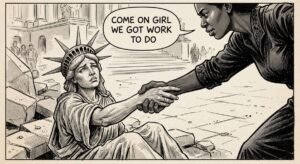
We have had to understand racism without forgetting sexism. We have had to understand sexism without forgetting poverty. We have had to understand poverty while recognizing that not every Black woman is poor, not every white woman is privileged in every circumstance, and not every person who shares our political affiliation shares our priorities.
That is a complicated education. You do not buy that, you live that.
It can produce a particular kind of political wisdom, especially when women turn those experiences into organizing, institution-building, and coalition work.
But I would distinguish what Black women have learned through history from what society expects Black women to provide for everybody else. Those are two very different things.
1. We have a history of recognizing the people who fall through the cracks
Consider the Black women’s club movement of the late nineteenth and early twentieth centuries.
Women organized around education, childcare, public health, employment, racial violence, and community welfare. They created institutions because existing institutions frequently excluded Black people or failed to serve them adequately.
And here is what I find especially interesting.
When you build a childcare program because mothers cannot work without someone caring for their children, you have identified a problem that extends beyond race.
When you fight for decent sanitation, safer housing, or access to education, you are dealing with conditions that can affect entire communities.
A solution can grow out of a particular group’s experience without being limited to that group. That is one of the most valuable contributions of Black American women’s organizing traditions.
2. We learned to work across differences without assuming those differences disappeared
Black women have worked within churches, labor organizations, civil rights groups, women’s organizations, neighborhood associations, and political parties.
Those spaces did not always agree with one another. Sometimes they did not even treat Black women fairly or safely. Yet Black women continued building organizations of our own while participating in broader coalitions.
That’s the difference between cooperation and agreement.
You can work with somebody on voting access without sharing their religious beliefs. You can support a neighborhood safety initiative without agreeing with every position held by the people involved.
And you can recognize a shared problem without surrendering your independent judgment. Coalition-building does not have to mean becoming politically indistinguishable from everybody else in the room.
That is a lesson worth carrying into contemporary politics.
3. We have produced leaders who understand that leadership is not always about being the star
Ella Baker offers a powerful example.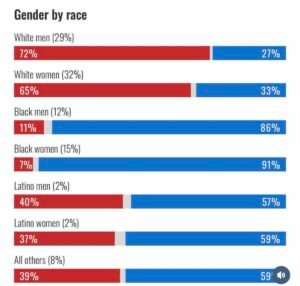
Baker helped develop grassroots leadership during the civil rights movement. She believed ordinary people should have the power to organize and make decisions, rather than depending entirely on celebrated leaders. Her work helped shape the Student Nonviolent Coordinating Committee and its participatory approach to organizing.
There is something politically important about knowing how to make other people effective.
It means listening for the person who has a good idea but little status. It means recognizing that the woman who knows everybody in the neighborhood may understand its needs better than the person arriving with a prestigious title.
This kind of leadership can make a diverse organization stronger because participation becomes something people actually experience, not just something printed in a mission statement.
4. We have practiced political independence, even within our own communities
One of the most overlooked parts of Black women’s history is that Black women have disagreed with one another. Always. Always. Always.
That’s strength building. Some women in the historic club movement favored gradual reform, respectability, and institution-building. Others, including Ida B. Wells-Barnett and Josephine St. Pierre Ruffin, favored more confrontational approaches to injustice. Those disagreements shaped the organizations they built.
That history challenges the idea that Black women are naturally one political bloc.
Even today, research on Black women’s political participation emphasizes differences in age, class, religion, geography, and ideology. Look at the differences among our thinking and approach to issues and divisions today.
Diversity works better when people are allowed to bring their differences into the room without being required to abandon them at the door. Black women have a long history of negotiating that tension.
5. We often understand the difference between representation and actual improvement
There is a difference between inviting a Black woman to sit on a committee and giving her the authority to change what the committee does.
There is a difference between celebrating diversity and asking whether an organization’s policies actually serve the people it claims to represent.
Black women’s political history offers many examples of women who moved beyond seeking recognition to building schools, organizing workers, creating mutual-aid institutions, and expanding civic participation.
A diverse room is not automatically an effective room. Somebody still has to ask who benefits, who bears the costs, what evidence supports the proposal, and whether the promises survive contact with everyday life.
Those questions can make an institution more accountable to everybody, more competitive, and more successful.
6. But there is a price to being everybody’s bridge
Sometimes what people call our extraordinary ability to bring everybody together is also an expectation that we will do the emotional work for everyone, absorb the disagreements, repair the relationships, and keep the organization functioning.
And then, when Black women have our own needs, boundaries, or political disagreements, that same generosity is expected to continue without interruption. That is not an equitable arrangement.
Black women should be able to contribute to a coalition without being responsible for holding it together alone.
We should be able to say, “This proposal does not serve Black women,” or “This policy creates a problem for women and girls,” without having our commitment to cooperation called into question.
A coalition that benefits from Black women’s leadership should also be willing to listen when Black women disagree.
What I think is at the heart of it
There is an old political tradition among Black American women that combines practical service, independent thinking, institution-building, and an understanding of how exclusion operates. Black women experience exclusion not just in white male spaces but many different spaces, including spaces built for women. And you experience this even when your work centers around the advancement of women. Still, to this very day. (There’s a difference between “I don’t agree with you on everything” and complete exclusion.
The pain and setback of that gives you a body of knowledge, cultivated across generations, that American political life has repeatedly drawn upon. After the sharp betraying sting and after the tears, by necessity you become an expert hurdler over obstacles of all shapes, sizes, and textures.
And there is a beautiful historical expression of that tradition: Lifting as We Climb, the motto of the National Association of Colored Women.
We can lift as we climb without agreeing to carry everybody on our backs.
We can make political spaces more thoughtful, more functional, and more welcoming while remaining fully ourselves. We can collaborate across differences without treating every disagreement as a failure of solidarity.
And we can insist that the measure of a diverse political space is not simply how many different people it welcomes, but how seriously it takes their voices once they arrive.