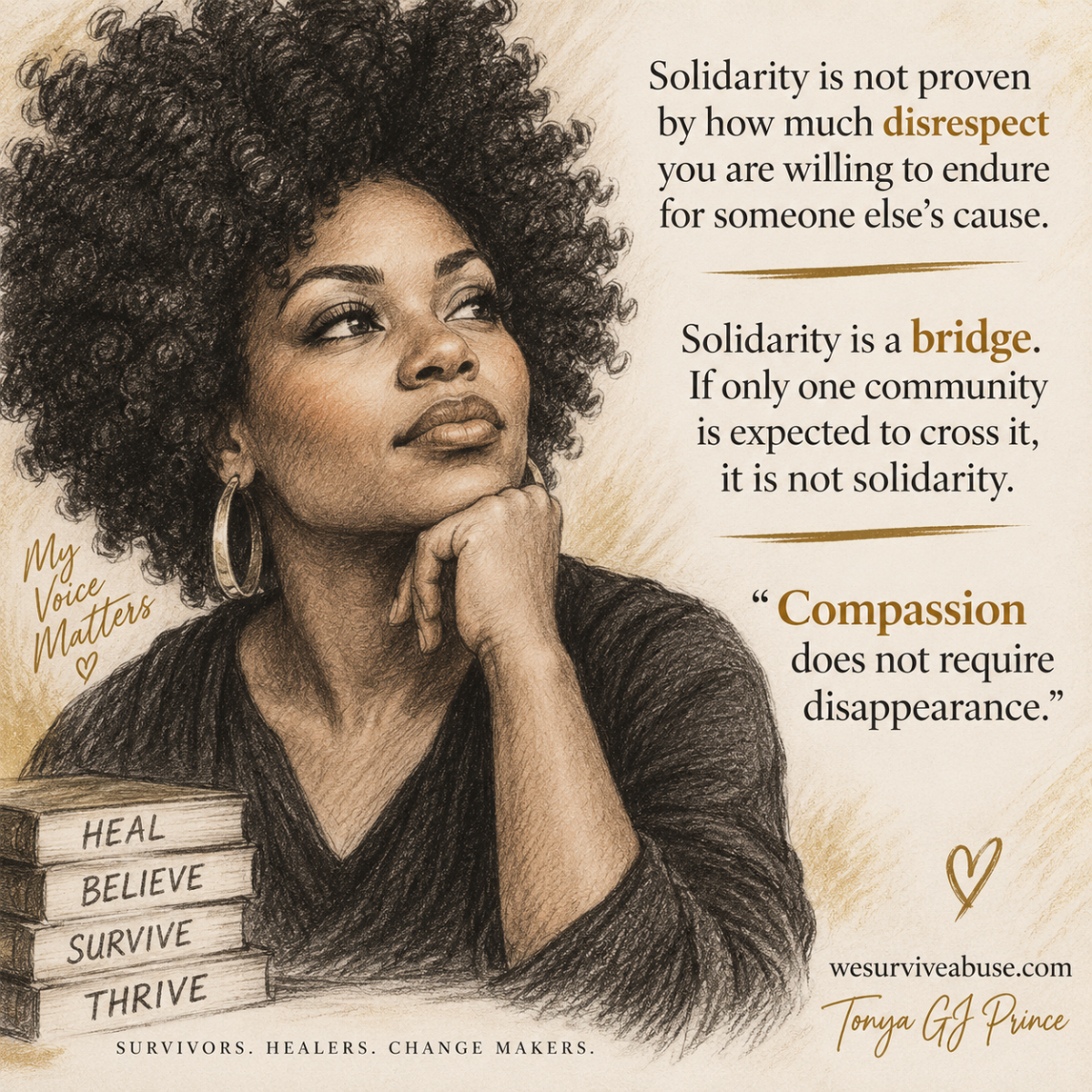
Where did people get this bizarre idea that solidarity doesn't require respect and reciprocity...at a minimum?If you are able, you defin
 Where did people get this bizarre idea that solidarity doesn’t require respect and reciprocity…at a minimum?
If you are able, you definitely want to avoid allowing people to recruit you for battles and wars AND THEN telling you that you must endure disrespect BECAUSE there is a war going on.
This is what Addie W. Hunton encountered during World War 1.
Hunton was already an educator and Black women’s organizer when she went to France during World War I. She was one of only three Black women who reached France before the Armistice to do YMCA work among roughly 200,000 segregated Black troops. She was disheartened to see the sentiment against Black troops who were considered good enough to fight America’s declared enemy but not human enough to get their needs addressed. (Listen to the podcast episode below for more.)
Movements are not a new entity. Urgent causes are certainly not new. Today’s movements seem to believe that the strength and urgency of the cause is a valid reason to disrespect the people asked to join the movement. We can never forget that movements are made up of people with needs, rights, and histories. Movements do not yet make use of AI robots. They NEED the power of human beings.
Movements are often born because somebody is hurting. There is injustice, violence, displacement, poverty, discrimination, war, repression. The stakes may genuinely be enormous. But urgency can slowly become a kind of moral currency: because this situation is terrible, you must give more. Because people are suffering, your boundaries are selfish. Because the cause is righteous, your exhaustion, fear, grief, disagreement, safety, family, community, or dignity must wait.
A community does not become selfish because it asks, Who is standing with us while we are standing with everybody else?
The urgency of a cause does not outweigh the humanity of the people called to serve it. A movement that cannot make room for their dignity, safety, grief, boundaries and obligations is already reproducing something it should be trying to change. Human beings can’t be treated like blockades keeping you from getting where you are going.
Addie Waites Hunton – Archives of Women’s Political Communication
Addie Waites Hunton – Wikipedia
Affirmations
I can love people, support people, defend people and still tell them when something they are doing harms me.
I am not required to absorb unlimited harm simply because I have survived harm before.
I can be generous without making myself endlessly available.
I can serve without becoming servile.
I can offer grace without surrendering discernment.
I can leave spaces that welcome my labor but reject my dignity.
I am allowed to expect respect from the people who ask for my solidarity.
I can carry concern for people across the world while keeping my own people in my work and conscience.
There is room in my heart for more than one grief.
I do not have to choose between humanity and self-respect.
I can cross the bridge for others and still ask who is willing to cross it for me.
My humanity does not become negotiable because someone else’s need is urgent.
I am allowed to notice when reciprocity is missing.
I can stand in solidarity without surrendering my dignity.
I do not have to accept disrespect to prove that my heart is good.
Another person’s emergency does not erase my humanity.
I can hear someone else’s pain without silencing my own.
I will not mistake being needed for being cherished.
I will not mistake endurance for obligation.
I will not mistake silence for solidarity.
My boundary is not a betrayal.
My refusal to accept degradation is not a failure of compassion.
I am allowed to ask whether the care I give is also being extended to me.
I can care about you without disappearing from myself.
What does solidarity actually require—and what happens when only one side is expected to practice it?
In this episode, Tonya GJ Prince begins with a principle that gets lost in conversations about war, injustice and coalition: solidarity is reciprocal. Caring about another community’s suffering should not require ignoring racism directed at your own. Compassion is not supposed to demand self-erasure.
And Black women have encountered this bargain before. During World War I, Black educators Addie W. Hunton and Kathryn M. Johnson crossed the Atlantic to serve Black American troops. But when Johnson sought to work among those soldiers, she encountered an astonishing contradiction: Black men could be sent overseas to fight a world war, yet they could still be characterized as too “rough” for a Black woman sent there to serve them.
Johnson did not simply accept that judgment. Her story opens a much larger conversation about Black women, service, racial stereotypes, boundaries, coalition politics—and what happens when people eagerly accept what Black women provide while becoming uncomfortable when we ask how we and the people we love are being treated.
We can mourn children thousands of miles away and speak about anti-Black racism at the same time. We can stand against atrocities without surrendering our dignity. We can care deeply about another people without disappearing from our own conscience. Because solidarity that only travels in one direction has another name
.And Black women are allowed to ask what comes back across the bridge.