,In my years as a court advocate, there was a dynamic that used to make me so angry. A woman would come forth seeking a protective order. Ma
, In my years as a court advocate, there was a dynamic that used to make me so angry. A woman would come forth seeking a protective order. Maybe she was law enforcement, held a black belt accomplishment, or heck…maybe she was a park ranger and knew how to handle a shotgun. (That day I was stunned. She was a petite woman -tiny-who came to court in her uniform and he said no, she carries firearms and knows how to use them, so…basically, “she’ll be alright.”)
Unfortunately, some judges would view such a woman as “less vulnerable” than other women.
Now I’m talking. There are days when you are accompanying several women in one day. But the one or two women who were deemed to be “strong” were considered “capable of taking care of themselves” Against a MAN. Sometimes a man who told her that he was going to kill her.
Not race, not socioeconomics, not his attorney showing up…sometimes it simply came down to whether or not she was perceived as being “strong” enough to “handle” the threat of a man who told her to her face that he was going to kill her because she set new boundaries, left him, and just wanted to move forward in life. You gotta understand, men tend to kill women when they no longer want to be bothered with them anymore. With the exception of racism or other hate crimes, they kill men who bother them. Women who don’t WANT to be bothered with them.
Which is …a form of a hate crime. I wasn’t bothering you. I was minding my business, and you are trying to harm me.
What is “female vulnerability?”
Female vulnerability refers to the ways women and girls, as a class, can be exposed to particular risks because of a combination of biological realities, social structures, and historical patterns of male violence and dominance. It does not mean women are weak, incapable, or lacking agency. Vulnerability and weakness are not the same thing.
There are several dimensions to it:
1. Physical vulnerability
On average, men have significantly greater upper-body and overall muscle strength than women. That means in a physical confrontation, many women face a disadvantage against many men.
This matters because:
Most sexual violence is committed by men against women and girls.
Most intimate partner homicide victims are women killed by male partners.
Physical coercion or the credible threat of it can shape women’s behavior even when no violence occurs.
Many everyday precautions women take—holding keys between their fingers, sharing their location with friends, avoiding isolated places at night, watching their drinks—reflect an awareness of this vulnerability.
Research consistently finds that, on average:
Men have about 40–75% more upper-body muscle mass than women.
Men produce roughly 50–100% more upper-body strength, depending on the muscle group and how strength is measured.
The differences are especially pronounced in the shoulders, chest, back, and arms because testosterone during puberty drives greater muscle growth.
The gap in lower-body strength is generally smaller:
Men have about 25–50% more lower-body strength on average.
These are population averages, not absolutes. There are certainly women who are stronger than many men—for example, elite female athletes, powerlifters, or women with extensive strength training. But if you randomly pair an average adult woman with an average adult man, the man is likely to have a substantial strength advantage, particularly in the upper body.
Why does this matter?
Upper-body strength is especially relevant in situations involving:
Grabbing or restraining someone
Punching or pushing
Escaping a hold
Carrying or moving another person
Physical intimidation
This is one reason discussions about violence against women often consider sex-based physical differences. It’s not because women lack resilience or capability, but because average differences in physical strength can affect outcomes in physical confrontations.
An example
Imagine:
An average untrained man.
An average untrained woman of similar age.
Even if both are healthy, the man is likely to have considerably greater grip strength, pulling strength, pushing strength, and punching force. Those differences can matter in situations where one person attempts to use physical force against the other.
What this does not mean
It does not mean:
Women are incapable.
Women cannot become very strong.
Every man is stronger than every woman.
Men are naturally violent.
It simply describes a well-established biological difference in average physical capacity that has practical implications for safety, sports, military standards, and discussions about violence. Recognizing this difference is a matter of understanding human biology, not assigning value or worth to either sex.
2. Reproductive vulnerability
Women bear the biological consequences of pregnancy.
Pregnancy can involve:
medical risks,
loss of income,
long-term health effects,
caregiving responsibilities,
and social or economic consequences.
Historically, control over women’s reproductive capacity has been one of the central ways societies have controlled women.
3. Sexual vulnerability
Women and girls are disproportionately targeted for:
sexual harassment,
sexual assault,
trafficking,
coercion,
stalking,
image-based abuse.
Many women begin experiencing unwanted sexual attention while still children or adolescents.
That reality shapes how women move through public spaces, workplaces, schools, and online environments.
4. Social vulnerability
In many cultures, women are expected to:
be accommodating,
avoid conflict,
prioritize others,
maintain relationships,
avoid appearing “rude.”
Abusive people often exploit these expectations.
For example, many women report ignoring their instincts because they didn’t want to seem impolite.
5. Economic vulnerability
Historically—and still in many places—women have had less access to:
property,
credit,
higher-paying jobs,
political power,
leadership positions.
Economic dependence can make it harder to leave abusive relationships.
6. Institutional vulnerability
For much of history, institutions often failed to protect women.
Examples include:
marital rape once being legal in many countries (including the US) and continues to be
sexual harassment being ignored,
domestic violence treated as a “private matter,”
victims facing disbelief or retaliation.
These histories help explain why many women value spaces where they can speak openly with other women.
Female Protection is Acknowledging Reality
Needing protection in the face of a real danger is not weakness. It’s a rational response to reality.
Every society recognizes this principle in other contexts. We protect children because they are more vulnerable than adults. We protect the elderly from exploitation. We install locks on our doors, wear seatbelts, and have workplace safety rules—not because we’re weak, but because we acknowledge real risks.
The same reasoning applies to women in relation to male violence.
On average, men are physically stronger than women, and men commit the overwhelming majority of violent crimes, including sexual violence and most intimate partner homicides. Recognizing those patterns is not a judgment about every individual man; it is an acknowledgment of population-level realities.
Protection is not the opposite of strength. In fact, one of the responsibilities of a just society is to protect people from foreseeable harm. That is why laws, policing, shelters, self-defense training, secure public spaces, and women-only services exist.
It’s also important to distinguish being vulnerable from being powerless:
Vulnerability means you face a greater risk of harm under certain conditions.
Powerlessness means you have no agency or capacity to respond.
Women are vulnerable to certain forms of male violence, but women are not powerless. Women organize, lead, defend themselves, build communities, advocate for change, and create institutions that increase safety. Seeking protection is one of the ways people exercise agency.
Black women have often had to reject two harmful myths at once: the myth that women are inherently weak, and the myth that because Black women are seen as “strong,” they don’t need protection. Both are asserted when people want something from Black women. The stereotype of the “strong Black woman” has too often been used to justify denying Black women care, safety, tenderness, and institutional protection.
The healthier principle is this:
Human dignity includes the right to reasonable protection from predictable harm.
Acknowledging female vulnerability is not surrendering women’s strength. It is recognizing that strength and protection are not opposites. A firefighter wears protective gear. A judge has courthouse security. A journalist in a war zone may wear body armor. None of those precautions diminish their courage. Likewise, women’s desire for safety, boundaries, and appropriate protections reflects prudence in a world where male violence is a documented reality, not a sign of weakness.
Why this matters
Understanding female vulnerability is not about portraying women as perpetual victims. It is about recognizing recurring patterns so that society can respond wisely.
For example, women-only:
domestic violence shelters,
rape crisis groups,
changing rooms,
hospital wards in some contexts,
support groups,
exist because women in those settings may need privacy, recovery, or protection from dynamics that are overwhelmingly associated with male violence or intimidation.
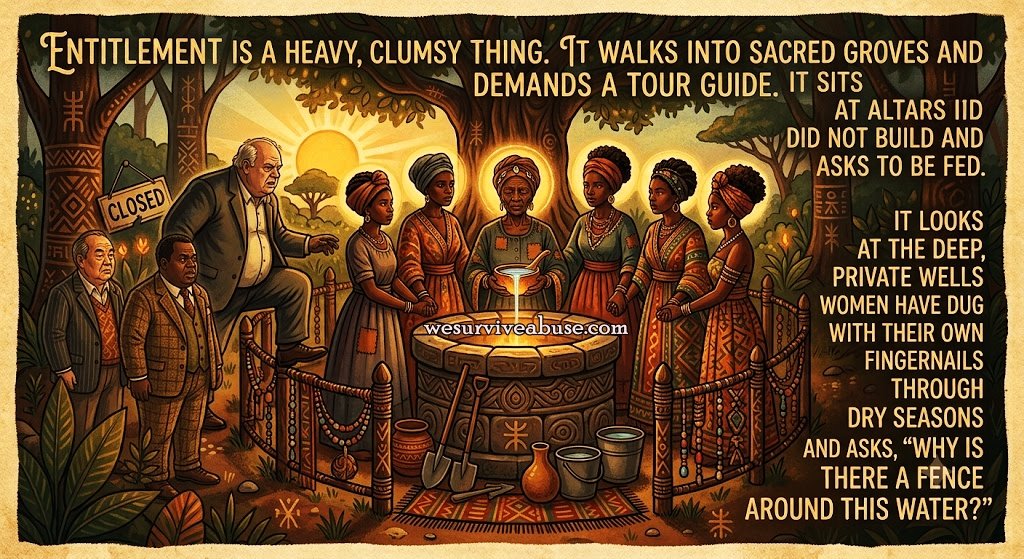
For centuries, our survival was treated as an administrative error if it didn’t serve a man’s comfort. But a woman’s worth is not measured by her hospitality to those who wish to occupy her peace. We are entitled to our borders, our quiet, and our strength.
Black women have long pointed out that female vulnerability cannot be separated from race, class, disability, or other forms of inequality. A Black woman may experience sexism and racism at the same time, creating distinct challenges that neither category alone fully captures.
At the same time, Black women thinkers have often resisted reducing women to victims. Their work emphasizes resilience, community, faith, resistance, and self-determination alongside an honest recognition of danger.
So female vulnerability is best understood as a social reality that calls for thoughtful protections and fair opportunities—not as a statement about women’s worth or capability. Recognizing it allows people to build institutions, policies, and communities that increase women’s safety, dignity, and freedom while affirming their full humanity.
What Is DARVO? How It Harms Black Women and Black Girls – WE Survive Abuse
When Love Feels Like Walking on Eggshells: FAQs About Coercive Control – WE Survive Abuse
Betrayal Blindness: The Cost of Ignoring Harm – WE Survive Abuse