Table of Contents
When men debate whether women deserve safety, they are not having a conversation.
They are auditioning for authority over women’s boundaries.
The year is 2026.
- Violence against women is being organized, taught, filmed, hidden, minimized, monetized, excused, and repeated while society keeps pretending the grey zone is a neutral place.
- In February 2025, multiple reports said women prisoners in Goma were raped and then burned to death after a prison was set on fire during the chaos around the M23 takeover. The Guardian reported that hundreds of women were raped and burned alive after the women’s wing of Munzenze prison was set on fire; other reports cited UN information saying more than 100 or more than 150 women were killed. Hundreds of women raped and burned to death after Goma prison set on fire | Global development | The Guardian
- Every day, women and girls are still being killed by intimate partners or family members.UN Women and UNODC’s 2025 femicide reporting found that gender-related killings continue with “no sign of real progress,” with women and girls most often killed by someone close to them, not a stranger in a dark alley.
- Nearly 1 in 3 women worldwide has experienced intimate partner violence or sexual violence. In 2025, the World Health Organization reported that an estimated 840 million women globally have experienced partner or sexual violence in their lifetime. WHO also noted that this figure has barely changed since 2000. That means the world has been talking for decades while the numbers have stayed brutal.
- UNODC’s 2024 Global Report found that women and girls remained the majority of detected trafficking victims worldwide, accounting for 61% of detected victims in 2022, with many women and girls trafficked for sexual exploitation. Reuters, summarizing the UNODC report, noted that detected trafficking victims rose 25% in 2022 compared with 2019, and that children made up 38% of detected victims. unodc.org/documents/data-and-analysis/glotip/2024/GLOTIP2024_BOOK.pdf?
- In the United States of America, terrified female prisoners are launching complaints about males harming them, and too few will talk above a whisper about it. Women and girls are assaulted by authorities and thank God, everyone has cameras now or very few would believe them.
- Guns make domestic violence far more lethal. Everytown’s research reports that one in three female firearm homicide victims in the U.S. were killed by a current or former intimate partner. A 2025 Everytown report also found that in intimate partner homicide-suicide incidents studied from 2014 to 2020, a firearm was the primary weapon in 85% of cases.
- Digital abuse is becoming part of girls’ ordinary social environment. A 2026 Barnardo’s survey reported by The Guardian found that nearly 1 in 5 girls in the UK had received repeated unwanted images online, and many girls reported being pressured to share nude images.
- Women’s safety keeps getting described as complicated while the lack of action remains simple. The facts point in the same direction: violence against women is common, girls are still being harmed, digital abuse is rising, domestic violence remains deadly, and many women punished by the criminal system have already survived violence before the state ever called them “offenders.”
- Child sexual abuse is still a major safety crisis for girls. The CDC states that about 1 in 4 girls and 1 in 20 boys in the United States experiences child sexual abuse. The CDC also warns that these numbers are likely underestimates because many children do not report right away, or ever.
Women and girls are not only being harmed by isolated acts of violence.
They are being harmed by networks.
They are being harmed by silence.
They are being harmed by delay.
They are being harmed by platforms.
They are being harmed by institutions.
They are being harmed by people who keep saying, “It’s complicated,” while the danger keeps getting organized.
Debates about whether or not women and girls “deserve” safety are still happening in 2026……
Debates about whether or not women and girls “deserve” safety are still happening in 2026……
Historically, every deadly colonization, genocide, enslavement, or other atrocious human rights violation began as a thought, an idea, or a question in search of others who agreed with them.
When people ask:
“Do women really need women-only spaces?”
“Are women exaggerating male violence?”
“Should women be allowed to say no to mixed intimate spaces?”
“Is it fair for women to exclude males from certain healing rooms, shelters, prisons, bathrooms, changing rooms, or support groups?”
Or post something on social media knowing that it is a violation of women’s boundaries, then write, “Thoughts?”
They are not only asking questions.
They are testing how much negotiation women will tolerate around their own bodies.
Because once your safety becomes “debatable,” your refusal becomes “controversial.”
Your boundaries become “discrimination.”
Your fear becomes “bigotry.”
Your evidence becomes “hysteria.”
Your lived experience becomes “anecdotal.”
Your protection becomes someone else’s inconvenience.
That is how danger gets dressed up in intellectual clothing.
Women have already paid in blood, bruises, silence, courtrooms, missing persons flyers, hospital rooms, shelters, graves, and whispered family secrets.
We are not waiting on theory.
We are living with receipts.
So the question is not, “Are women overreacting?”
The question is:
Why are so many people comfortable asking women to prove they deserve safety before they are willing to help create it? Why does a male performance artist who harms women grow in popularity once he harms a female artist more popular than he is? Why do female entertainers and fans become angry, hostile, and ready to throw their own careers away just because someone else told the truth about his violent history?
Why do people who read the same vile, disturbing, and day-ruining headlines we all do keep playing clueless about why women and girls need safety from male violence? Why do people who have no doubt been touched in some way by male violence against women (a relative, yourself, or a child you knew) keep cheering for and advocating for the violent males?
We have to stop crowning violent and harmful males, silencing women and children about safety, and then looking baffled because the world keeps getting more violent and harmful.
This is not “back in the day,” but we keep living like it is.
A woman should not have to sit quietly while people who will never carry her risk discuss whether her risk is real enough to matter. Especially as we live, breathe, and read about missing persons, mysterious deaths, rapes, men marrying little girls who barely understand the full scope of the hell that awaits them, female genital mutilations, femicides, and family annihilations daily…..as the world continues barbarically harming women and girls.
In 2026, we cannot keep talking about women and girls’ safety as if the only problem is misunderstanding. We are seeing femicides. We are seeing trafficking. We are seeing girls harmed by adults who should have protected them. We are seeing online spaces where men share tactics for drugging and sexually assaulting women. We are seeing women prisoners raped during riots and burned when the systems holding them failed to protect them. We are seeing homes, prisons, platforms, families, faith spaces, schools, and institutions become places where danger is excused, hidden, or debated until it is too late. This is not a grey area. This is a pattern.
Some people call it “nuance.”
Some call it “hearing all sides.”
Some call it “not rushing to judgment.”
But when endless debate leaves women and girls exposed, it is not wisdom. It is delay.
In this episode, we talk about the people and institutions that spend too much time camping in the grey area while women are told to doubt their feelings, soften their boundaries, question their instincts, and wait for protection that never comes.
Drawing from the parable Jesus tells in Matthew 21 about the two sons, we look at the difference between saying the right thing and doing the actual work. The son who sounded obedient did not go into the vineyard. The son who went did the will. That lesson still speaks.
A society does not get credit for saying it cares about women and girls while refusing to build guardrails. A community does not get credit for saying it believes Survivors while debating them out of their own warning signs.
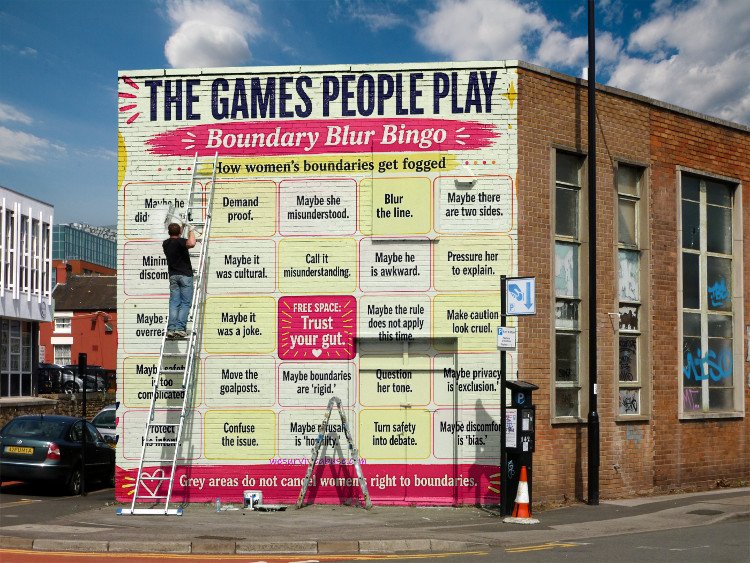
A church, school, family, movement, or institution does not get credit for “dialogue” when no safety plan follows. This teaching is for the women who have been told they were “overreacting.”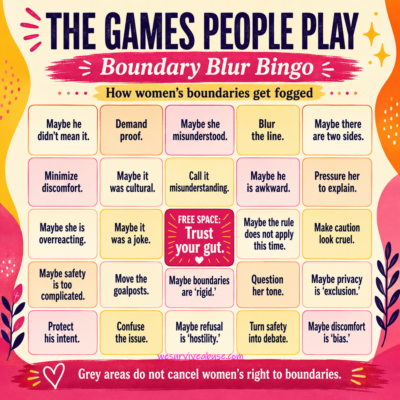
For the girls whose discomfort was explained away.
For the Survivors who were asked to keep talking while danger kept walking free.
For the safe adults who are done confusing endless discussion with protection.
Grey areas require lanterns to see clearly.
Grey areas require guardrails to protect women and girls.
Grey areas require action.
Bring a plan.
Bring protection.
Bring the work.
But do not bring another debate and call it safety.
Women’s safety is not a debate, and boundary blurring often begins when people use grey areas, ‘maybe’ language, and endless discussion to talk women and girls out of trusting their own discomfort.
Nearly 1 in 3 women worldwide has experienced intimate partner violence or sexual violence. In 2025, the World Health Organization reported that an estimated 840 million women globally have experienced partner or sexual violence in their lifetime. WHO also noted that this figure has barely changed since 2000.
That means the world has been talking for decades while the numbers have stayed brutal.
Miss women and girls with ignorant conversations about our safety. We are trying to survive. Make this world a safer place for us or stop pretending you are talking about safety.
Debates about whether or not women and girls “deserve” safety are still happening in 2026…. as male violence against women and children continues to steal our safety and lives.
New Survey: 1 in 10 Men Have Carried Out Sex Offenses Against Children – WESurviveAbuse
Qasim Rashid, Esq: Women Are Not Safe Around Men – WESurviveAbuse
🛑 You Can’t Build Something Sacred on Disrespect – WESurviveAbuse
🔥 What Is Gaslighting? – WESurviveAbuse
The Bench at Maple and Ninth: When Men Decide Whether Women Get Boundaries (audio) – WESurviveAbuse
Because I Don’t Want To: The Power of Women’s Final Answer – WESurviveAbuse
9 Dangerous Myths About Violence Against Women and Children – WESurviveAbuse
Rape Behind Bars: The Untold Dangers of Mixed-Sex Prisons for Women – WESurviveAbuse