
 What happens when somebody else has the institutional power to decide what kind of woman you are—and the power to punish you when you refuse to obey?
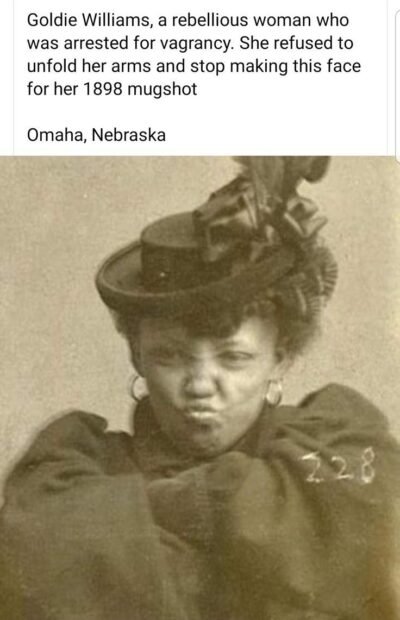
In 1898, Omaha police arrested twenty-two-year-old Goldie Williams for vagrancy and photographed her as prisoner 228. She stood before the camera in hoop earrings and an extravagant feathered hat, her arms folded across her chest and an expression people are still trying to interpret more than a century later.
A few years earlier in Georgia, Mattie Crawford had entered an even harsher machinery of American law. Convicted of killing a stepfather she said had abused her, Mattie was sentenced to life and sent into Georgia’s convict labor system. At the Chattahoochee brickyard, guards forced her out of her skirts and into trousers for blacksmithing work, reportedly whipping her until she complied.
Then Mattie became very good at the work.
By 1903, she was the sole blacksmith at Georgia’s state prison farm, a trusty whose skill had become known beyond the prison grounds. And when officials finally told her she could put her dresses back on, Mattie Crawford refused.
In this audio, we follow Goldie and Mattie into a largely forgotten history of African American women, vagrancy laws, convict leasing, forced prison labor, race and gender in the post-emancipation United States. Their experiences were different, and we keep them that way. Together, their surviving records leave us with a question that reaches beyond either woman’s life:
What happens when somebody else has the institutional power to decide what kind of woman you are—and the power to punish you when you refuse to obey?
Journey Down the Rabbit Hole
-
Goldie Williams — History Nebraska. This is our strongest institutional source for Goldie: her January 29, 1898 arrest for vagrancy, prisoner number 228, the name Meg Murphy, Chicago residence, occupation, physical description, injuries recorded by police, clothing, and photograph.
History Nebraska: Goldie Williams -
“A Woman Blacksmith,” The Atlanta Constitution, August 31, 1903 — Georgia Historic Newspapers. This is especially important because readers can inspect the contemporary newspaper themselves. It reports Mattie Crawford’s life sentence, her statement that her stepfather abused her, her work at the Chattahoochee brickyard, blacksmith training, guards forcing her into trousers, the whippings, her later refusal to return to dresses, her work as the prison farm’s blacksmith, and her status as a trusty. The article also contains a photograph of Mattie.
Read the 1903 Atlanta Constitution page -
Talitha L. LeFlouria, Chained in Silence: Black Women and Convict Labor in the New South — University of North Carolina Press, 2015. This is the essential scholarly work behind the larger story. LeFlouria reconstructs the lives and labor of incarcerated African American women in Georgia and restores women such as Mattie Crawford to a history often told primarily through men.
UNC Press: Chained in Silence -
Talitha L. LeFlouria, “Under the Sting of the Lash: Gendered Violence, Terror, and Resistance in the South’s Convict Camps.” Particularly useful for understanding Mattie’s resistance to the trousers and LeFlouria’s interpretation of gender, coercion and resistance. Importantly, LeFlouria herself qualifies the report that Mattie wanted to learn blacksmithing, writing “if what is said is true.”
Read LeFlouria’s article -
New Georgia Encyclopedia, “Chattahoochee Brick Company.” Excellent background on the place where Mattie was sent, the company’s use of convict labor, the economics of Georgia’s lease system and the racial structure surrounding it. The company was one of Georgia’s largest users of convict labor.
Chattahoochee Brick Company history -
New Georgia Encyclopedia, “Convict Lease System.” Useful for following the institutional history: Georgia’s first lease in 1868, the expansion and profitability of the system, documented brutality, its abolition in 1908 and the chain-gang system that followed.
Georgia Convict Lease System history -
New Georgia Encyclopedia, “The New South and the New Slavery: Convict Labor in Georgia.” A particularly accessible overview for listeners who want to understand the larger post-emancipation story, including African American women and juveniles in convict labor, vagrancy laws, the Thirteenth Amendment’s punishment exception, convict leasing and the transition to chain gangs.
Explore the Convict Labor in Georgia exhibition - When the State Stops Saying “Mother”: Why Inclusive Language Must Still Include Women – WE Survive Abuse
- Women’s Health and Safety Watch: June 2026 – WE Survive Abuse
- ⭐ Why I Resist Diluted Language Like “Birthing People” Part 1 – WE Survive Abuse
- Part 2: Why I Resist Diluted Language – WE Survive Abuse
- Why I Resist Diluted Language: Part 3 – WE Survive Abuse