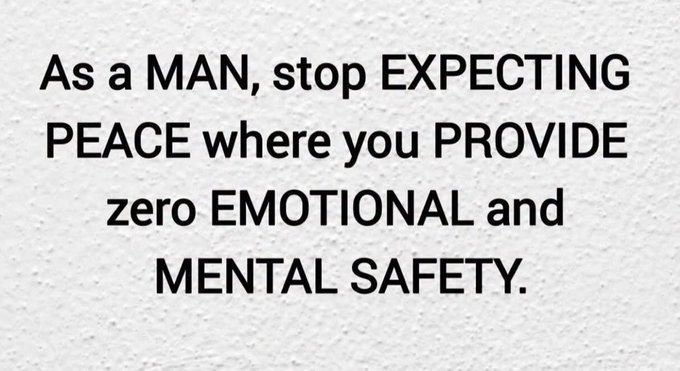
Identity is not a shield. A label is not a character reference. A man can be kind in public and entitled in private. A man can understand oppression a
Identity is not a shield. A label is not a character reference. A man can be kind in public and entitled in private. A man can understand oppression and still practice it. A man can call himself an ally and still be counting, in the back of his mind, what a woman owes him for it.
This is not about who a man says he is. This is about how he treats what is in front of him: a whole human being, not a resource.
Here are 10 signs
1. He believes access to a woman’s body is something he deserves.
He treats attraction, love, marriage, kindness, attention, or time as a down payment. In his mind, if he is patient enough, generous enough, persistent enough, the debt comes due. “No” doesn’t register as an answer — it registers as a delay. He doesn’t hear “I don’t want this.” He hears “not yet.” A woman’s body is not a vending machine that dispenses access once the right combination of behavior is entered. There is no combination. There is no code. There is only her decision, and her decision is complete the moment she makes it.
Affirmation: Your body was never a transaction. It answers to no accumulated kindness, no invested time, no one’s patience. It is yours, fully, permanently, without appeal.
2. He values women more for what they provide than who they are.
He can list what she does — the meals, the comfort, the sex, the way she makes him look good, the way she holds the household or the relationship together — long before he can list what she wants for her own life. Ask him about her fears, her ambitions, the shape of her inner world, and he goes quiet. He has been living off her output while remaining a stranger to her interior. That is not love. That is consumption with a soft voice.
Affirmation: You are not the sum of what you provide. Your worth was never up for renegotiation based on your output. You are a whole world, not a service.
3. He sees boundaries as rejection instead of respect.
A limit is information. It tells him where she is, what she needs, what keeps her safe and whole. But to a man who sees her as a resource, a boundary is an obstacle course — something to charm around, wear down, guilt through, or wait out. He doesn’t ask “what does this boundary protect?” He asks “how do I get past it?” That question alone reveals everything.
Affirmation: Your boundaries are not cruelty. They are not games. They are the architecture of your safety, and you owe no one an apology for building them.
4. He believes his desire creates a claim.
Wanting is not owning. Longing does not sign a deed. He can want her with his whole chest and it changes nothing about what belongs to her and her alone: her body, her time, her attention, her future. Desire is a feeling he is having. It is not information about her obligations.
Affirmation: Someone’s wanting you does not obligate you. Their hunger is theirs to manage. Your yes is the only thing that has ever mattered, and it is yours to give or withhold.
5. He expects women to carry emotional labor without recognition.
He comes to her exhausted and leaves her exhausted. She is his therapist, his translator, his emotional weather system, his soft place to fall — and somehow, none of that registers as work. It’s just “who she is.” Meanwhile her own exhaustion goes unnoticed, her own need for softness goes unmet, because in his accounting, only his depletion counts as real.
Affirmation: Your emotional labor is real labor. Your tenderness is not a bottomless well, and you are allowed to need tending, too — not just to give it.
6. He supports women’s freedom only when it benefits him.
He loves her independence — right up until it means she disagrees with him, leaves him, or chooses something other than him. He was never celebrating her freedom. He was celebrating a version of freedom that kept orbiting around his comfort. Real support for a woman’s autonomy doesn’t come with an expiration date the moment that autonomy stops being convenient.
Affirmation: Your freedom does not require anyone’s permission or approval to remain yours. It was never conditional, and it never will be.
7. He treats women’s bodies as symbols instead of lived experiences.
He will argue about her body in the abstract — her reproduction, her clothing, her sexuality, her worth — as if she is a debate topic and not a person standing in the room breathing, deciding, living. Somewhere in the argument, the actual human being gets lost underneath the symbol he’s built out of her.
Affirmation: You are not a symbol, a talking point, or a battleground. You are a person with a real, lived, breathing life, and your experience outweighs anyone’s theory about you.
8. He believes being a “good man” should guarantee access to women.
He points to his kindness, his identity, his struggles, his self-improvement, as though they are currency that should be redeemable for her body, her time, or her affection. But goodness is not a coupon. Being decent is the baseline for being in relationship with another human being — it is not a transaction that entitles him to anything from her.
Affirmation: No one’s résumé of decency entitles them to you. Your access is not a prize for good behavior. It is a gift, given freely or not at all.
9. He dismisses women’s experiences when they challenge his comfort.
The moment her account of harm makes him uncomfortable, the subject quietly changes — to his intentions, his reputation, his feelings, his side of the story. Her experience gets treated as an inconvenience to be managed rather than a truth to be reckoned with.
Affirmation: Your account of your own life does not need his comfort to be true. What happened to you does not require anyone’s permission to matter.
10. He wants dignity for himself but negotiates the dignity of women.
He can articulate, in detail, every way he has been diminished, disrespected, or dismissed — and in the very next breath, diminish, disrespect, or dismiss a woman without noticing the contradiction. Understanding your own oppression should widen your capacity for empathy. For some men, it only sharpens their sense of what they’re owed.
Affirmation: Your dignity is not up for negotiation by anyone — including someone who understands, in their own body, exactly what it feels like to be denied theirs.
Women are not resources. Women are not rewards. Women are not therapists, sexual access points, symbols, or proof of someone else’s character.
A just world runs on one simple truth: every person owns their own body, their own choices, their own humanity — completely, without asterisks.
The real measure of a man is not whether he demands dignity for himself. It’s whether he extends that same dignity to every woman in front of him, especially when it costs him something.
Calling Women “Hateful” for Wanting Safety Is Abuse Dressed in Decorum – WE Survive Abuse
Facing Reality: Identity Does Not Erase Patterns of Male Violence – WE Survive Abuse