
Table of Contents
We recognize the expectation that women should accommodate men. We recognize the practice of dismissing women’s objections as emotional, irrational, or uninformed. We recognize the habit of treating women’s sacrifices as evidence of goodness.
People in the future will get a kick out of this one. It is nearly 2027, and the media will bring on a panel of men to answer the question, “What is a woman?” As if to inform women of who WE are.
Anyway…..Women are tired of being told that recognizing sexism and misogyny requires some extraordinary level of intellectual sophistication.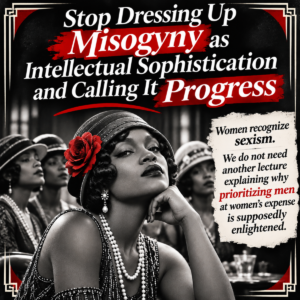
We have heard enough explanations about why women should wait, accommodate, reconsider, sacrifice, and understand. We have watched familiar forms of sexism return wearing the language of “compassion, progress, and the greater good.”
There is a difference between examining a complicated issue and using complexity to avoid answering a simple question.
Women should not have to earn the right to be heard by mastering somebody else’s academic vocabulary.
And women are allowed to understand an argument perfectly well and still reject it.
1. Women’s Humanity Diminished
Public arguments sometimes discuss women as categories to be managed rather than human beings with their own judgment, needs, and ambitions. Their lived experiences become secondary to abstract theories, political objectives, or institutional reputations.
Women are not intellectual exercises. We are people who must live with the consequences of decisions other people debate.
2. Accountability Selectively Applied
Institutions may demand strict accountability from ordinary women while extending repeated opportunities for rehabilitation to influential men. A woman’s objection can become a scandal while a powerful man’s misconduct is explained away as complicated.
Fairness requires consistent standards, including when the accused is admired, wealthy, politically useful, or powerful.
3. Women’s Choices Overridden
Women may be told that decisions have already been made for their benefit. When they object, their disagreement is interpreted as evidence that they do not understand what is good for them.
This is an old form of paternalism. Deciding what women should want and then criticizing them for wanting something else is not liberation.
4. Women’s Labor Taken
Women are often expected to provide the emotional and practical work of keeping families, organizations, communities, and political coalitions functioning. Their contributions may remain invisible until they withdraw them.
Women are praised for holding everything together, but that praise means little when they are denied the freedom to decide how much they are willing to give.
5. Female Independence Punished
A woman who refuses to organize her life around men’s approval may be described as selfish, bitter, difficult, or hateful. Her independence becomes a problem because it challenges expectations that she should prioritize other people’s comfort.
We have spent generations confronting those expectations. There is nothing progressive about bringing them back.
6. Women’s Equality Postponed
Women may be told that their concerns must wait until a supposedly more urgent political objective has been achieved. They are expected to demonstrate solidarity by accepting disadvantages today in exchange for promises about tomorrow.
Women have heard versions of this argument throughout history. Equality that must always wait for somebody else’s permission is not equality.
7. Progress Defined Selectively
Social change is celebrated because it benefits one group without adequately examining its consequences for women and girls. When women raise concerns, they may be accused of standing in the way of progress.
But progress is not established by announcing it. It must withstand questions about fairness, consequences, and whose interests are being protected.
8. Female Autonomy Treated Conditionally
Women are encouraged to think independently until their conclusions conflict with institutional preferences. Their autonomy is then recast as ignorance, prejudice, or an inability to understand sophisticated arguments.
Apparently, some people believe women should think for ourselves only when we arrive at approved conclusions.
That is not independence.
9. Women’s Protection Politicized
Safety measures may be defended or opposed primarily because of their political symbolism. The practical circumstances of women using shelters, hospitals, prisons, changing rooms, and other facilities can receive insufficient attention.
Women should not have to apologize for asking how policies will affect their privacy, dignity, and safety. Those are legitimate questions, not intellectual shortcomings.
10. Misogyny Politically Rehabilitated
Conduct once recognized as demeaning toward women may be excused when the person responsible is useful to a political movement. The same movement may condemn similar behavior when it comes from its opponents.
This is how principles become political conveniences. If humiliating women, dismissing their boundaries, or silencing their objections is wrong, it does not become right because someone calls it progress.
When Women’s Disagreement Is Treated as a Failure to Understand
There is something particularly insulting about the suggestion that women disagree because we simply have not understood the argument.
As though another lecture will finally make us recognize the wisdom of surrendering something we have already considered and decided to protect.
As though another academic paper, another philosophical theory, or another impressive title after somebody’s name will settle the question.
We can appreciate scholarship. We can recognize competing interests. We can acknowledge that some legal and ethical questions genuinely are complicated.
But unlearning sexism does not require us to forget what sexism looks like.
We recognize the expectation that women should accommodate men. We recognize the practice of dismissing women’s objections as emotional, irrational, or uninformed. We recognize the habit of treating women’s sacrifices as evidence of goodness.
These patterns did not become unfamiliar simply because the vocabulary changed.
You can dress an old prejudice in new language, surround it with impressive credentials, and deliver it from a prestigious institution.
But the question remains:
Who is expected to surrender something, and who is being told they deserve it?
An argument can be intellectually complicated and still be morally weak. It can cite philosophers, invoke justice, and appeal to the greater good while failing to account for the women who must live with its consequences.
And when women point out those consequences, the response should not be another lecture about why we have failed to understand.
Sometimes we understand perfectly well.
We understand what is being asked. We understand who is expected to accommodate whom. We understand that the proposed arrangement may benefit someone else while costing us something we value.