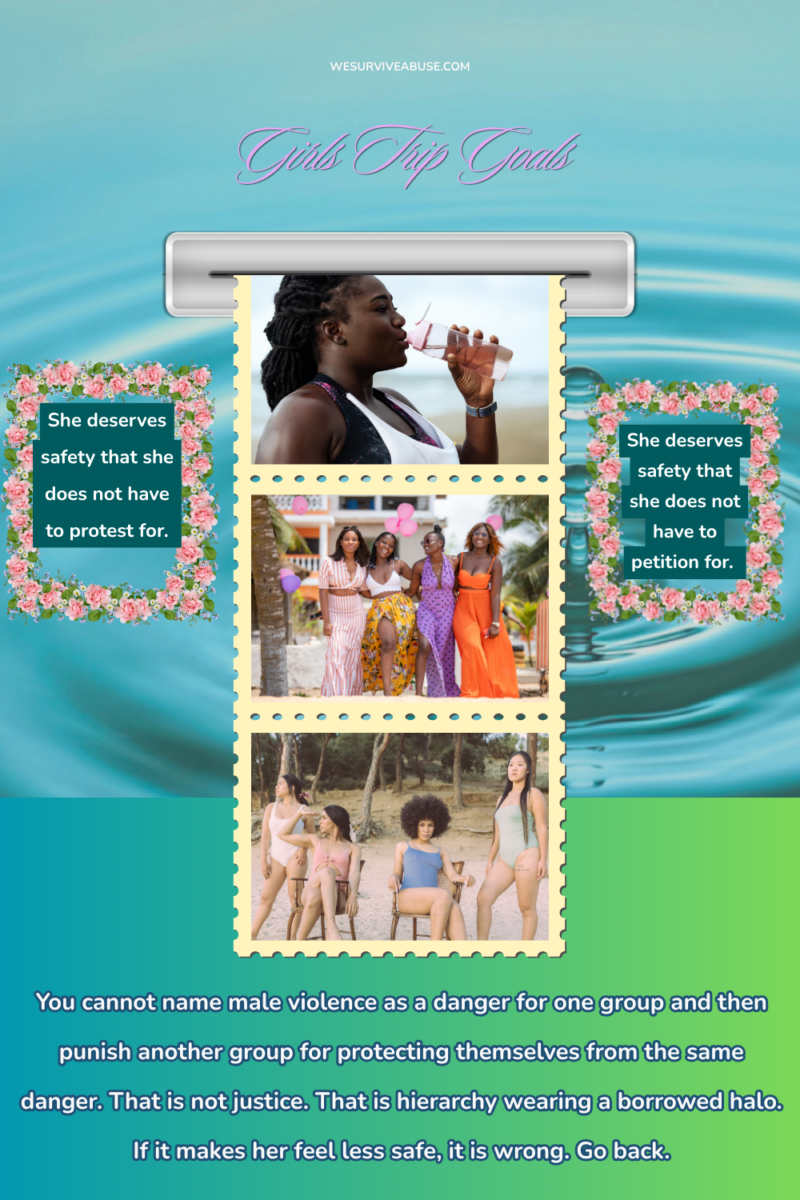
You cannot name male violence as a danger for one group and then punish another group for protecting themselves from the same danger. That i
You cannot name male violence as a danger for one group and then punish another group for protecting themselves from the same danger. That is not justice. That is hierarchy wearing a borrowed halo.
Shared danger: male violence.
Double standard: one group gets protection, another gets punishment.
False moral costume: hierarchy pretending to be justice.
Sometimes society admits, quietly or loudly, that two groups are vulnerable to male violence against women and girls.
But then it turns around and says:
Only one group may name the danger.
Only one group may organize around it.
Only one group may request protection without being called hateful.
Only one group may have boundaries without being accused of cruelty.
Only one group may be believed when they say, “We are at risk here.”
And that is not protection.
That is selective permission.
It says the danger is real, but not everyone gets to respond to it.
It says the pattern exists, but only certain people are allowed to build shields.
It says some people’s fear is “valid,” while other people’s fear is “bigotry,” “paranoia,” “selfishness,” or “exclusion.”
That is where the unfairness becomes plain.
Because if male violence against women and girls is real, then women and girls need the right to name it, prepare for it, set boundaries around it, and refuse conditions that increase their risk.
Not just when society finds their vulnerability sympathetic.
Not just when their protection fits a fashionable script.
Not just when their pain can be used to support somebody else’s argument.
All women and girls who face male violence deserve serious protection.
Black women.
Disabled women.
Elder women.
Poor women.
Women in prisons.
Women in shelters.
Women in hospitals.
Girls in schools.
Women in faith spaces.
Women in bathrooms, locker rooms, medical settings, group homes, crisis centers, and anywhere else privacy and power meet.
And here is the part people keep trying to dodge:
You cannot claim to care about male violence while denying women the practical boundaries that help prevent it.
That is like admitting the storm is coming, then confiscating umbrellas from half the neighborhood because their shelter makes somebody uncomfortable.
The deeper issue is this:
Some people do not want women protected.
They want women managed.
They want women’s fear translated into softer words.
They want women’s boundaries made negotiable.
They want women’s safety needs filtered through someone else’s feelings before they are treated as real.
And when women refuse that arrangement, the accusation arrives fast.
“Mean.”
“Divisive.”
“Unkind.”
“Unsafe.”
But women saying no is not violence.
Women naming risk is not cruelty.
Women asking for female-only spaces in intimate, vulnerable, high-risk settings is not a failure of compassion.
It is pattern recognition.
It is memory.
It is survival wisdom.
If we agree that male violence puts women and girls at risk, then protections cannot be granted selectively. Women do not lose the right to safety because their boundaries inconvenience someone else’s belief system. Most men have beliefs around safety and women and girls. Women and girls have life-and-death reality everywhere on this planet.
Women are not shields for men’s comfort. Women are not shields for men’s access. Women are not shields for men’s beliefs. Women are not shields for men’s violence.
Women are not shields for men.
We are not the padding placed between danger and public reputation.
We are not the soft place where hard truths are hidden.
We are not the sacrificial bodies society offers up so that all forms of male violence does not have to be named out loud.
A protection that requires women to stand in front of danger so someone else can feel included is not protection. It is sacrifice dressed up as kindness.
Women are not shields for men.
Women are not proof of anybody else’s kindness.
Women do not owe danger their bodies so a room can keep calling itself compassionate.
ADDITIONAL READING
23 Common Excuses Used to Downplay Safety Risks for Women – WESurviveAbuse
Malcolm X Wisdom: When Lies Become the Environment, Safety Disappears – WESurviveAbuse
A Debt of Safety: Moving Beyond the “Infinite Well” of Women’s Care – WESurviveAbuse
When Someone Else’s Path Becomes a Rulebook for All Women – WESurviveAbuse
Maleness Is Portable Power: 20 Reasons Women Are Still Asked to Move Over – WESurviveAbuse
Risk Doesn’t Rise by Accident—What Happens When Care is Uneven for Black Women – WESurviveAbuse
Jim Crow Was About Stripping Boundaries-Not Setting Them – WESurviveAbuse
We Need Politicians Who Center Women’s Real Lives – WESurviveAbuse
🚫 It Violates Women’s Boundaries: Abuse Disguised as Entitlement – WESurviveAbuse
🖤 It Isn’t Discipline. It’s Domination Disguised as a Lesson. – WESurviveAbuse
I Wish You No Harm—But This Doesn’t Work for Me: The Truth About Women’s Boundaries – WESurviveAbuse
Why Do They Say We’re “Against Men” Just Because We Want to Be Safe? – WESurviveAbuse
Inclusion Should Never Cost Girls Their Safety – WESurviveAbuse