
Table of Contents
There has always been somebody ready to tell women how to be women.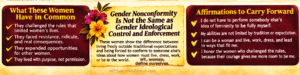
And isn’t it something how often those instructions have come from people who weren’t the least bit interested in listening to women?
They told us what to wear, what to study, how to behave, and which jobs were suitable for us. They told us that a respectable woman should be agreeable, modest, obedient, and careful not to embarrass the people around her.
For Black women, those expectations came with another set of rules. Racism determined which doors we could enter, which opportunities we could pursue, and how much independence society was prepared to tolerate.
But some women looked at those rules and decided they were going to live anyway.
They didn’t all agree about politics, religion, marriage, or femininity. Some wore dresses and loved them. Others preferred trousers. Some married, some didn’t. Some raised families. Others devoted their lives to professions that society insisted were unsuitable for women.
What they shared was a refusal to let other people decide the limits of their womanhood.
And their stories remind us that gender nonconformity isn’t some new invention. Women have been challenging restrictive expectations for generations.
1. Ida B. Wells: She Wasn’t Going to Be Quiet Just Because Someone Expected Her To
Ida B. Wells understood that being a Black woman in America came with expectations about obedience.
She was expected to know her place.
In 1884, she refused to leave a first-class railroad car when ordered to move to segregated accommodations. She challenged the railroad in court and initially won, although the Tennessee Supreme Court later reversed the judgment.
Wells went on to become one of America’s most important investigative journalists.
When white mobs lynched Black Americans and powerful people tried to justify the violence, Wells investigated the claims. She examined evidence, published her findings, and exposed the lies.
Her newspaper office was destroyed in 1892. She continued her work from outside Memphis.
I think about the women who are still told that speaking forcefully makes them angry, aggressive, or difficult.
Wells reminds us that sometimes the people complaining about a woman’s tone are far more comfortable with injustice than with the woman exposing it.
She wasn’t obligated to make the truth comfortable.
2. Bessie Coleman: She Wanted to Fly, and That Was Reason Enough
Imagine telling a young Black woman that she couldn’t learn to fly an airplane because she was Black and female.
That was the world Bessie Coleman encountered.
American aviation schools refused to admit her. So she learned French, traveled to France, and earned her pilot’s license in 1921.
She became the first Black woman to earn a pilot’s license.
Coleman didn’t wait for American institutions to decide that aviation was appropriate for women like her.
She found another way.
And she wanted other Black people to have opportunities in aviation, too.
There is something wonderful about that determination.
She didn’t need to prove that flying was feminine. She didn’t need to persuade anybody that an airplane was an appropriate place for a woman.
She wanted to fly.
Sometimes freedom begins when a woman stops defending the reason for her dream.
3. Elizabeth Packard: Her Husband Had Her Committed Because She Wouldn’t Agree With Him
Elizabeth Packard’s story deserves far more attention than it receives.
In nineteenth-century Illinois, Packard disagreed with her husband, a minister, about religious beliefs and other matters. He considered her views unacceptable.
In 1860, he arranged to have her committed to the Illinois State Hospital for the Insane.
At the time, Illinois law gave husbands extraordinary authority to have their wives confined without the ordinary commitment proceedings required for many other people.
Packard spent approximately three years institutionalized.
A woman disagreed with her husband, and the consequences included losing her freedom.
Her own understanding of her mind, her beliefs, and her experiences could be dismissed because someone with authority over her insisted that she was mentally unwell.
But Packard did not surrender her judgment.
After her release, she continued fighting for her rights. In 1864, a jury found her sane following a legal proceeding initiated after her husband confined her at home.
She went on to write books, organize, and advocate for changes to marriage laws and protections for people confined in psychiatric institutions.
She also worked to expose abuses and improve patients’ legal rights.
Packard’s advocacy helped bring attention to the danger of allowing one person to exercise unchecked power over another person’s liberty.
And here is something I especially want readers to consider.
When a woman is punished for disagreeing, the issue is no longer simply what she believes. It is who has the power to make her pay for believing it.
Packard’s story is not an argument against mental health treatment. It is a warning about what happens when mental health systems are misused to silence people and deny them due process.
She knew what it meant to have someone else claim authority over her thoughts.
Then she spent years trying to make sure other people had greater protection.
4. Alice Coachman: The Girl Who Wasn’t Supposed to Become an Olympic Champion
Alice Coachman grew up in Georgia during segregation.
As a Black girl, she faced barriers to athletic facilities and organized training. Opportunities available to white athletes were not equally available to her.
She practiced running and jumping using the resources she could find.
And she became extraordinary.
At the 1948 London Olympics, Coachman won the women’s high jump, becoming the first Black woman to win an Olympic gold medal.
A girl who had been denied equal access to athletic opportunities stood on the Olympic podium as a champion.
Her achievement challenged racial exclusion and the notion that girls should limit their physical ambitions to activities society considered appropriately feminine.
Coachman didn’t need people to lower the standards.
She needed the opportunity to meet them.
Her talent was already there. The opportunities had to catch up.
5. Mary Ann Shadd Cary: She Wasn’t Waiting for Men to Give Her a Voice
Mary Ann Shadd Cary was born free in Delaware in 1823.
She became an educator, abolitionist, journalist, and women’s rights advocate.
In 1853, she established The Provincial Freeman in Canada, becoming the first Black woman in North America to publish a newspaper.
At a time when women were often discouraged from public leadership, Shadd Cary used journalism to argue for abolition, education, independence, and opportunity.
She was outspoken, intellectually independent, and unwilling to accept that women should remain silent while men conducted the important discussions.
She later studied law at Howard University and became one of the earliest Black women to earn a law degree in the United States.
Shadd Cary’s life is particularly interesting because she did not simply demand inclusion.
She created institutions and opportunities through which Black people could exercise greater independence.
There is a lesson there for women who have spent years waiting for someone to invite them into the room.
Sometimes you build another room.
6. Pauli Murray: A Brilliant Mind That Would Not Stay Inside Society’s Categories
Pauli Murray was a lawyer, writer, civil rights advocate, and Episcopal priest.
Murray challenged racial segregation and sex discrimination, helping develop legal arguments that later influenced major civil rights advances.
In 1940, Murray and a friend were arrested after refusing to comply with segregation on a Virginia bus.
Murray later helped articulate the ways sex discrimination operated through law and institutional practice.
In 1977, Murray became the first Black woman ordained as an Episcopal priest.
Murray’s personal experiences of gender were complex, and historians have examined Murray’s writings about identity and embodiment. Those experiences deserve careful treatment rather than forcing Murray into a simple contemporary category.
But one thing is unmistakable.
Murray questioned systems that assigned people inferior legal standing because of race or sex.
And Murray did something else worth appreciating: used legal reasoning to expose contradictions in institutions that claimed to value equality while maintaining discriminatory rules.
Sometimes the most powerful challenge to an institution is asking it to apply its own principles consistently.
7. Althea Gibson: She Wouldn’t Accept That Tennis Belonged to Somebody Else
Before Serena and Venus Williams became household names, Althea Gibson was challenging racial barriers in professional tennis.
Gibson grew up in Harlem and developed into an exceptional athlete.
But talent did not erase segregation.
She encountered restrictions that kept Black players out of important competitions and limited their opportunities to advance.
In 1950, Gibson became the first Black player to compete in the U.S. National Championships, the predecessor of today’s US Open.
In 1956, she became the first Black player to win a Grand Slam singles title, at the French Championships.
She went on to win Wimbledon and the U.S. Nationals in 1957 and 1958.
Gibson’s achievements challenged racial exclusion in a sport long associated with white privilege.
And she did so as a woman competing at the highest level.
I think about how often women’s sports are treated as something less serious than men’s competition.
Gibson’s life offers a useful response.
She trained, competed, won, and made history.
The seriousness of her work did not depend on whether everyone was prepared to recognize it.
8. Shirley Chisholm: Unbought, Unbossed, and Unwilling to Shrink
Shirley Chisholm became the first Black woman elected to the United States Congress in 1968.
Four years later, she sought the Democratic presidential nomination.
She entered a political world in which the people holding power were overwhelmingly male and white.
Chisholm faced racism and sexism, including opposition from people who questioned whether a Black woman should seek the presidency.
But she did not accept that leadership was somebody else’s territory.
Her famous campaign slogan, Unbought and Unbossed, captured her political independence.
I especially appreciate the way Chisholm challenged the expectation that women should be grateful merely to be included.
She wasn’t running to decorate the political process.
She had ideas, convictions, and a constituency to represent.
A woman does not become less of a woman when she exercises authority.
9. Mary Edwards Walker: She Wore Trousers Because She Wanted To
Dr. Mary Edwards Walker was a physician, Civil War surgeon, women’s rights advocate, and the only woman to receive the Medal of Honor.
She also preferred wearing trousers.
During the nineteenth century, women’s clothing could be heavy, restrictive, and impractical for physically demanding work.
Walker believed women should have greater freedom to dress for their comfort, health, and activities.
Her clothing choices attracted ridicule and public hostility. Historical accounts also describe arrests connected to her unconventional dress.
But Walker continued wearing what suited her.
What I find interesting is that a woman could be educated, capable, and dedicated to serving others, yet people still treated her clothing as an offense against proper femininity.
Walker did not need a new definition of womanhood.
She needed people to stop treating a woman’s trousers as a threat to society.
10. Esther Rolle: She Was Willing to Be Called Difficult
Esther Rolle gave television audiences one of the most memorable Black mothers in American sitcom history.
As Florida Evans on Good Times, she portrayed a woman who loved her family, valued education, and insisted on dignity even while struggling financially.
But Rolle also had concerns about how the program portrayed Black family life.
She objected to the growing emphasis on J.J.’s exaggerated behavior and the direction of the show’s writing.
She believed the program could do better.
Her disagreements with the production became public, and she eventually left the series before returning for its final season.
Rolle’s story is worth revisiting because women in professional settings are often expected to remain agreeable even when they have legitimate concerns.
A woman who insists on standards may find that the conversation suddenly becomes about her personality.
Is she difficult?
Is she demanding?
Does she think she’s better than everyone else?
But those questions can distract from what she is actually saying.
Rolle wanted Black families portrayed with dignity.
And she was prepared to challenge the people making the decisions.
Sometimes being called difficult means a woman has stopped making everybody else’s comfort her responsibility.
What These Women Understood About Freedom
These women did not live identical lives.
They did not all challenge the same institutions or face the same consequences.
For some, the struggle involved racial segregation. For others, it involved professional exclusion, legal restrictions, or expectations about proper feminine behavior.
Elizabeth Packard faced something particularly frightening: the use of psychiatric confinement against a woman who disagreed with her husband.
Ida B. Wells faced racial violence and threats for exposing injustice.
Alice Coachman and Althea Gibson challenged barriers in athletics.
Esther Rolle challenged the people who controlled the stories Black Americans saw about themselves.
Different circumstances. Different risks.
But one question keeps returning.
Who gets to decide what a woman is allowed to be?
And who gets to punish her when she refuses?
Gender Nonconformity Is Not the Same as Gender Ideological Control and Enforcement
There is an important distinction here.
Gender nonconformity concerns the freedom to live outside traditional expectations of femininity and masculinity.
A woman can wear trousers, pursue a profession traditionally associated with men, reject marriage, enjoy sports, or live without performing conventional femininity.
None of those choices makes her less female.
Gender ideological control and enforcement, as we’re using the phrase, concerns attempts to make people conform to prescribed ideas about gender through institutional power, coercion, or punishment.
Historically, those ideas frequently involved traditional sex roles.
Women were told they should be obedient wives, modest daughters, agreeable employees, and deferential citizens.
Some rules were enforced through law. Others through employment policies, social exclusion, or professional consequences.
And that history gives us a useful way to examine contemporary disagreements without assuming that every rule or request is coercive.
We can ask whether an institution is regulating conduct for a legitimate purpose or attempting to compel agreement with a particular belief.
We can ask whose rights are affected and whether disagreement is permitted.
We can also recognize that freedom of expression belongs to people whose views differ from our own.
The freedom to live differently and the freedom to disagree should not automatically be treated as enemies.
We Owe These Women More Than Admiration
I think about how easily we celebrate women after history has proven them right.
We put their faces on posters. We repeat their quotations. We teach children about their accomplishments.
But while many of these women were alive, they were not always celebrated.
They were questioned.
They were excluded.
Some were punished.
Others had to fight for opportunities that should never have been denied.
And I wonder whether we are always as generous toward women who challenge expectations in our own time.
Because it is easy to admire a woman who refused to follow the rules a hundred years ago.
It can be much harder to respect a woman who is questioning the rules today.
That doesn’t mean every challenge is correct or every objection is justified. It means women deserve the freedom to think, question, and participate without their character becoming the price of admission.
The women in these stories remind us that individuality is not a defect to be corrected.
A girl can be brilliant, athletic, outspoken, quiet, ambitious, unconventional, traditional, or some combination nobody expected.
She does not have to prove that her interests are sufficiently feminine.
She does not have to surrender her judgment to be considered respectable.
And she does not have to spend her life trying to become somebody else’s approved version of a woman.
The women before us did not challenge one set of restrictive rules so we could spend our lives obeying another.
They helped make room.
We should be careful not to close it.
Original Affirmations to Carry Forward
1. I do not have to perform somebody else’s idea of femininity. My interests, abilities, and choices are part of my life, not evidence that I have failed to be a woman.
2. I can speak when someone expects silence. I can question an institution without surrendering my dignity. My disagreement does not make me defective.
3. I honor the women who challenged the rules before me. Their courage reminds me that what society calls impossible may simply be something women have not yet been permitted to do.
4. I am allowed to be an individual. I do not owe anyone a performance of femininity to earn respect.
5. My freedom includes the right to think. I can listen, learn, reconsider, and disagree without handing another person authority over my conscience.
A Question Worth Keeping
When somebody tells a woman that she must dress, behave, speak, or believe a certain way to be recognized or respected, ask:
Who made that rule? Who benefits from it? And what happens to the woman who refuses?
Elizabeth Packard: The Woman They Called Incurable Until She Changed the Law – Brighter Faith
Esther Rolle Was Called a Troublemaker. Her Answer Was, “But So Be It.” – Survivor Affirmations
We Are Not Meant to Disappear Inside Someone Else’s Reflection – WE Survive Abuse
