Autonomy is powerful. But it is not a shield. Not in this world. A woman can know herself.She can have boundaries, voice, purpose, and strength.And s
 Autonomy is powerful. But it is not a shield. Not in this world.
A woman can know herself.
She can have boundaries, voice, purpose, and strength.
And still be harmed.
She can choose her words with care.
She can live by principle.
She can be brilliant, successful, deeply loved—and still experience abuse, manipulation, or violence.
That’s not weakness.
That’s the world we live in.
A world that too often punishes women for daring to stand tall.
We must stop measuring the value or credibility of Survivors by how “independent” they were, how “strong” they were, how many red flags they did or didn’t miss.
This is not about missing signs.
It’s about people ignoring stop signs.
It’s about a world that teaches some people they are entitled to overpower others, even in the face of “no,” “stop,” or silence.
A woman’s autonomy is not an invisible force field.
It is sacred.
But it still deserves protection.
Some of the strongest, most iconic women in history have written or spoken about surviving abuse—reminding us that power, beauty, and brilliance do not offer immunity.
Eve – rapper and actress, has spoken about surviving an abusive relationship early in her career.
Pam Grier – legendary actress, shared experiences of sexual abuse and relationship violence in her memoir Foxy: My Life in Three Acts.
Sandra “Pepa” Denton – from Salt-N-Pepa, wrote about enduring abuse in her memoir Let’s Talk About Pep.
Tina Turner – music legend, spoke out against decades of brutal abuse in her relationship with Ike Turner.
Megan Thee Stallion – rapper and cultural force, publicly testified about being shot and ridiculed after.
Rihanna – globally acclaimed artist and entrepreneur, survived a high-profile assault by a former partner.
Mary J. Blige – shared her history of childhood sexual abuse and abusive adult relationships.
Queen Latifah – shared that her brother’s death led to unresolved grief and abuse in a relationship.
Fantasia Barrino – American Idol winner, revealed she was in a controlling and abusive relationship.
Terry McMillan – author of Waiting to Exhale, survived a relationship with emotional manipulation and betrayal.
Claudia Jordan – TV personality, has spoken out about being in a physically abusive relationship.
Karrine Steffans – author of Confessions of a Video Vixen, wrote about being exploited and abused throughout her life.
Tamar Braxton – singer and reality star, opened up about being in a violent and controlling relationship.
KeKe Palmer – actress and advocate, filed a restraining order and bravely discussed experiences of abuse and being silenced.
Nina Simone – iconic musician, wrote and sang about the deep pain, racial trauma, and interpersonal abuse she endured.
Lisa “Left Eye” Lopes – of TLC, experienced abuse in her early life and later relationships, speaking about it in interviews.
Lauryn Hill – though private, her lyrics and statements suggest experiences of emotional trauma and exploitation.
- K. Michelle– has spoken candidly in interviews and through her music about surviving an abusive relationship, particularly with a former partner in the music industry.
- Halle Bailey– Halle was granted a temporary restraining order against her ex, rapper/streamer/DDG (Darryl Dwayne Granberry Jr.), citing years of physical, verbal, emotional, and financial abuse throughout their relationship. The court awarded her temporary sole legal and physical custody, with a 100-yard protective order to shield Halle and their child. A temporary restraining order was granted in favor of DDG, requiring Halle to stay 100 yards away from him—but only until the hearing could take place.
- Lupita Nyong’o-wrote a powerful New York Times op-ed detailing how, while a student at Yale School of Drama in 2011, she endured two separate instances of sexual harassment by Harvey Weinstein
- Chaka Khan– revealed that during a tumultuous relationship with her second husband, she experienced a terrifying moment: he punched her in the face while she was eight months pregnant with their son, Damien. 2003 memoir Chaka! Through the Fire,
- Donna Summer- survived sexual assault by a minister early in her life, endured violent relationships that affected not only her but also her family. Love to Love You: Donna Summer (HBO).
- Kerri Shanelle Harris, 31, female professional working as a Quality Assurance Manager at a Cargill facility in DeKalb County, Georgia. Master’s degree. She was not dating or even friends with the man who worked at the same company that she did. But after her rejections, her and repeated reports to human resources he murdered her. Kerri was not made aware that he had been convicted of taking another female’s life before.
- Shani Baraka, and her partner, Rayshon Holmes, –In 2003, Amiri Baraka’s daughter, Shani Baraka, and her partner, Rayshon Holmes, were murdered in a brutal act of domestic violence. They were found together. Two Black women who loved each other. Two women who were in the home of their Shani’s sister trying to protect her from her abusive estranged husband. Instead, when he found Shani and her partner Rayshon at the home, he murdered them.
- Betty Davis– briefly married to jazz legend Miles Davis (1968–1969), funk music pioneer in her own right. 2018 documentary Betty: They Say I’m Different brings this to light, combining powerful accounts and her own reflections to honor her truth. (Miles Davis denies violence against her). Critics highlight the deep toll her tumultuous marriage took on her both personally and professionally — Betty eventually withdrew from the spotlight and lived in quiet solitude in Pittsburgh for decades newyorker.com.
“Every day married to him was a day I earned the name Davis,”
and later reflects,
“I told no one of how Miles was violent” en.wikipedia.org+6nowtoronto.com+6enterthevoyd.com+6en
These women were bold. Brilliant. Resilient.
And still, someone tried to break them. End them.
So if someone harmed you, it doesn’t mean you weren’t powerful.
It means they were wrong.
Let’s be clear about this:
Your strength doesn’t mean you “should have known better.”
Your independence doesn’t cancel out someone else’s wrongdoing.
Your power doesn’t mean people won’t try to strip it from you.
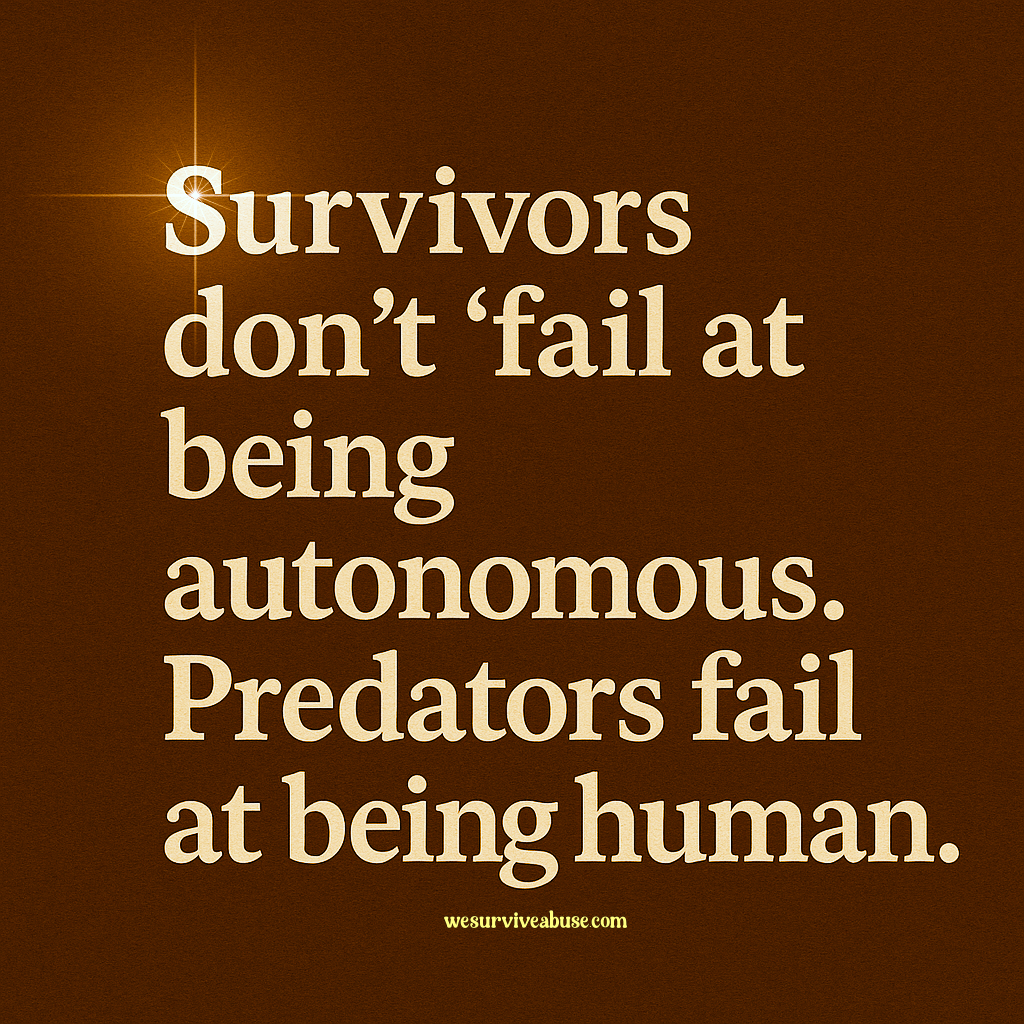
Survivors don’t “fail” at being autonomous.
Predators fail at being human.
If this happened to you, it’s not because your armor was thin.
It’s because someone chose to strike.
And you are not to blame.
**Please stop hammering Survivors with your silencing and do what too few in this world do. LISTEN. I have talked to thousands of Survivors. Each and every one of them taught me something new and enlightening.
I strongly support autonomy. But, to date, autonomy has not stopped stalking, a hammer, a speeding car, a punch, a bullet, a push, or two hands around any woman’s neck.
Please stop blaming victims for not stopping violence when entire governments and systems have fallen short.