
Table of Contents
There are cases that remind us why understanding domestic violence cannot be limited to advocates, shelter workers, police officers, or women who have already lived through it.
Everybody needs to understand this.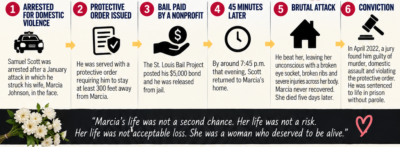
Families need to understand it.
Friends need to understand it.
Judges, nonprofits, employers, medical professionals, journalists, policymakers, and communities need to understand it.
Because sometimes what looks like an ordinary decision to someone who does not understand domestic violence can have enormous consequences for the person living inside it.
The killing of Marcia Johnson is one of those cases.
Marcia Johnson, Part 2: Follow the Chain. Why Was Her Safety Riding on $5,000? – WE Survive Abuse
1. 🚨 The story did not begin on the night Marcia was fatally attacked.
On January 6, 2019, according to court records, Samuel Lee Scott struck his wife, 54-year-old Marcia Johnson, on the right side of her face, causing injuries around her ear and cheekbone.
But there was something else.
According to the probable-cause statement, Scott also threatened that he might as well “finish what he started” because she was going to contact police.
🔎 PATTERN TO RECOGNIZE
Violence + threat + victim seeking help
These pieces should not be viewed separately.
The violence tells us something.
The threat tells us something.
And threatening a woman because she is going to contact authorities tells us something about how her attempt to seek protection is being received.
Domestic violence is rarely understood well when we examine each incident as though nothing came before it and nothing could come after it.
2. 📝 Marcia sought protection.
By April, Scott was arrested and held on a misdemeanor domestic-assault charge stemming from the January attack.
An order of protection barred him from coming within 300 feet of Marcia or entering her home.
That detail deserves more than a passing sentence.
TRANSLATION
A protective order tells someone:
You may not cross this boundary.
But paper cannot physically stop a person determined to cross it.
Protective orders can be extremely important. They can establish legal boundaries, create consequences for violations, and become part of a larger safety strategy.
They are not force fields.
3. 💵 A nonprofit posted his $5,000 bond.
On April 9, the St. Louis Bail Project posted Scott’s $5,000 bond.
The organization was part of the national Bail Project, whose work challenged the inequity of keeping people jailed before trial simply because they could not afford bail. The organization later said it did not know about the protective order when it posted Scott’s bond and maintained that a person with enough money could have obtained pretrial release without its assistance. (True)
That context belongs in the story.
And so does Marcia.
Because criminal-justice reform and victim safety should not require us to pretend that domestic-violence risk disappears.
⚖️ TWO THINGS CAN REQUIRE OUR ATTENTION
Poverty should not determine justice.
AND
Domestic-violence victims require serious safety assessment.
Those principles do not have to be enemies.
4. ⏰ He went back to the woman he had been ordered to stay away from.
Scott was released.
That evening, he returned to Marcia’s home.
Contemporary reporting placed him there around 7:45 p.m. A friend later found Marcia gravely injured and unconscious. Court records described a broken eye socket, several broken ribs, and bruising across her body.
She never recovered.
Marcia Johnson died five days later.
🚨 LOOK AT THE SEQUENCE
Previous assault
⬇️
Threat connected to her contacting police
⬇️
Arrest
⬇️
Protective order
⬇️
Release
⬇️
Return to Marcia
⬇️
Violation of the order
⬇️
Fatal violence
This is why knowledge about domestic violence matters.
Individual pieces can look very different when you understand the pattern they form together.
5. 🧠 Domestic violence is not simply “a couple fighting.”
This misunderstanding has cost women dearly.
Domestic violence can involve physical violence, threats, intimidation, stalking, coercive control, sexual violence, destruction of property, financial abuse, monitoring, isolation, and repeated violations of boundaries.
Sometimes people outside the relationship see only individual incidents.
He hit her.
They argued.
She got an order.
He called again.
He showed up.
But someone trained to recognize abusive patterns may ask a different question:
What is happening across time?
That question can reveal something the individual snapshots conceal.
6. 📈 Escalation deserves our attention.
Not every abusive relationship follows the same course, and not every abuser becomes homicidal.
But previous violence and threats are not meaningless history.
When violence becomes more severe, when threats emerge, when stalking begins, when an abuser repeatedly violates boundaries, or when a woman is attempting to separate, those circumstances can carry important information about danger.
🔎 PATTERN RECOGNITION
Don’t only ask:
“What happened today?”
Also ask:
“What has been happening?”
And:
“Is it getting worse?”
That is one of the differences between seeing an incident and recognizing a pattern.
7. 🗣️ A woman’s fear is information.
This is something I wish more people understood.
When a woman living with an abusive person tells us:
“I’m afraid of him.”
we should not automatically translate that into:
She’s emotional.
She’s overreacting.
They’re having relationship problems.
She’ll calm down.
He hasn’t done anything that serious.
Fear can contain information.
She knows things about him that the rest of us may not know.
She has seen him angry.
She knows what makes him escalate.
She knows whether he has threatened her.
She knows whether he follows her.
She knows whether he respects boundaries.
She knows what happens after everybody else leaves.
Listening to a woman’s assessment of her own danger does not require abandoning evidence or due process.
It requires recognizing her as a source of evidence about her own life.
8. 🚪 A boundary only protects someone when violations are taken seriously.
Scott had been ordered to remain at least 300 feet from Marcia and not enter her home.
He returned anyway. His eventual convictions included violating the order of protection.
That gives us another lesson.
BOUNDARY:
Stay away from her.
VIOLATION:
He goes back.
WRONG QUESTION:
Why didn’t she just keep him away?
BETTER QUESTION:
What happens when the person creating the danger refuses to obey the boundary?
We ask women to establish boundaries constantly.
Sometimes the problem is not that the woman failed to establish one.
The problem is that somebody decided her boundary did not apply to him.
9. ⚠️ “He hasn’t killed anybody” is not a safety assessment.
This is an especially dangerous way of thinking about violence.
Every person who commits a first homicide once had no homicide conviction.
The absence of the worst possible outcome yesterday cannot prove that the worst possible outcome will not happen tomorrow.
That doesn’t mean we predict murder every time someone commits domestic violence.
It means we assess risk rather than waiting for catastrophe to provide certainty.
LOOK AT THE DIFFERENCE
❌ “He hasn’t killed anybody.”
versus
✅ “What indicators of serious or escalating danger are present?”
The second question gives us somewhere useful to go.
10. ❤️ Good intentions do not eliminate the need to understand domestic violence.
This may be one of the hardest lessons in Marcia’s case.
The Bail Project existed to address a genuine problem: people who had not been convicted could remain incarcerated because they were poor while similarly situated people with money could purchase their freedom.
After Marcia’s killing, St. Louis Circuit Attorney Kim Gardner urged the organization to review court records before posting bail and to contact prosecutors before posting bail for defendants accused of crimes involving victims, including domestic violence, so victims and witnesses could be notified. (True AND a review is needed for how the entire system handles domestic violence.)
That response contains a larger lesson for every organization doing social-justice work.
GOOD MISSION + INCOMPLETE UNDERSTANDING = POSSIBLE HARM
You can care about poverty.
You can care about incarceration.
You can care about racism.
You can care about rehabilitation.
You can care about defendants’ rights.
And you must still understand domestic violence.
Women cannot become collateral damage inside somebody else’s vision of justice.
11. 🏠 Familiarity does not automatically mean safety.
People are often taught to fear the stranger.
Domestic violence teaches us to understand another form of danger.
Sometimes he already knows her.
He knows where she works.
He knows her children.
He knows her routines.
He knows her family.
He knows where she sleeps.
He may know exactly what frightens her because intimacy gave him access to that information.
🔎 PATTERN TO RECOGNIZE
Access is not the same thing as safety.
Familiarity is not the same thing as safety.
Marriage is not the same thing as safety.
Love is not permission to harm.
12. 👥 Domestic-violence education is for all of us.
We sometimes treat domestic violence as specialized information women should seek once they are already in danger.
That’s much too late.
Parents need this knowledge.
Teenagers need it.
Men need it.
Women need it.
Pastors need it.
Teachers need it.
Judges need it.
Police need it.
Doctors and nurses need it.
Nonprofit leaders need it.
Employers need it.
Friends who receive the 2 a.m. telephone call need it.
Because when somebody finally says, “I’m afraid,” the person hearing those words should understand that the next response can matter enormously.
13. ⚖️ Scott was eventually convicted. Marcia was still gone.
In April 2022, a jury found Samuel Lee Scott guilty of first-degree murder, domestic assault, and violating an order of protection. First Alert 4 reported that the murder conviction carried a mandatory sentence of life imprisonment without parole.
There was accountability.
But there was no way to give Marcia her life back.
That is why domestic-violence work cannot begin and end with punishment after a woman has been killed.
Prevention asks us to recognize danger while she is still here.
🌿 THE TRUTH TO CARRY WITH US
Marcia Johnson was 54 years old.
Her story should not be remembered merely because a nonprofit posted somebody’s bail.
Remember the larger lesson.
A previous assault can be information.
A threat can be information.
A woman’s fear can be information.
A protective order can be information.
A violation of that order can be information.
Escalation can be information.
None of these automatically tells us exactly what will happen next.
Together, however, they may tell us that somebody could be in serious danger.
That is why learning about domestic violence is not somebody else’s job.
We cannot promise that understanding abusive behavior will allow us to predict every tragedy. It can help us stop dismissing warning signs simply because we do not understand what we are looking at.
Marcia deserved to live.
The women calling hotlines tonight deserve to live.
The woman quietly making an exit plan deserves to live.
The woman who just told her sister, “I’m scared of what he’s going to do,” deserves to have those words taken seriously.
And the woman who has already obtained the order, made the report, left the house, changed the locks, or asked for help should not have to become a homicide victim before the rest of us finally understand:
She was telling us there was danger.
That is why we all need to learn the dynamics of domestic violence and abusive harm.
Not after the funeral.
While she is still here.